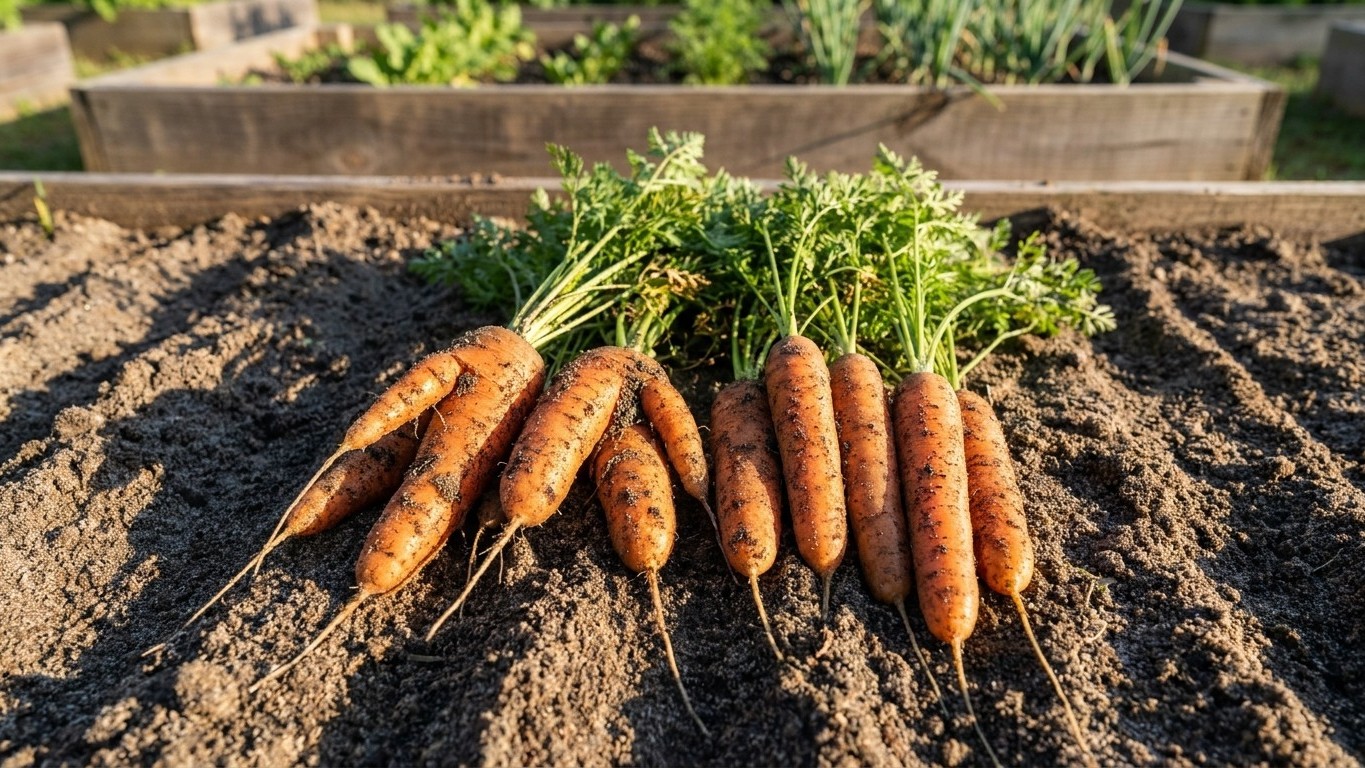

Pull Hawaii carrots when the shoulders poke through the soil at about three-quarters of an inch across, somewhere between 65 and 100 days after seeding depending on which extension window you follow. Cut the tops off within a day of harvest, chill the roots near freezing, and keep the air around them damp. Skip any of those three steps and the clock on your harvest starts running fast, especially in a warm, humid climate like Hawaii’s.
When carrots are ready in Hawaii
The date on a calendar tells you less than the root itself does. Carrots signal readiness by pushing their shoulders, the wide top of the root, up to or just above the soil line. At that stage they’ve usually reached close to their mature diameter, and the color has gone from pale to a solid orange. Scrape a little soil away from a few roots in the row and look before you commit to pulling the whole bed.
The seeding window
Because carrots are sown directly in the ground, with no transplanting step, every day of maturity counts from the seed going into the soil, not from any later date. Utah State University Extension frames the window as 70 to 100 days from seeding, while Clemson Cooperative Extension’s guidance lands a bit earlier, at 65 to 75 days after planting. That overlap, roughly two to three months, is the range worth writing on a garden calendar rather than a single fixed day.
What moves a Hawaii planting toward the earlier or later end of that window isn’t frost. Most of the state doesn’t see the kind of seasonal freeze that shapes mainland planting charts, and no state-specific frost-date figures are published here for this crop. Elevation and microclimate do the work that frost dates do elsewhere. A bed in a cooler upland pocket may run slower to mature than one at low elevation with steady warmth, so the shoulder check matters more in Hawaii than the day count does. Treat the days-from-seeding window as a starting estimate, and let the root’s own shoulder width make the final call.
Keeping them, and for how long
Clemson Cooperative Extension’s Home & Garden Information Center puts the storage instructions in plain terms: store carrots at 33 °F and high humidity to prevent wilting, and bunched carrots (meaning the tops are still attached) will hold for about 10 to 14 days under those conditions. That’s a maximum under good conditions, not a guarantee, and it assumes the temperature and humidity actually hold steady the whole time.
Why the tops matter
Leafy tops keep pulling moisture out of the root long after harvest, which is exactly why bunched carrots fade in under two weeks while trimmed roots, with the greens cut off close to the crown, last far longer in the same cold, damp storage. Cutting the tops the same day you pull the carrots is the single easiest way to extend how long they last. Skip that step and you’re storing a root that’s still actively losing water to leaves that no longer feed it anything back.
What Clemson’s numbers mean side by side
| Detail | Figure |
|---|---|
| Harvest window | About 65 to 75 days after planting |
| Storage temperature | 33 °F |
| Storage humidity | High |
| Bunched (tops on) storage life | About 10 to 14 days |
Notice how far 33 °F sits from room temperature, and even from a lot of home refrigerator settings. That gap is where most stored carrots actually go bad, not in the garden bed.
Where in the house that actually is
A standard kitchen fridge set in the mid-30s to upper 30s Fahrenheit is the closest thing most Hawaii households have to the 33 °F Clemson calls for, and it’s a reasonably close match. The crisper drawer, not the open shelves, is where humidity actually stays high enough, because the door seal there traps moisture the rest of the fridge lets escape every time it’s opened. A perforated bag or a slightly damp paper towel wrapped around the roots inside that drawer helps close the gap further.
A heated room is out of the question here. Even without heating systems running the way mainland homes need them, ordinary indoor air in a Hawaii home typically sits well above 33 °F, and carrots left on a counter or in a pantry will soften and sprout in a fraction of the time Clemson’s figures describe. A garage or an open carport isn’t much better, since it swings with the outdoor weather rather than holding a steady chill, and Hawaii’s outdoor air rarely drops anywhere near freezing except at high elevation.
The practical fix is simple: clip a thermometer to the crisper drawer and check it against 33 °F rather than trusting the fridge’s dial setting, since many household fridges run several degrees warmer than their control shows. If the drawer reads much above the mid-30s, nudging the whole fridge colder, or moving the carrots to the coldest back corner of the main compartment, closes more of that gap than any amount of wrapping will.
What goes wrong here
Hawaii’s climate creates its own particular failure points, distinct from what a cold-winter garden deals with.
Forked roots from heavy ground
The Hilo series, the volcanic-ash soil USDA lists as representative of Hawaii, is a heavy soil by carrot standards: about 35 percent clay and 55 percent silt, against just 10 percent sand. Utah State University Extension is direct about what that means for a root crop like carrots, which want deep, sandy, well-drained ground: heavy or rocky soil makes the root fork rather than growing straight. The state figure is a starting point, not a diagnosis of any one garden, since a state spans hundreds of soil series and a yard that’s been graded, filled, or built on top of volcanic ash may test nothing like it. A simple home soil test settles the question a state average can’t. Where the ground does run heavy, working in generous compost and double digging the bed, or building a raised bed filled with lighter mix, prevents the forking Utah State describes.
Rot from a damp climate, and pests from a warm one
The same high humidity that keeps stored carrots from wilting can tip into rot if roots go into storage wet or packed too tightly. Wipe roots dry, don’t wash them until just before use, and give them airflow inside whatever container holds them. On the pest side, the University of Hawaii CTAHR Extension documents aphids, beet armyworm, cabbage webworm, Chinese rose beetle, leafminers and bean fly, melon fly, Southern green stinkbug and mites, and whiteflies as pressures on garden crops in the state. Checking foliage weekly for these specific pests catches an infestation while it’s still small enough to manage by hand or with targeted controls, rather than after it’s spread through the whole row.
Common questions
Can I leave carrots in the ground longer than 100 days if I’m not ready to harvest?
The published windows top out around 100 days from seeding under Utah State University Extension’s figures. Beyond that, roots left in heavy or wet ground risk splitting or forking further, so checking shoulder width remains the better guide than pushing the calendar.
Do I need to wash carrots before storing them?
The sourced guidance here doesn’t specify washing steps, but the general storage principle, keeping roots dry going into cold storage, argues for brushing off loose soil rather than washing until just before you plan to use them.
Will a garage work if my fridge doesn’t have room?
Not reliably in Hawaii’s climate. A garage tracks outdoor temperature, and outdoor air here rarely approaches the 33 °F Clemson’s figures call for, so a fridge crisper drawer remains the closer match.
Why do my carrots taste bitter after storage?
That’s outside what the sourced figures here cover directly, but it often tracks with roots stored too warm or too long past the maximum window Clemson describes, which is 10 to 14 days for bunched carrots under ideal cold, humid conditions.