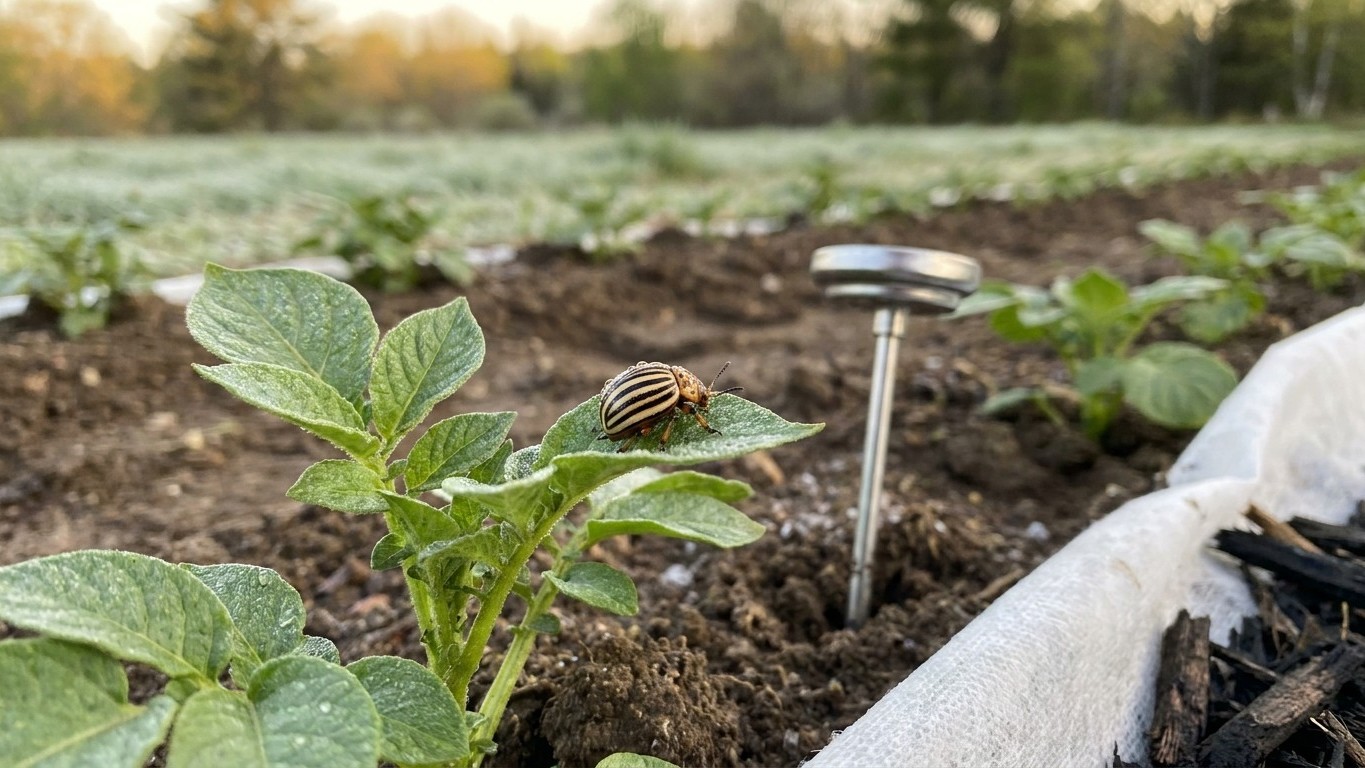

Utah State University Extension documents about a dozen garden pests for the state, and only some of them go after potatoes. The ones that do are aphids, flea beetles, grasshoppers, slugs, spider mites, tomato hornworm and, to a lesser degree, leafminers. They show up in sequence after the frost-free window opens, and the first sign is almost always a change in the leaves. The Growing Potatoes in Utah guide covers the crop itself; this page covers what chews on it.
Which pests attack potato in Utah

Utah State University Extension’s documented list for Utah gardens has fifteen entries: aphids, cabbage looper, corn earworm, cucumber beetles, flea beetles, grasshoppers, imported cabbageworm, leafminers, melon, onion thrips, potato, slugs, spider mites, squash bug and tomato hornworm. That is the whole list. Nothing else gets named on this page, because a pest that isn’t documented here isn’t something this site can vouch for.
Start by crossing off the entries that aren’t pests. “Melon” and “potato” are crops, not animals, so they tell you nothing about what eats a potato plant. Set both aside.
Next, cross off the specialists. Cabbage looper and imported cabbageworm are caterpillars of the cabbage family, and they have no reason to leave the broccoli row for a nightshade. Onion thrips belong to onions. Squash bug and cucumber beetles belong to squash, cucumbers and melons. Corn earworm is named for its crop, and it has no business in a potato patch. If you find one of these on your potatoes, it most likely wandered over from a neighboring bed.
That leaves seven that plausibly feed on potato: aphids, flea beetles, grasshoppers, leafminers, slugs, spider mites and tomato hornworm. Tomato hornworm is on the list for a simple reason. Potato and tomato are close relatives, and a caterpillar that likes one will happily eat the other. Leafminers are the minor player of the seven. They mostly mar leaves rather than threaten the crop.
One caution about the list itself. It is what the extension service documents, not a census of every insect that could chew a spud in every Utah county. If your damage doesn’t match anything here, that is a reason to ask your county office, not a reason to guess.
The clock matters as much as the names. Frost-free dates in Utah vary enormously. NOAA NCEI’s Climate Normals put the last spring 32F freeze at April 12 to April 29 (the 30-70% probability band) at the Salt Lake station. Salt Lake sits in a mild valley. Most of Utah is higher and colder, and southern Utah is warmer, so treat that range as one city’s number, not the state’s.
When each one shows up, and what it does first
The extension list documents which pests occur in Utah gardens. It doesn’t publish calendar dates for each one on potato. So this timeline is built on your own frost-free window, and the honest version is relative: early, mid, late, counted from when your plants come up.
Flea beetles and slugs tend to come first, while plants are young. Flea beetles leave a scatter of tiny round holes, like the leaf was hit with birdshot. Slugs prefer cool, damp spells and leave ragged holes with dried silvery trails on the leaves or the soil beside them. Later in the season slugs can work down to the tubers, where the damage is shallow holes or pits in the flesh.
Aphids come as the foliage fills in and the new growth turns soft. What you see first is curled or distorted tip leaves, sometimes a sticky sheen, and small clusters packed along stems and on leaf undersides. Grasshoppers tend to arrive when the surrounding ground is drying out and the weeds and grass are less appealing. The signature is chewed leaf edges, working inward, often starting at the margin of the patch closest to a field or vacant lot.
Spider mites belong to hot, dry stretches, well into summer. You will not see the mite. You will see leaves that look faintly dusty, stippled pale or bronzed, and sometimes fine webbing on the underside. Leafminers leave winding pale tracks or blotches inside the leaf itself, because the larvae feed between the leaf surfaces.
Tomato hornworm usually comes late. It’s a big green caterpillar, and it does its damage in a hurry. A plant that looked fine at the last check has whole sections stripped down to bare stems, with chunky dark droppings on the leaves below. The caterpillar blends into the foliage so well that the droppings are often what gives it away.
All of that shifts with elevation. Count from your own last frost date, not from the Salt Lake range, and check the planting calendar counted back from your last frost to see where your plants sit in the season. A garden in a cold high valley may plant weeks after a St. George garden, and its pests arrive on their own timetable.
Telling the damage apart from everything else
A yellowing, chewed or spotted potato leaf has half a dozen possible causes, and insects are only some of them. Wrong diagnosis is the most common waste of money in a home garden. This table lists the sign that separates each look-alike. It doesn’t tell you what you have, only what to check.
| What you see | Could be | What settles it |
|---|---|---|
| Small round holes in young leaves | Flea beetles, or mechanical damage such as hail or windblown grit | Tiny dark beetles that jump when you approach; hail damage shows on many plants at once, in the same direction |
| Pale stippling or bronzing | Spider mites, or water stress, or a nutrient problem | Look at the underside with a hand lens for specks or fine webbing; stress shows on the whole plant, not on scattered leaves |
| Curled, sticky tips | Aphids, or virus, or herbicide drift | Clusters of live insects on the underside; virus and drift show without any insects |
| Ragged holes plus slime trails | Slugs | Silvery dried trails; check at dusk or after watering |
| Winding tracks or blotches inside a leaf | Leafminers, or a leaf disease | Hold the leaf to the light: a track with a tiny larva inside points to leafminers |
| Holes or pits in tubers | Slugs, or a hoe or fork strike | Slug damage is often shallow and irregular; a tool strike is a clean cut |
Virus deserves a second look, because it fools people. It can mimic insect damage or nutrient trouble, and it comes in on the seed piece. Turn the leaf over before you decide anything, and if the underside is clean and the pattern spreads through whole plants, take a sample to your extension office instead of reaching for a spray.
What actually works here, and what is a waste of time
Physical barriers placed at the right moment beat chemical treatments, and on a season this short the calendar does more than any product. Lightweight row cover laid over the row at planting keeps flea beetles and grasshoppers off young plants. Potatoes don’t need insect pollination to make tubers, so covering them costs little. Take the cover off once the plants are big enough to shrug off some chewing, and before you hill up the rows.
Hand-picking works for hornworms, and it works fast because a single caterpillar does so much damage. Check the plants when leaves start disappearing. For slugs, the answer is mostly habitat: water in the morning so the surface dries before night, clear boards and heavy mulch away from the rows, and hill soil over developing tubers. For aphids and spider mites, a strong stream of water on the leaf undersides knocks populations back, and keeping plants from drying out stresses the mites less.
Buy certified seed potatoes. Uncertified seed carries virus, and no spray fixes an infected plant. Choosing an early or mid-season type from the potato varieties that suit Utah can also shorten how long the crop sits exposed to late-season pressure.
What doesn’t work is easy to list. Spraying on a schedule, before anyone has identified a pest, kills the beneficial insects along with everything else, and spider mites often flare afterward. Planting earlier than the soil allows to “beat” the bugs just trades pests for frost damage. Spraying a general-purpose product at the first few flea beetle holes is a habit, not a plan, since healthy plants tolerate light chewing.
This site does not name or recommend pesticides. What’s registered for potatoes and home use in Utah is a question for Utah State University Extension, which is the only place that knows what’s currently approved in the state.
Where to check this for your own county
Utah State University Extension has a county office in most of the state, and that’s the right place for an identification. Bring a sample (a leaf with the damage, in a sealed bag) or a clear photo of both sides of the leaf. Note when you planted and when the damage first appeared.
Pest presence changes inside a single state, and even inside a single county. A pest documented in Utah may be common in a warm valley garden and rare in a high, cold one, or the reverse. A grasshopper year in one county can pass right over the next. A state-level list tells you what has been documented somewhere in Utah. It doesn’t tell you what is in your garden.
The frost numbers work the same way. April 12 to April 29 describes the Salt Lake station, and your own last frost may fall well outside it. Everything on this page that runs on the calendar should be counted from your own frost-free date.
The next step is small: before you spray or dig anything up, photograph the damage on the top and underside of the leaf, write down your planting date, and take both to the county extension office.
Common questions
Does the April 12 to April 29 frost range apply to all of Utah?
No. It is the NOAA NCEI Climate Normals 30-70% band for a 32F freeze at the Salt Lake station. Salt Lake sits in a mild valley, most of Utah is higher and colder, and southern Utah is warmer.
Do cabbageworms and squash bugs eat potatoes?
They are on Utah State University Extension’s documented list, but for other crops: cabbageworms for the cabbage family and squash bugs for squash. They are not what to suspect first in a potato patch.
Can a pest problem be caused by the seed I planted?
Virus can be. Uncertified seed carries it, and it can look like insect damage or a nutrient problem. Certified seed is the one preventive step that no later treatment replaces.
Who tells me what I can spray on potatoes in Utah?
Utah State University Extension. This page doesn’t name products or active ingredients, because only the extension service knows what is currently registered in the state.