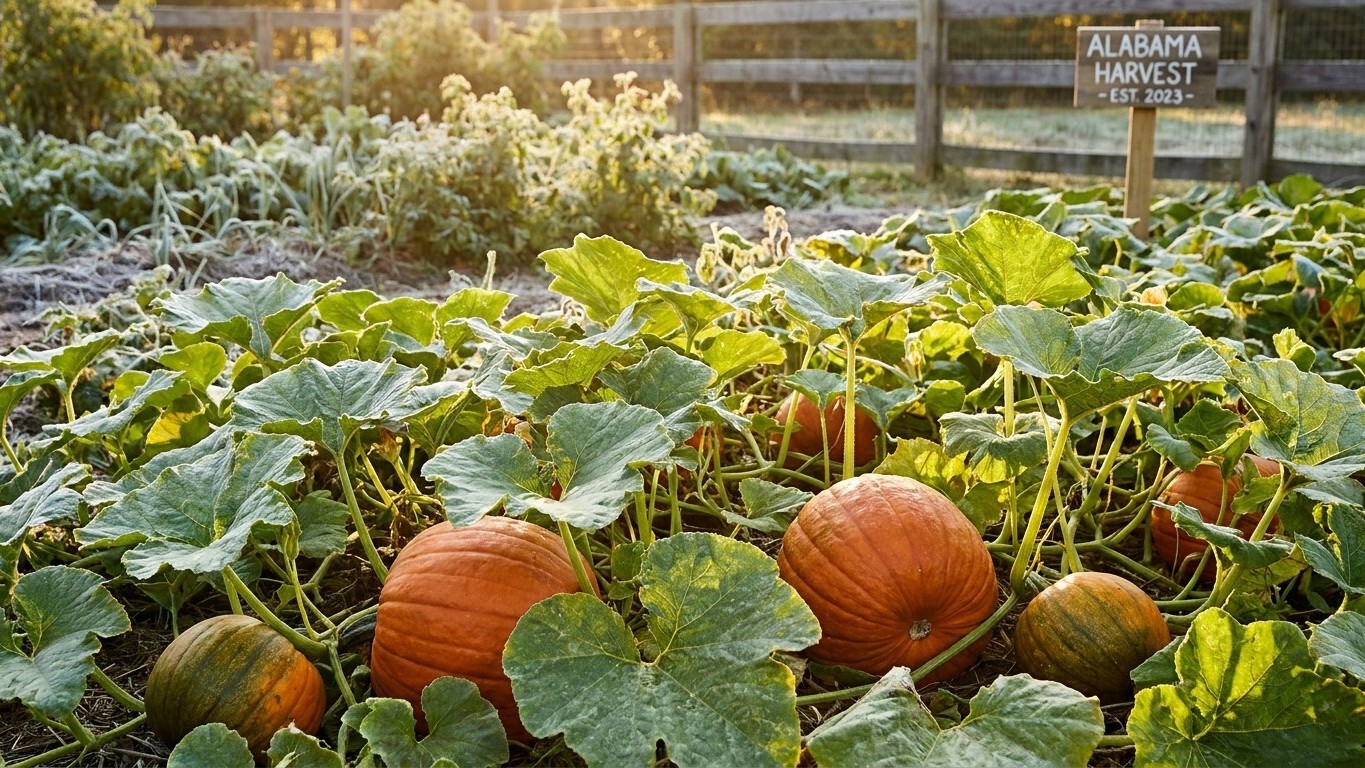

Pumpkins in lowland Hawaii don’t have to outrun a frost, because there isn’t one to outrun. NOAA’s 1991-2020 Climate Normals for Hawaii show zero days per year at or below 32°F, with every freeze percentile flagged as not-computable. That doesn’t mean the 45-to-55-day countdown from flowering disappears. It means the clock that matters here is something else entirely: rainfall, elevation, and whether a garden sits windward or leeward.
The short answer
Everywhere else in the country, growing a pumpkin is a subtraction problem. You take the first fall frost date, count back 45 to 55 days (measured from the day the flower opens, not the day the seed goes in the ground), and that tells you the last safe date to let a flower set fruit. Utah State University Extension lays out that window plainly: pumpkins need 45 to 55 days after flowering to mature, and they should come off the vine with the stem attached before a killing frost arrives.
That subtraction problem has no answer in Hawaii, because there’s nothing to subtract from. The climate data for the islands, drawn from NOAA’s National Centers for Environmental Information at station USW00022521, doesn’t give a frost date at all. Every percentile for a 32°F or 36°F freeze comes back not-computable, and the annual count of days at or below 32°F sits at zero. Frost exists in Hawaii, but only on the summits of Mauna Kea, Mauna Loa, and Haleakala, thousands of feet above where anyone is tending a pumpkin patch.
So the honest answer to “will pumpkins ripen before frost” is that the question, as written, doesn’t apply to a garden at sea level or even at a few thousand feet of elevation on these islands. A flower that opens in a lowland Hawaii garden has 45 to 55 days ahead of it with no calendar deadline forcing an early harvest. The fruit either colors up and hardens on its own schedule, or something other than cold stops it, usually standing water, a fungal disease that takes the vine down early, or a fruit that rots on wet ground before its rind toughens.
That’s a different kind of planning problem than the one gardeners face in Maine or Minnesota. Instead of racing a date on the calendar, growing pumpkins in Hawaii means racing conditions: getting a flower to set before a wet spell arrives, or choosing a planting site where drainage and airflow give the fruit a fighting chance to finish what it started. The 45-to-55-day window from Utah State still applies as the biological clock inside the fruit. It’s just that nothing outside the plant is ticking down to stop it.
When to sow here
Because there’s no frost date to build a calendar around, the only hard threshold that matters for sowing is soil temperature. Utah State University Extension is clear that pumpkins go into soil once it reaches 65°F, and that number is a soil reading, not an air-temperature guess and not a stand-in for a frost date that doesn’t exist on these islands.
- Drop the frost-date habit entirely. There’s no last spring frost and no first fall frost to plan around in inhabited parts of Hawaii, so a planting calendar built on frost timing will mislead more than it helps.
- Check soil temperature directly with a soil thermometer rather than guessing from air temperature or the season on the wall calendar. Soil warms and cools on its own delayed schedule, lagging behind whatever the air is doing by a matter of weeks, so an early warm spell in the air doesn’t mean the ground underneath is ready yet.
- Factor in elevation and exposure. A garden on a windward slope catching regular rain and cloud cover will hold cooler, wetter soil longer than a leeward garden in a drier rain shadow, even at similar elevations. That difference can push the date soil hits 65°F earlier or later by a real stretch of time depending on where the plot sits.
- Use row covers where soil is slow to warm, particularly in cooler upland gardens. Row covers trap heat near the ground and can buy roughly two weeks on the soil-warming timeline, letting a gardener sow sooner than bare ground would allow.
- Once soil holds steady at 65°F, sow with the 45-to-55-day post-flowering window in mind, but don’t expect a frost deadline to force the harvest. In Hawaii, that window is a biological floor, not a race against the weather.
What goes wrong here
- A late flower that never colors. Without frost to blame, a fruit that stays green usually points to weak sun exposure or a vine shaded out by overcrowding. Give plants full sun and enough spacing that leaves aren’t stacking on top of the developing fruit, and let the full 45-to-55-day window run its course before assuming something’s wrong.
- A fruit caught by heavy rain instead of frost. There’s no cold snap to worry about here, but a driving rain on a windward-facing garden can sit against a ripening pumpkin long enough to soften the rind or start rot before the skin hardens. Elevate developing fruit on a board, mulch, or straw so it isn’t resting directly on wet ground during the ripening window.
- A vine that dies back before the skin hardens. High humidity and standing moisture, not cold, are what typically take a Hawaii pumpkin vine down early. Improve drainage at planting, space vines for airflow, and water at the base rather than overhead to keep foliage drier and buy the vine more time to finish hardening the fruit’s rind.
- Fruit set too late in a wet stretch. Since there’s no frost forcing an early harvest, gardeners sometimes let flowering drift later than necessary, only to have the fruit’s final weeks land during the wettest part of the year for that particular site. Timing flowering around known dry spells for a given elevation and exposure, rather than around a frost date that doesn’t exist, gives the fruit a better shot at finishing dry.
Insect pressure adds another layer worth checking separately. For pest identification and control specific to this crop and region, see the site’s pages on squash bugs in Hawaii and cucumber beetles in Hawaii rather than treating pest damage as a ripening problem.
Common questions
Do pumpkins ever face frost anywhere in Hawaii?
Frost occurs only at the summits of Mauna Kea, Mauna Loa, and Haleakala, well above any elevation where food gardens exist. NOAA’s climate data for the inhabited station used here shows zero days per year at or below 32°F, so frost isn’t a factor for any garden in populated areas of the islands.
If there’s no frost, what actually limits how long a pumpkin can ripen?
Rainfall timing, soil drainage, and exposure (windward versus leeward) do the work that frost does elsewhere. A fruit can technically ripen at any point in the 45-to-55-day post-flowering window, but wet conditions or rot are the practical stopping points instead of cold.
Does the 65°F soil threshold change anywhere in Hawaii?
The 65°F figure from Utah State University Extension is a soil-temperature threshold, not tied to any frost date. Because soil temperature varies with elevation and exposure across the islands, the date any specific garden hits 65°F will differ by site, even though the threshold itself stays the same everywhere.
How should pumpkins be stored after harvest in Hawaii?
Utah State University Extension doesn’t publish a specific storage temperature, humidity level, or keeping time for pumpkins, only the general guidance to keep harvested fruit somewhere it won’t freeze. Since freezing isn’t a concern in lowland Hawaii, the priority after harvest is a dry, well-ventilated spot rather than a temperature-controlled one.