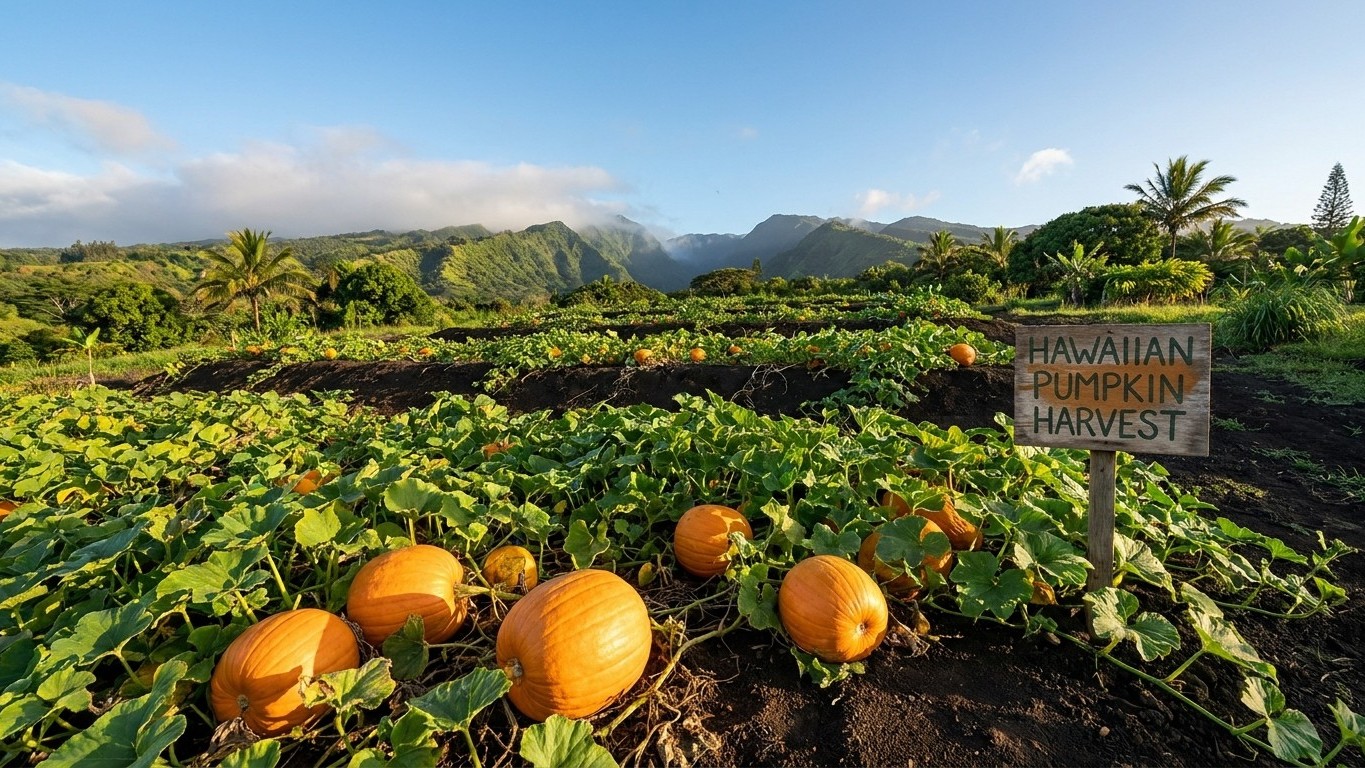

Will Pumpkins Ripen Before Frost in Hawaii? Pumpkins ripen fine in Hawaii, and the reason has nothing to do with frost. NOAA’s climate records show no measurable freeze at all in the state’s inhabited areas, so the frost-to-harvest countdown mainland gardeners rely on simply doesn’t exist here. What decides whether a flower turns into a hard-skinned pumpkin is rainfall timing, elevation, and which side of an island you’ve planted on. The 45- to 55-day clock from flower to harvest still runs, but you set it against wet-season patterns instead of a frost date.
The short answer
Start with what the numbers actually show. NOAA’s National Centers for Environmental Information, pulling three decades of climate normals from station USW00022521, records zero days per year at or below 32°F for that station, and every percentile calculation for a 32°F or 36°F freeze comes back flagged as not-computable. There’s no first fall frost window to open the calendar with, because lowland Hawaii doesn’t have a frost season. Frost exists only on the summits of Mauna Kea, Mauna Loa, and Haleakala, thousands of feet above anywhere a pumpkin patch could survive.
That changes the whole exercise. On the mainland, growers work backward from a known frost date, subtracting the 45 to 55 days that Utah State University Extension lists between a pumpkin flower opening and the fruit finishing, to find the last safe day a flower can open. In Hawaii, that backward math has no anchor point. A pumpkin vine here isn’t racing a falling thermometer. It’s working against rainfall timing, cloud cover, and elevation, three factors that shift by island and even by which slope of a single mountain you’re standing on.
The flowering math itself doesn’t change: once a female flower opens and gets pollinated, the fruit still needs 45 to 55 days to reach a hard, storable rind, per Utah State University Extension. That window is fixed biology, not climate. What’s different in Hawaii is that you can hit that window nearly any time of year in the warmer lowland zones, since there’s no cold snap waiting to cut the season short. The tradeoff is that persistent rain, heavy cloud cover during wet months, and constant humidity create their own limits, ones that don’t show up on any frost map but matter just as much to whether a flower sets fruit at all and whether that fruit finishes hardening once it’s ripe.
Windward coasts, the wetter sides of islands like the Hilo area or Hana, see more cloud cover and consistently damp soil, which can slow pollination and invite rot before a pumpkin ever gets to harden. Leeward areas, closer to Kona or Central Oahu, run closer to the sunny, well-drained conditions pumpkins actually favor. Elevation adds one more layer: upcountry ground on Maui or the Big Island cools off enough overnight that soil warms more slowly, pushing back When to Sow Pumpkins in Hawaii even with no frost anywhere on the calendar.
When to sow here
Most states time pumpkin sowing off the gap between the last frost and the day soil hits 65°F, the threshold Utah State University Extension sets for planting. Hawaii breaks that formula at the first step: there’s no last frost date to count from. The soil-temperature threshold still applies. You just reach it by reading a thermometer, not by counting weeks off a frost calendar that doesn’t exist for this state.
- Skip the frost calendar entirely. Mainland guides tell growers to wait two to four weeks past the last frost for soil to warm to 65°F. That gap has no meaning here, since NOAA’s normals for this state show zero measurable freeze days a year, so there’s nothing to count weeks forward from.
- Check soil temperature directly. Push a soil thermometer about 4 inches down at the same spot for several consecutive mornings and watch for a steady 65°F, the sowing threshold Utah State University Extension publishes. This is the only reliable read in a place with no frost benchmark to lean on.
- Watch the wet season, not the thermometer, for the bigger risk. Since rainfall stresses vines here more than cold ever will, aim your sowing so flowering lands before the heaviest rain weeks in your specific location, since that timing shifts a lot between windward and leeward sides.
- Use row covers to shave time off germination, not to dodge frost. Covers can warm soil faster right after sowing, buying roughly two weeks, which is useful here for pushing flowering ahead of the wettest stretch rather than for beating a freeze that isn’t coming.
- Count 45 to 55 days from the first open flower, not from the sowing date. Mark the day the first female flower opens (look for a small swollen bulge behind the petals) and count forward from there, per Utah State University Extension. That’s your harvest window, regardless of when the seed went in the ground.
What goes wrong here
- A late flower that never colors. This happens when sowing gets pushed into the wettest months, delaying flowering into weeks of heavy cloud cover. Pollinators are less active in soaked, overcast conditions, so flowers open but fail to set fruit, or set fruit that stalls out green. The fix is sowing early enough, using the 65°F soil check, that first flowers open before your area’s heaviest rain weeks arrive.
- A fruit that stalls in saturated soil. Where mainland growers lose a pumpkin to an early freeze, Hawaii growers lose one to weeks of standing wet soil that stops the fruit from finishing its 45 to 55 days cleanly and invites rot at the base. Elevating the fruit on a paver or straw, and improving bed drainage before sowing, keeps the rind curing instead of softening.
- A vine that dies back before the skin hardens. Continuous warm, humid conditions let pest pressure build faster here than in a shorter mainland season, and a stripped vine can’t finish curing a fruit’s rind even if the fruit itself is close. Squash bugs and cucumber beetles are the usual culprits, and this site covers identification and control for both on their own state pages rather than repeating it here.
Checking this against your own county
Everything above describes lowland and upcountry patterns broadly, but rainfall totals, wind exposure, and soil type change block by block across the islands, sometimes more than they change between states on the mainland. Before committing a full pumpkin patch to a planting window, run it past the University of Hawaii’s CTAHR Cooperative Extension. Their agents work county by county and can tell you what your specific elevation and coastal exposure mean for wet-season timing, something no statewide guide, including this one, can pin down precisely. That local check matters more here than in most states, since the difference between a windward valley and a leeward slope ten miles away can be the difference between a pumpkin that hardens on schedule and one that rots two weeks short.
Common questions
Can pumpkins actually grow in Hawaii’s climate?
Yes. They’re grown in home gardens and on a smaller commercial scale across several islands, mostly in cooler upland pockets and drier leeward zones where drainage and sun exposure resemble mainland growing conditions more closely than the wet windward coasts do.
How do I know when to expect harvest if there’s no frost deadline?
Track the date the first female flower opens, then count 45 to 55 days forward from that point, the window Utah State University Extension sets for pumpkins to finish. Sowing date alone won’t tell you much here, since germination and vine growth speed before flowering vary with rainfall and elevation.
Does elevation change anything for pumpkin timing?
Yes. Upcountry areas on Maui and the Big Island run cooler overnight, which slows how fast soil climbs to the 65°F sowing threshold, even though those same areas never see a freeze.
Do I need to worry about frost damaging pumpkins in Hawaii?
No. NOAA NCEI’s climate normals for station USW00022521 show zero days per year at or below 32°F, with every freeze percentile flagged as not-computable, confirming that inhabited parts of the state don’t experience a frost season at all.