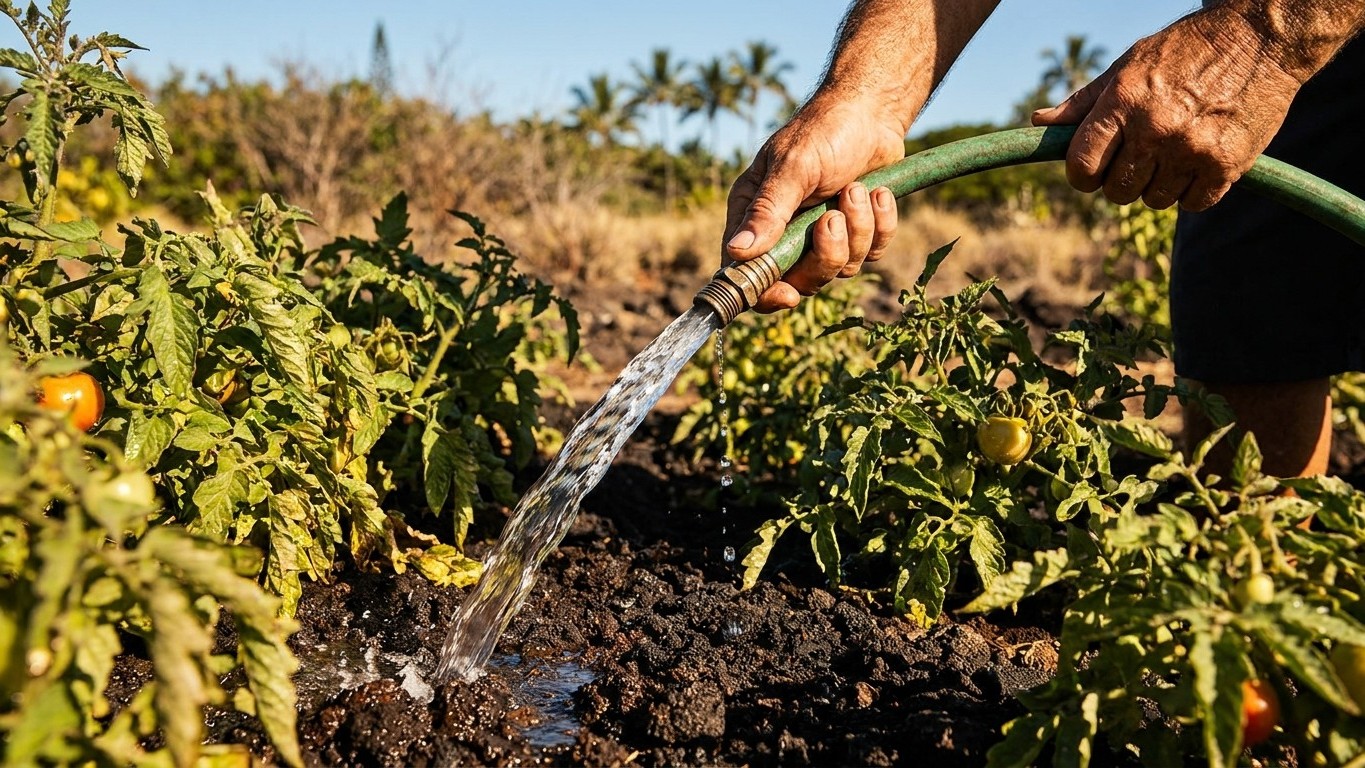

Hawaii’s driest summer month brings just 0.5 inches of rain, and the islands log 18.7 days a year at 90F or hotter. Put together, that means a garden bed here spends its hottest stretch getting almost nothing from the sky, right when evaporation is working hardest against it. The gardener, not the weather, has to close that gap.
What changes here

Start with the two numbers that matter most: 0.5 inches of rain in June, the driest summer month, and 18.7 days a year that hit 90F or above. Together they describe a pattern gardeners need to plan around rather than react to: summer heat peaks at the exact moment rainfall bottoms out, so the usual assumption that “it rained this week, the garden’s fine” stops holding.
A vegetable bed or a bed of annuals generally wants about an inch of water a week to keep growing without stress. June, at 0.5 inches for the whole month, spreads out to roughly 0.12 inches a week if that rain fell evenly, which it rarely does in a tropical climate where showers tend to arrive as short, heavy bursts rather than steady drizzle. That leaves the gardener responsible for close to 0.88 inches of that weekly inch, delivered by hose or drip line rather than by clouds.
July isn’t much better, at 0.52 inches for the month. August climbs slightly to 0.84 inches, still well short of what a thirsty bed needs across four or five weeks. The three-month summer average lands at about 1.9 inches total, against a year that brings 16.4 inches overall, meaning the bulk of Hawaii’s rainfall falls outside the very months when plants are working hardest and need it most.
Soil texture changes how far that gap actually goes. A sandy plot lets water drain through within hours, so even a modest hose session needs repeating sooner. A heavier, clay-rich bed holds moisture for days, which sounds like an advantage until a well-meaning gardener adds more water before the soil has had a chance to dry, pushing air out of the root zone and slowing growth instead of helping it. Knowing which kind of ground is under a particular garden bed matters more here than in a place where summer rain fills in the blanks automatically.
How to water when it matters
The method that works in a low-rain, high-heat summer isn’t complicated, but it runs against instinct. Deep, infrequent watering at the base of the plant, done in the morning, beats a daily splash almost every time, and each piece of that routine does a specific job.
Watering deeply pushes moisture down to where roots actually live, several inches below the surface, which trains those roots to grow downward and reach for it. A shallow sprinkle never gets that far, so roots stay near the surface where the day’s heat dries them out fastest. Morning watering gives the soil time to absorb before the sun climbs, and it lets any moisture on the leaves dry off before evening, when damp foliage overnight becomes an open invitation for fungal disease.
Checking the soil rather than guessing is the habit that separates a garden that survives June from one that struggles through it.
- Push a finger or a garden trowel about two inches into the soil near the plant’s base; if it comes out dry at that depth, it’s time to water, regardless of how the surface looks.
- Water slowly and directly at the base of the plant, avoiding the leaves, until moisture has clearly soaked down past the root zone rather than pooling and running off.
- On sandy ground, plan on shorter, more frequent sessions, roughly every two to three days during the driest weeks, since sand simply can’t hold a week’s worth of water.
- On heavier clay soil, stretch the interval out, checking again with the finger test before adding more, since clay can still be holding last week’s water even when the surface looks dusty.
- Use about one inch of water a week as the starting point for most beds, then adjust up or down based on what the finger test actually shows in that specific patch of ground.
That one-inch figure is a place to start, not a rule carved in stone. Two beds ten feet apart can behave differently depending on shade, slope and how much organic matter is mixed into the soil, so the finger test stays the final word over any fixed schedule.
What goes wrong
Watering a little every day
A quick daily splash feels responsible, but it wets only the top inch or two of soil and never reaches deeper. Roots follow the water, so they stay shallow and exposed to the heat of an afternoon that regularly climbs past 90F. When a hot streak hits, those roots have nowhere cooler to retreat to, and the plant stresses out fast.
Watering the leaves in the evening
Wetting foliage after work, once the sun has dropped, leaves water sitting on leaves through the warm, humid night. Fungal spores thrive in exactly that window, and a garden that looked fine at sunset can show blight or mildew by morning. Watering the base of the plant, not the leaves, and doing it early in the day sidesteps the problem entirely.
Trusting a rain shower that didn’t do the job
A short summer downpour can look convincing from a window, but a lot of Hawaii’s summer rain arrives as brief, intense bursts that wet the surface and run off before they soak in. The only way to know if a shower actually helped is the same finger test used any other day: two inches down, dry or damp. Skipping that check and assuming the rain “took care of it” is one of the more common ways a bed quietly dries out during June and July.
Skipping mulch
Bare soil under an 18.7-day stretch of 90-degree heat loses moisture to the air almost as fast as it’s added. A two- to three-inch layer of mulch around plants, kept clear of the stems themselves, slows that evaporation and stretches the time between waterings, which matters most in the exact months when rainfall is thinnest.
Local help
Watering rules and restrictions vary by water district and can change with drought conditions, so check with the local water utility for anything currently in effect. For soil testing, plant recommendations and season-specific guidance for the islands, the University of Hawaii College of Tropical Agriculture and Human Resources (CTAHR) Extension Service is the state’s land-grant extension resource.
Common questions
How often should I water during June, the driest month?
With only 0.5 inches of rain expected that month, plan on supplying most of a bed’s weekly inch yourself, checking soil moisture two inches down every few days rather than watering on a fixed daily schedule.
Does mulch really make a difference with 18.7 days above 90F a year?
Yes. Mulch slows evaporation from the soil surface, which matters most on the hottest days of summer when bare ground loses moisture quickly to the air.
Is morning or evening watering better?
Morning. It lets the soil absorb water before the day’s heat peaks and gives leaves time to dry before nightfall, lowering the risk of fungal disease that comes with damp foliage overnight.
Can I rely on August rain since it’s higher than June or July?
Not entirely. August brings 0.84 inches on average, better than June’s 0.5, but still well under the roughly one inch most beds want in a single week, so supplemental watering is still usually needed.