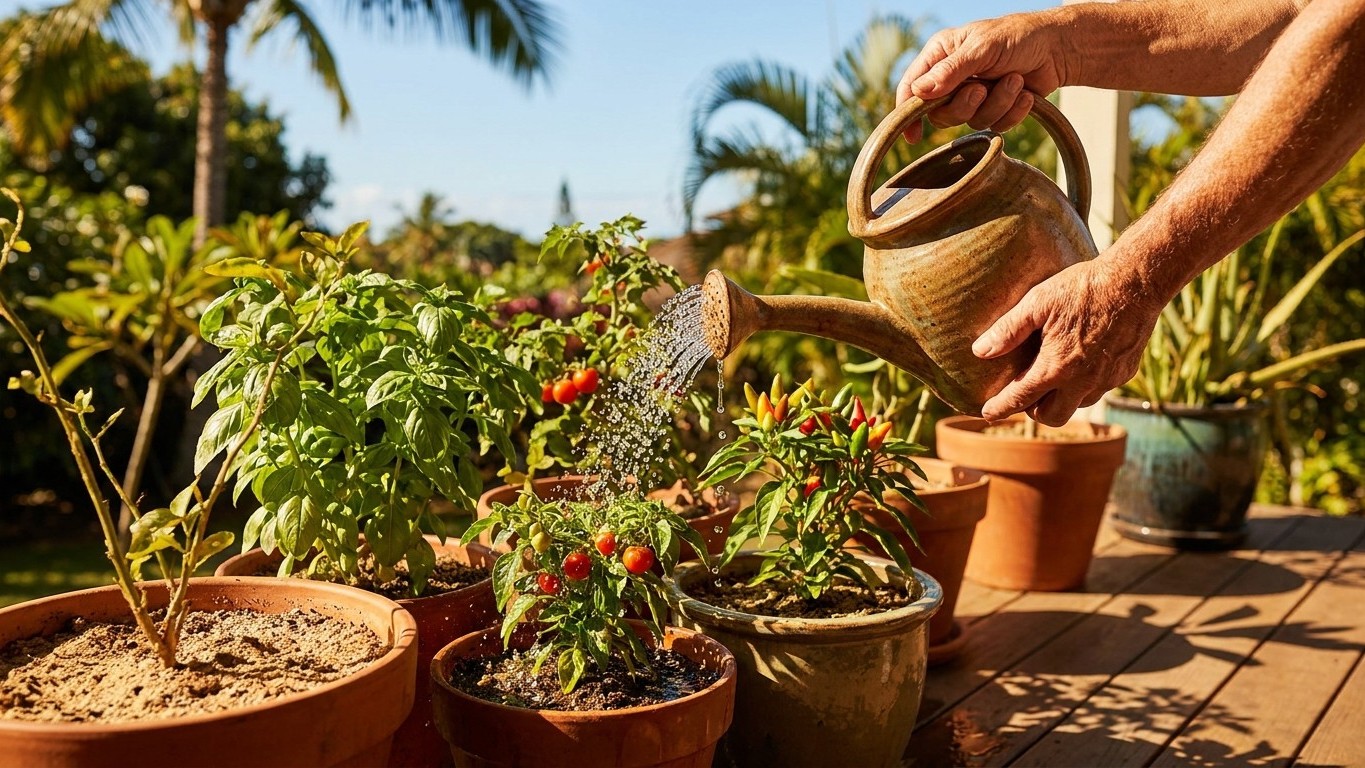

Hawaii’s driest summer stretch still delivers only about half an inch of rain a month, while nearly three weeks of the year push past 90F. That gap between what falls and what plants need is exactly why Containers and watering pots matter more here than the sprinkler alone: they let a gardener close that gap by hand, on a schedule the sky won’t keep.
What changes here

Two numbers set the terms for every Hawaii garden bed: 0.5 inches of rain in June, the driest summer month at the reference station, and 18.7 days a year that reach 90F or higher. Put together, they mean the driest stretch of summer arrives at the same time heat is pulling moisture out of the soil fastest, so a bed left to the sky alone runs a real deficit right when it can least afford one.
The arithmetic makes that deficit concrete. A vegetable bed or a bed of annuals generally wants about an inch of water a week to keep growing without stress. June’s 0.5 inches is spread across the whole month, not concentrated in one week, so an average week in June brings in roughly 0.12 inch of rain from the sky. That leaves close to 0.88 inch that has to come from a hose, a can, or a drip line if the bed is going to reach that one-inch target. July isn’t much better, at 0.52 inches for the month; August climbs to 0.84 inches, still short of what a single week alone is supposed to provide.
Soil texture changes how far that carried water actually goes. On sandy ground, water drains through quickly and doesn’t linger at root depth, so the same inch disappears faster and needs to be replenished sooner. On heavier, clay-rich ground, water is held longer near the surface and can take a week or more to fully drain, which changes the risk in the other direction: overwatering rather than underwatering becomes the more likely mistake. Knowing which kind of ground a bed sits on matters as much as knowing the rainfall total, because the same 0.88 inch of hand-watering behaves completely differently depending on what it lands on.
None of these figures are a forecast for any one yard. They’re 1991-2020 normals from a single reference station, and a garden a few miles away, on a slope, near the coast, or in a different microclimate, can see meaningfully different numbers. A simple rain gauge on the actual property is the only way to know what a specific bed is really getting in a specific week.
How to water when it matters
The method that works with Hawaii’s rainfall pattern isn’t complicated, but it runs against instinct. Watering deeply and infrequently, at the base of the plant, in the morning, does three things a quick daily sprinkle never manages: it pushes moisture down where roots actually grow, it avoids wetting foliage right before the cooler overnight hours when fungal disease takes hold, and it gives the plant a full day to take up water before the heat of an afternoon that might hit 90F pulls it back out through the leaves.
Checking soil moisture at root depth, rather than trusting the surface, is the step most gardeners skip. The top half-inch of soil can look and feel damp within an hour of watering while the ground two or three inches down, where roots are actually working, stays bone dry. A finger pushed two inches into the bed, or a small trowel pulled up for a quick look, tells the real story in a way that scanning the surface never will.
Soil texture sets the rhythm from there. Sandy ground holds very little water at any one time, so it calls for shorter, more frequent soakings rather than one big weekly drink that mostly runs past the root zone. Heavy clay holds close to a week’s worth of water once it’s saturated, but watering it again before it’s had the chance to dry invites root rot rather than growth, since roots sitting in waterlogged clay are effectively drowning.
A reasonable starting point, given June’s 0.5 inches of rain, is to plan on supplying close to the full one-inch weekly target by hand during the driest summer months, then adjust up or down after checking the soil directly.
- Push a finger or trowel two inches into the bed before deciding to water at all.
- Water early in the morning, aiming the can or hose at the base of the plant rather than the leaves.
- On sandy soil, water in smaller amounts every two to three days rather than one large weekly soak.
- On clay-heavy soil, water once a week in a deeper soak, then let it dry fully before watering again.
- Recheck at the two-inch depth a day later and adjust the next watering up or down from there.
What goes wrong
Watering a little bit every day
A light daily sprinkle wets only the surface, and roots follow the water they’re given. Instead of growing down where the soil stays cooler and holds moisture longer, roots stay shallow and close to the surface, exactly where the day’s heat, especially on the 18.7 days a year that top 90F, bakes them hardest.
Watering the leaves in the evening
Wetting foliage after the sun goes down leaves plants damp all night, and that combination of moisture and warm overnight air is close to ideal for fungal disease to take hold. Watering the base of the plant in the morning instead lets any incidental moisture on the leaves dry off within a couple of hours.
Trusting a passing rain shower
A short summer downpour can look like it’s done the job while only wetting the top half-inch of soil, especially given how little of Hawaii’s summer rain, 0.5 to 0.84 inches a month, tends to fall in any single event. The only way to know for sure is the same finger-in-the-soil check described above, not a glance out the window.
Skipping mulch on a hot bed
Bare soil exposed to nearly three weeks a year of 90-plus-degree heat loses moisture fast, giving back to the air much of what was just watered in. A two- to three-inch layer of mulch slows that evaporation and stretches the time between waterings, particularly useful given how little rain arrives on its own during June and July.
Overwatering ground that hasn’t dried
On heavier, clay-leaning soil, the opposite mistake shows up: watering again before the previous soak has had a chance to drain. Roots sitting in saturated clay are cut off from oxygen, and what looks like a plant needing more water is often one already drowning.
Local help
The University of Hawaii’s Cooperative Extension, run through the College of Tropical Agriculture and Human Resources, offers local guidance for gardeners across the islands. Watering restrictions vary by district and change with drought conditions, so check with the local water provider or county water supply for current rules before setting up any regular watering schedule.
Common questions
How often should containers be watered in Hawaii’s dry summer months?
With June averaging just 0.5 inches of rain for the whole month, containers, which dry out faster than ground beds, typically need checking daily and watering whenever the top two inches of potting mix feel dry, rather than on a fixed calendar schedule.
Does rainfall in Hawaii vary much month to month during summer?
Yes: June is driest at 0.5 inches, July close behind at 0.52 inches, and August noticeably wetter at 0.84 inches, so a watering routine set in June may need scaling back by August.
What’s the biggest watering mistake in a hot Hawaii summer?
Watering shallowly every day, which keeps roots near the surface exactly when 18.7 days a year of 90-degree heat is hitting that same shallow zone hardest.
Can a rain gauge really replace guessing about summer rainfall?
It’s the most reliable tool available, since the 0.5 to 0.84 inch monthly averages cited here come from a single reference station and can differ from what falls on any individual property.