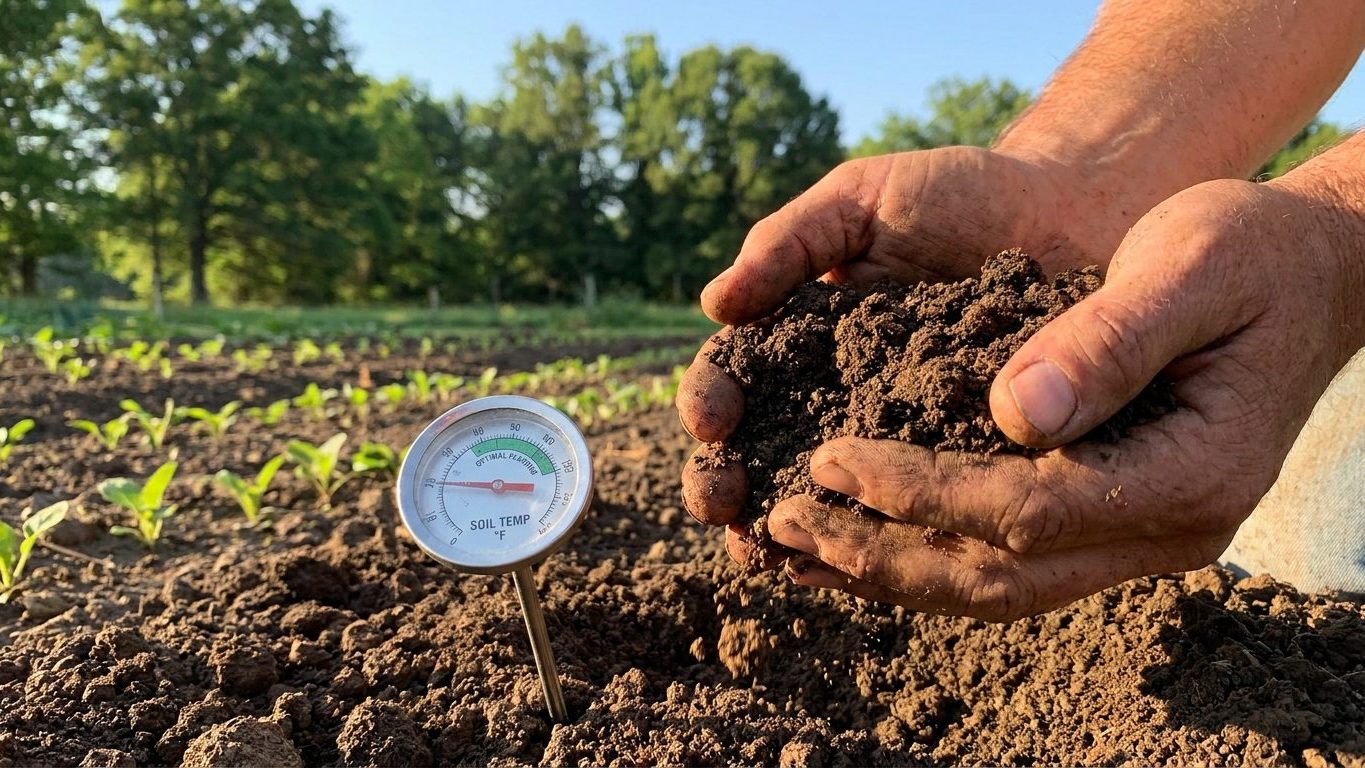

The honest answer is that “Texas” isn’t one climate but four USDA zones stitched together, so the calendar that works in Houston can miss a northern county by months. What decides winter squash planting isn’t the date on a calendar at all: it’s soil temperature, and that’s the mechanism worth understanding before touching a seed packet.
When the soil is warm enough in Texas

Winter squash seed doesn’t care what the calendar says. It cares whether the soil around it has warmed past the point where germination is reliable, and that threshold is reached AFTER the frost risk has passed, not the moment it does. Frost dates are useful because they’re measured and published, but they’re a proxy for soil warmth, not the thing itself.
At Houston’s Bush Intercontinental Airport station (USW00012960), NOAA’s 1991-2020 Climate Normals put the last spring frost, defined as the 30 to 70 percent probability band for a 32F freeze, somewhere between February 4 and March 1. That’s a probability window, not a promise: some years the risk clears earlier, some later, and a grower who plants at the first mild week in February is accepting real odds of a setback.
Here’s where the “Texas planting calendar” idea falls apart. These IAH figures sit at the mild Gulf end of the state. The Panhandle freezes both earlier in fall and later in spring, sometimes by two months or more. Hill Country and North Texas run their own separate schedules again. Even inside the Houston area, Hobby Airport typically runs about two weeks milder than IAH, which means a gardener ten miles away from the reference station is already working with a different number.
Why cultivar names don’t belong here
This is also why naming a specific variety on a page like this would be irresponsible. Winter squash comes in types, and which type performs depends on trial data specific to a growing region, soil, and disease pressure that a general Texas page cannot know. The Texas A&M AgriLife Extension Service, at agrilifeextension.tamu.edu, publishes the variety trial results and planting guidance by county, and that’s the resource that actually answers “which one” for a specific address. What matters here is the mechanism: wait for soil warmth behind the frost risk, then choose a type suited to the season length available, which is the next question.
How long the season lasts here
Using both frost windows from the Houston station gives a rough frost-free stretch. Last spring frost falls between February 4 and March 1; first fall frost arrives between December 1 and December 19. Stack those together and Houston’s frost-free window runs roughly nine to ten and a half months a year, depending on which end of each range actually occurs.
That’s a long season by national standards, and it changes what’s worth doing with it. A short frost-free window, the kind found in much of the northern half of the country, forces a single decision: pick a type that matures before the first fall frost and commit to it, because there’s no room for a second attempt if the first sowing fails or gets eaten by squash bugs in week three.
A window this long opens a different option: succession sowing. A gardener near Houston who loses an early planting to pests or a rough June has enough season left to sow again and still bring fruit to full maturity before the December frost risk climbs. It also changes whether transplanting is worth the trouble. Winter squash resents root disturbance, and where the season is tight, many gardeners direct-sow to avoid the setback of transplant shock eating into days they don’t have. With nine-plus months on the table, a head start from transplants becomes a reasonable trade rather than a risk.
The mechanics of staggering plantings, how far apart to space sowings and what to watch for as summer heat peaks mid-season, are covered in more detail in this site’s succession sowing guide. The point to take from the Houston numbers alone is that length of season is not a fixed fact about “Texas”: it’s a fact about a specific station, and a gardener further north or west should expect a noticeably shorter version of it.
Heat and water in Texas

The Houston station averages 102.4 days a year at or above 90F, a NOAA 1991-2020 Climate Normal. That’s a heat load, not a temperature reading: it’s a count of how many days the garden is losing water fast, plants are under stress, and pollination can falter because squash flowers open in the morning and can wilt before bees finish the job on the hottest days.
Rainfall doesn’t offset that heat as neatly as the raw number suggests. Summer rain at the same station averages about 14.6 inches across June, July and August, out of 51.8 inches for the year, with July the driest summer month at 3.77 inches, June at 6.0 inches and August at 4.84 inches. On paper that’s not a drought. In practice, Gulf Coast summer rain tends to arrive as thunderstorms: a heavy burst that runs off a clay soil surface or a compacted bed rather than soaking down to the root zone, followed by stretches of nothing while 90-plus-degree days keep pulling moisture out of the topsoil.
The real risk here isn’t dryness
This is the detail that separates Houston from a genuinely hot, dry Southwestern climate. Winter squash grown somewhere with low rainfall and high heat needs irrigation to carry the fruit through its filling stage, full stop. Houston’s issue is closer to the opposite problem layered on top of heat stress: humidity. Warm nights combined with periodic soakings create ideal conditions for powdery mildew and downy mildew on squash leaves, and a vine that loses leaf area to fungal disease mid-summer struggles to finish sizing its fruit even if the soil never dries out.
The practical response is airflow and spacing rather than more water. Wide plant spacing, morning watering at the base rather than overhead in the evening, and removing badly infected leaves as they appear all reduce the conditions mildew needs. None of that requires a named fungicide or a dosage; it’s a matter of managing humidity around the plant, because chasing yield with more irrigation in a climate this humid usually just feeds the disease instead of the fruit.
Which winter squash suit Texas
Reasoning from Houston’s own numbers points to a type, not a name. A frost-free window running nine to ten and a half months means the earliest-maturing types aren’t strictly necessary near the coast the way they would be further north in the state, where a shorter window makes an early type the only realistic option. That leeway matters less than the heat and humidity picture, though, which is really the deciding factor here.
A climate with 102.4 days above 90F and humid, storm-driven summer rain favors types known for handling heat stress on the vine and for some tolerance to powdery and downy mildew, since those two fungal pressures are the more likely cause of a failed crop than an early frost near the Gulf. Airflow and root shading, achieved through spacing and mulch rather than variety alone, do real work regardless of which type gets planted.
What this page won’t do is put a cultivar name on that description. Any specific variety claim would have to rest on trial data from a specific region of a state that runs from Gulf humidity to Panhandle winters and Hill Country limestone, and no single source that covers all of it exists. The Texas A&M AgriLife Extension Service (agrilifeextension.tamu.edu) runs the county-level trials that actually test types against local disease pressure and heat, and that’s where “which one” gets a real answer, not a generic one. Refusing to guess here isn’t a gap in this page. It’s the correct answer to a question that only local trial data can settle.