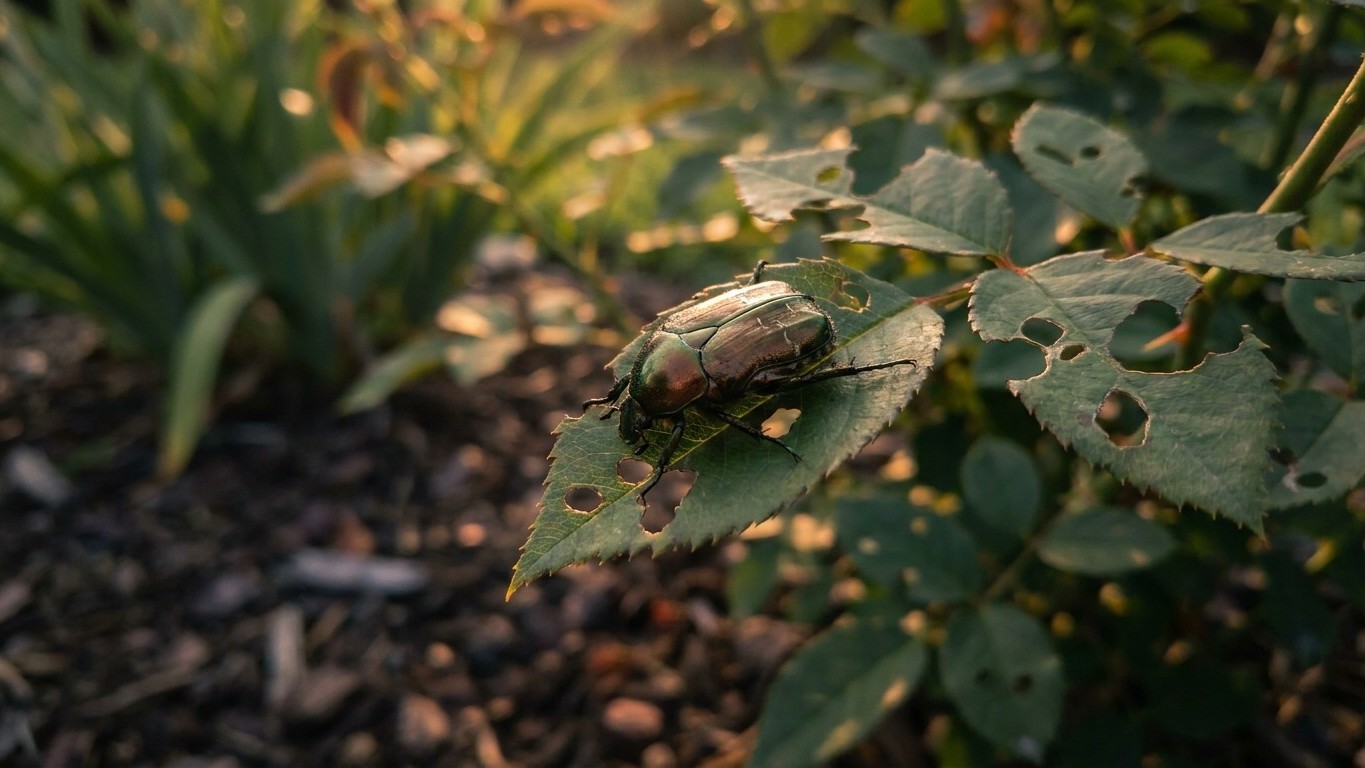

Chinese rose beetle adults feed at night, year-round, in every lowland region of Hawaii where host plants grow. There’s no true off-season here: no frost ever interrupts the cycle. What actually stops damage is timing your defenses to the beetle’s nocturnal habits, not to a calendar date, and knowing that adults, not the grubs in the soil, do the damage you see on your roses, beans and eggplant.
The weeks to watch
There is no specific weekly window to circle on a calendar. The University of Hawaii CTAHR Extension does not publish a seasonal flight schedule for the Chinese rose beetle the way some mainland extension services do for pests tied to freeze cycles. That absence is itself informative: this insect breeds continuously in Hawaii’s frost-free lowlands, so instead of a spring emergence and a fall die-off, gardeners deal with overlapping generations feeding at low but steady levels most of the year.
Nighttime activity, not seasonal activity
The pattern worth tracking isn’t monthly, it’s daily. Adults hide in soil, mulch or leaf litter during daylight and emerge at dusk to feed on foliage through the night, retreating again before sunrise. Warm, dry evenings tend to bring out more activity than cool, wet ones, which is why damage often looks worse during Hawaii’s drier months on leeward coasts than during heavier windward rains, though this is a general tendency rather than a documented CTAHR schedule.
Why generations overlap instead of separating
In climates with winter, distinct generations show up as separate waves because cold kills off adults and resets the population. Hawaii’s warmth removes that reset button. Eggs, grubs, pupae and adults can all be present in the same garden bed at the same time, which is part of why this beetle is such a persistent nuisance across the islands rather than a seasonal visitor.
Reading the calendar from your last frost
Here’s the part that trips up gardeners who moved to Hawaii from a place with real winters: there is no frost date to count from. NOAA’s climate data for the islands shows zero days per year at or below 32°F in inhabited areas, and every standard freeze percentile comes back not computable. Frost occurs only on the summits of Mauna Kea, Mauna Loa and Haleakala, thousands of feet above where anyone grows tomatoes or roses.
That means the usual “weeks after last frost” math simply doesn’t apply. Chinese rose beetle activity tracks soil warmth and moisture, and in Hawaii’s lowlands the soil is warm enough for beetle activity essentially all year. Instead of a frost-based calendar, growing here follows a different set of variables:
- Elevation: gardens above roughly 2,000 feet run cooler and drier, which can slow beetle activity somewhat compared to hot coastal lowlands.
- Windward versus leeward exposure: windward sides (facing the trade winds) stay wetter and greener year-round, while leeward sides go through pronounced dry spells that seem to concentrate nighttime feeding on remaining green foliage.
For a home gardener, the practical takeaway is that protective covers on young transplants shouldn’t be timed to a frost date that doesn’t exist. Cover new plantings from the day they go in the ground and expect to keep watching for feeding marks within the first couple of weeks, regardless of month.
What it attacks, and what the damage looks like
Most gardeners notice the damage long before they ever spot the insect responsible. Leaves start looking lacy, almost see-through in patches, with the tissue between veins chewed away while the veins themselves remain intact, giving foliage a skeletonized, window-pane appearance. New rose leaves are often hit hardest, curling and browning at the edges after a night or two of feeding. Because the beetles work in darkness and retreat by morning, it’s common to find severe leaf damage with no visible culprit anywhere on the plant during the day.
This damage is caused almost entirely by the adult beetle, not by the larval stage. The grubs live in soil, feeding on organic matter and occasionally on grass roots, but they’re rarely the source of visible plant injury that gardeners complain about. That distinction matters for treatment: anything aimed at soil-dwelling grubs won’t touch the adults doing the nighttime feeding, and vice versa.
Host plants span both ornamentals and food crops, which is part of why this beetle frustrates so many different types of gardeners across the islands:
- Roses (a favorite target, hence the common name)
- Beans and other legumes
- Eggplant
- Corn
- Sweet potato foliage
- Grapes and various ornamental shrubs
If a plant on this list is showing lacy, skeletonized leaves overnight with no daytime insect in sight, Chinese rose beetle is a reasonable first suspect in Hawaii gardens.
How Hawaii sits in this pest’s range
On this site, Chinese rose beetle is documented in exactly one territory: Hawaii. That’s not a coincidence of data collection so much as a reflection of the insect’s biology. It’s a tropical and subtropical species that needs warm, frost-free conditions to sustain the kind of year-round breeding described above, and Hawaii’s climate delivers that in a way most of the continental United States simply doesn’t.
There’s no neighboring state’s data to lean on here, because this pest’s range on record doesn’t extend beyond the islands in the way a widespread mainland insect might span a dozen states with only timing differences between them. Hawaii isn’t near an edge of this beetle’s range, it’s essentially the range itself as far as this site’s coverage goes. That also means local guidance, like the CTAHR Extension recommendations referenced above, isn’t borrowed or adapted from a mainland source; it’s built around Hawaii’s specific growing conditions from the start.
What actually works against it
Control starts with the cheapest, lowest-effort options and moves up from there. The order matters, because some measures stop working entirely once the beetle has already reached certain life stages or plant tissue.
- Hand-picking at night with a flashlight. Because adults feed after dark and are sluggish in cool evening air, many gardeners find they can knock beetles into a container of soapy water during an evening check. This costs nothing and works as long as you’re catching adults before they’ve laid eggs, but it needs repeating regularly since new adults keep emerging.
- Reducing outdoor lighting near vulnerable plants. These beetles are drawn to light sources, so porch lights and garden lighting near roses or vegetable beds can pull in more adults from the surrounding area. Turning off unnecessary lighting, or moving it away from prized plants, reduces how many beetles find their way to a given bed in the first place.
- Row covers or fine mesh over young transplants. Physical barriers work only while they’re in place and only against adults trying to feed at night; once a cover is removed for watering or harvesting, protection ends immediately. This is most useful for seedlings and new transplants during their first vulnerable weeks.
- Clearing leaf litter, mulch piles and garden debris. Adults hide in these spots during the day, so removing daytime shelter reduces the local population over time, though it won’t stop beetles flying in from elsewhere in the neighborhood.
- Crop rotation and diversifying plantings. Since the beetle favors specific hosts like roses and beans, spacing out or rotating these plantings can reduce concentrated damage, though it won’t eliminate the pest from a property with mixed landscaping.
Some gardeners also reach for copper tape or ultrasonic repellent devices around vulnerable beds. Copper tape is popular for other soft-bodied pests, but there’s no Established mechanism showing it affects Chinese rose beetle specifically, and controlled trials on copper barriers for beetles generally don’t show consistent results. The same caution applies to ultrasonic devices: they’re widely sold, but the evidence for effectiveness against nighttime-feeding beetles like this one is thin. Once larvae are established in soil feeding on organic matter, none of the above measures reach them at all; soil-dwelling grubs are largely out of reach of hand-picking, covers or light management, which is one more reason the adult stage is where most home control effort belongs.
Common questions
Does Chinese rose beetle damage ever stop completely in Hawaii?
Not in the way a frost would stop it elsewhere. Activity can slow during cooler, wetter windward conditions or at higher elevations, but the frost-free climate means there’s no true dormant season across the islands as a whole.
Are the grubs in my soil the ones eating my rose leaves?
No. The visible lacy leaf damage comes from adult beetles feeding at night. The grubs live below ground and feed on organic matter and occasionally grass roots, but they aren’t responsible for the skeletonized foliage gardeners typically notice first.
Will moving plants to a shadier or more enclosed spot help?
It may reduce exposure somewhat, since adults are drawn partly by lighting and open feeding routes, but it won’t eliminate risk. These beetles fly readily between yards, so isolation helps more as one layer of protection alongside covers and nighttime hand-picking than as a standalone fix.