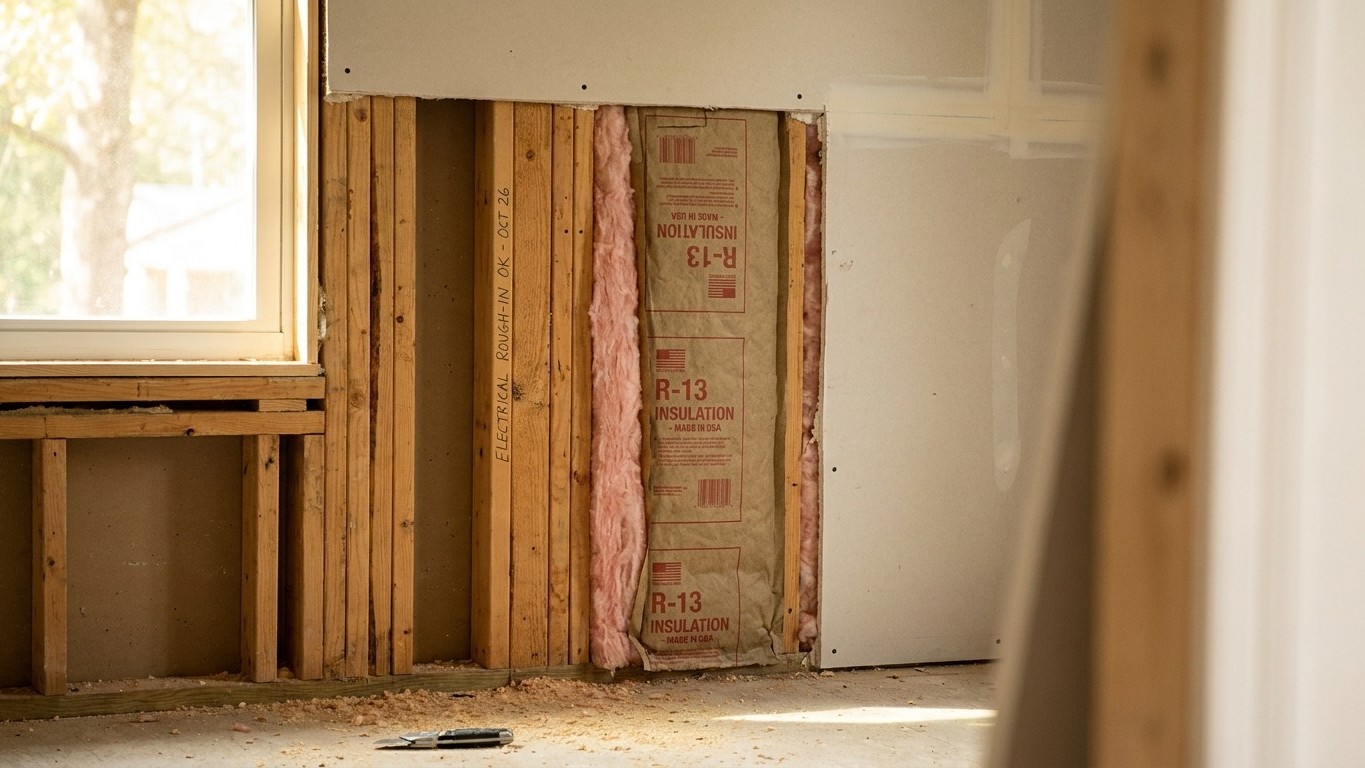

Yes, most of Idaho falls under building code climate zones that require an interior vapor retarder on framed walls. The state’s 44 counties split between IECC zone 5B and zone 6B, and neither one qualifies for the code’s exemption. What changes from one Idaho county to the next isn’t whether a retarder is needed, but which class of material satisfies the rule and how a local jurisdiction has written it into its adopted code.
What the code asks for in Idaho

The 2021 International Residential Code, Section R702.7, says a vapor retarder of the class listed in Table R702.7(2) “shall be provided on the interior side of frame walls.” That’s the baseline rule, and it applies to nearly every county in Idaho because the exception written into that same section only kicks in for climate zones 1, 2 and 3, the warm and hot parts of the country. Idaho isn’t there.
The state’s 44 counties divide into two zones: 22 counties sit in zone 5B, and 22 sit in zone 6B, according to the 2021 IECC’s Table R301.1. Both are cold, dry-region designations. Neither is a 1, 2 or 3. So while the state technically spans two climate zones, the answer to the retarder question lands in the same place for both: a vapor retarder is required, not optional, on the interior side of exterior framed walls.
Where the two zones actually diverge is in the insulation tables that sit next to the vapor retarder section, not in the retarder requirement itself. Zone 6B carries a colder design temperature than 5B, which changes minimum R-values for walls, ceilings and floors. A homeowner in a 6B county and one in a 5B county both need a retarder; they don’t necessarily need the same wall assembly around it.
Why this isn’t a judgment call
Nothing in R702.7 leaves this to preference. The code frames it as a mandatory provision with four listed exceptions, and “you’re in a cold zone” isn’t one of them, it’s the opposite. Cold zones are exactly where the provision applies. A wall built without any interior vapor control in a 6B county in Idaho isn’t taking a risk-tolerant shortcut; it’s built outside the assumption the code is written around.
That said, “required” doesn’t mean there’s only one acceptable product. The code names three classes of retarder by permeance, not by brand or material name, and which class fits a given wall depends on the rest of the assembly, exterior sheathing, cladding and insulation choices. That’s a conversation for the county building department, not something this page can settle for a specific house.
Why the answer is the opposite in a warm climate
The reason Idaho’s answer differs from a house in Florida or coastal Georgia comes down to which direction the water vapor is traveling, not a difference in how strict the codes are. In a cold-zone house like most of Idaho’s, warm moist air sits inside the living space all winter. That air pushes toward the cold sheathing behind the siding, and if nothing stops it, it condenses somewhere inside the wall cavity. An interior vapor retarder blocks that path before the moisture reaches a cold surface.
Flip the climate and the physics flips with it. In a warm-humid zone, the outside air carries the moisture load, and it’s pushing inward, not outward. If a wall in that climate has a Class I retarder, the kind Idaho code effectively calls for, sitting on the interior side of the insulation, the U.S. Department of Energy’s Building America program describes exactly what happens next: “the water vapor will condense on this cool, impermeable surface,” and the result is “ruined insulation, mold, and structural rot of framing members.”
That single sentence from the DOE explains the entire structure of the exception written into R702.7. Climate zones 1, 2 and 3 don’t lose the vapor retarder requirement because regulators decided humid states deserve a break. They lose it because the same material that protects a wall in Boise would actively damage a wall in Miami. It’s not bureaucracy drawing an arbitrary line at the zone boundary, it’s the code following the direction the water travels.
This is also why nobody should treat vapor barrier advice as portable across state lines, or even always across county lines within a state that spans more than one zone. A product recommendation built for a 6B assembly is doing a specific job: keeping interior humidity from reaching a cold sheathing. Move that same assembly into a warm-humid zone and it stops doing a job and starts causing the exact damage the code is trying to prevent elsewhere.
The three classes, and why the word matters
Code language sorts vapor control into three classes by how much moisture they let through, measured in perms, not by product name. Idaho’s requirement doesn’t specify polyethylene sheeting by name; it specifies a permeance range, and several very different materials can satisfy it.
| Class | Example materials | Permeance range |
|---|---|---|
| Class I | Sheet polyethylene, nonperforated aluminum foil | 0.1 perm or less |
| Class II | Kraft-faced fiberglass batts, vapor retarder paint | Above 0.1 up to 1.0 perm |
| Class III | Latex or enamel paint | Above 1.0 up to 10.0 perm |
Notice what’s missing from that list: any mention of “vapor barrier” as a single category. Sheet polyethylene is often called a vapor barrier in casual conversation, but the code only ever refers to it as a Class I vapor retarder, and that distinction is the whole point. The disagreement between a builder working in a cold Idaho county and one working in a humid Gulf Coast county was never about whether to use a vapor retarder at all, it’s about which class belongs in which wall.
Here’s the detail most homeowners miss entirely: ordinary latex or enamel paint on interior drywall already functions as a Class III vapor retarder. Anyone who has painted an interior wall with a standard latex finish has installed vapor control without necessarily meaning to, or knowing the code has a name for it. That’s often enough to satisfy the requirement in many wall assemblies, without adding a separate sheet product at all.
One more distinction worth keeping straight: a vapor retarder and an air barrier are not the same thing, even though a single sheet of material sometimes does both jobs at once. A vapor retarder slows the diffusion of water vapor through a material. An air barrier stops bulk air movement, which carries far more moisture, far faster, through gaps and penetrations. Both matter. They’re just not interchangeable, and satisfying one doesn’t automatically satisfy the other.
Where the rule stops
R702.7’s vapor retarder requirement carries four exceptions, and they apply in Idaho the same way they apply everywhere the base rule holds:
- Basement walls
- The below-grade portion of any wall
- Construction where accumulation, condensation or freezing of moisture will not damage the materials
- Climate Zones 1, 2 and 3, the exception that doesn’t apply to Idaho’s counties
The basement exception is the one most Idaho homeowners actually run into, since finished basements are common in a state with this much winter. A poured concrete foundation wall holds groundwater and releases it slowly, sometimes for years after construction, regardless of how well the exterior was waterproofed. If a builder adds an impermeable interior vapor retarder to that wall, the assembly loses its ability to dry toward the interior, and moisture that would otherwise pass through and evaporate instead gets trapped between the concrete and the retarder. That trapped moisture is exactly the setup that damages framing and insulation over time, the same failure mode the DOE describes for warm-humid above-grade walls, just triggered by a different moisture source.
The third exception is broader and more case-specific. It covers assemblies where the materials themselves, or the design of the wall, mean moisture accumulation simply won’t cause damage, which is a judgment a code official or engineer makes for a specific project rather than a blanket category. For a closer look at how the basement exception plays out in practice, the basement wall guide on this site walks through the assembly details.
None of these exceptions ban a vapor retarder from being used in those situations. They remove the obligation to install one, which is a different thing entirely. A builder can still choose to install vapor control in a basement wall assembly if the design calls for it; the code just isn’t the one demanding it there.
Who actually decides, in Idaho
The International Residential Code is a model code. It becomes law only once a state or local jurisdiction adopts it, and jurisdictions adopt editions on their own schedule, sometimes with amendments that change the base text. That means the version of R702.7 enforced in one Idaho county’s building department isn’t guaranteed to match the 2021 edition referenced here word for word. The only way to know what applies to a specific project is to ask the local building department which edition and which amendments are currently in force.
This matters more in Idaho than in a state with a single, uniform climate zone. Boise Air Terminal, the reference weather station for the state’s largest metro area, averages about 5,320 heating degree days a year against a 65°F base, alongside about 1,045 cooling degree days. That’s a heating season with real demand behind it, not a mild inconvenience, and it’s the kind of number that explains why the vapor retarder question carries weight here at all: a house working that hard to stay warm for months at a stretch is exactly the assembly R702.7 was written to protect.
Heating degree days measure accumulated demand, not a single temperature reading, and a mountain county elsewhere in Idaho can run considerably colder than the Boise reference station. That’s one more reason a county building department, not a national code text or a single weather station, is the source that actually settles what a specific wall needs.
A wall built with the wrong vapor control choice rarely announces the problem right away. There’s no crack, no stain, no obvious sign at the time of construction. The damage the DOE describes, ruined insulation, mold, framing rot, tends to surface years later, often after the drywall comes down for an unrelated repair. That lag is the real argument for checking with the local building department before assuming any general rule, including everything on this page, applies exactly as written to one particular house.