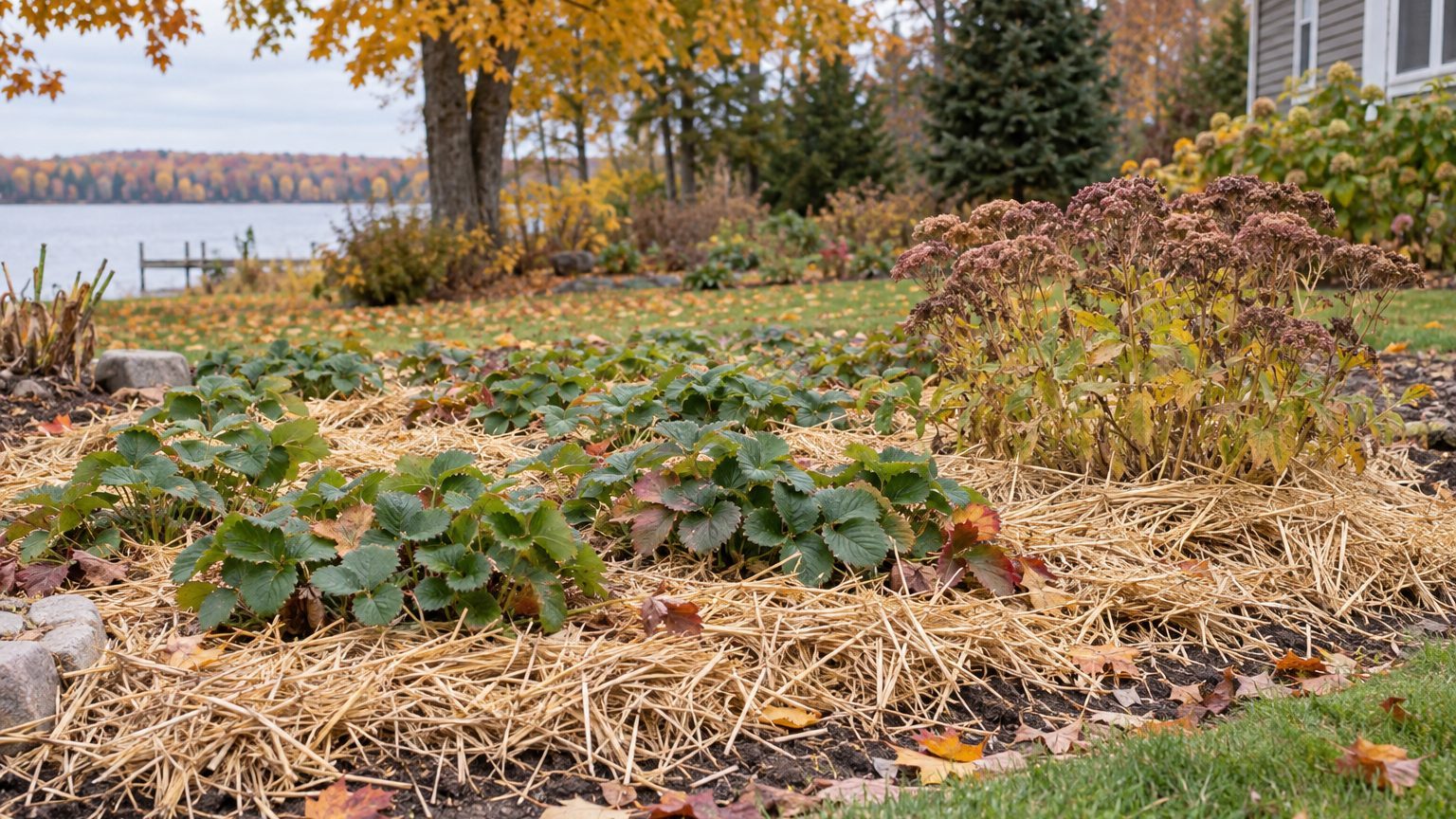

Wait for the ground to start freezing. In Boise, NOAA’s 1991-2020 Climate Normals put the first 32°F freeze between October 7 and October 21, and winter mulch belongs after that window, not inside it. Strawberries and borderline perennials follow the same rule: a loose layer of clean straw or similar material once the soil surface stiffens, then pulled back when spring growth starts. Higher, colder parts of Idaho freeze sooner, so their mulching day arrives earlier on the calendar too.
When to put winter mulch down in Idaho
Most gardeners assume mulch is a blanket, something that keeps plants warm. It isn’t. Think of the lid on a cooler: it keeps cold things cold. Winter mulch has one job, which is to hold the soil at a steady frozen temperature so it doesn’t thaw on a sunny January afternoon and refreeze that night. Those swings are what push shallow crowns up out of the ground. Spread mulch while the soil is still warm and you get the opposite result. The layer holds heat, plants stay active longer than they should, moisture gets trapped against stems, and field mice and voles find a cozy, roofed shelter before the cold arrives.
For a reference point, the NOAA NCEI 1991-2020 Climate Normals for the Boise station put the first fall freeze at 32°F somewhere between October 7 and October 21, using the band where the probability of a freeze runs from 30 to 70 percent (station USW00024131). Winter mulch goes down after that band has passed, once the soil surface has actually begun to freeze. The same normals show the mean daily minimum of Boise’s coldest month at 25.4°F, so below-freezing nights are the norm there and the freeze logic applies. Boise, though, is a low valley. Most of Idaho sits higher and colder, with far shorter growing seasons, so the first frost comes earlier there and the mulching window moves earlier with it. The First and Last Frost Dates in Idaho page is the place to find a number closer to your own yard.
Read the ground, not the calendar
A first frost is a warning, not a trigger. It blackens tomato vines and basil long before the soil itself is anywhere near frozen. The better signals are on the ground: nights that stay below freezing instead of dipping there once, a crust on the top of the soil in the morning, and perennials that have stopped growing and gone dormant, with strawberry leaves darkening at the edges. Wait until after the first-frost window passes, then mulch once the soil surface has started to freeze. That decision is worth writing on the calendar as a reminder to check, not as a date to act on.
Hardiness zones don’t settle the timing. The USDA Plant Hardiness Zone Map (2023 edition, built on 1991-2020 normals) runs from 3b to 7b across Idaho, but it rests on a single variable, the average annual extreme minimum temperature. That tells you what survives your winter, not when to lay mulch. Look up your own ZIP code rather than borrowing a neighbor’s zone from another valley.
When winter stays mild
Some years the cold arrives late and in fits. If a warm, wet November drags on, hold off. A pile of straw sitting beside the bed, ready to go, costs nothing, while mulch laid too early on wet, warm soil can start a rot problem. When a hard cold snap is forecast, that is the moment to spread it. Snow cover works as natural mulch where it falls early and stays, but a thin, patchy snowpack does not do the same job, and Idaho winters vary a lot from one year and one valley to the next.
Strawberries
Strawberry crowns sit right at the soil surface, with the roots packed just beneath. That shallow layout is why they suffer in winter. Cold alone can injure exposed crowns, but heaving does more damage. Repeated freezing and thawing lifts the whole plant a bit each time, and by late winter roots that should be buried are dangling in open air, drying out. Bare soil with no snow above it is the worst case, since nothing buffers the temperature swings. Anyone who has walked a neglected bed in March and found plants sitting on top of the soil knows how that looks.
Clean straw is the standard material because it is light, it sheds water better than a wet leaf pile does, and it fluffs back up after snow compresses it. Use straw, not hay. Hay is cut with the seed heads on and will seed your rows with weeds and grass. Whole leaves, especially large maple or cottonwood leaves, tend to mat into a wet sheet over the plants, which is exactly what you don’t want sitting on a crown for months. If you only have leaves, shred them first.
On depth, the only sourced figure is the one from the NC State Extension Gardener Handbook (chapter 11, Woody Ornamentals): “A 2-inch to 3-inch layer of mulch suppresses most annual weed seeds and makes it easy to hand-pull any that do germinate.” That is written about weed control, and straw settles as it gets wet, so treat that range as the ceiling and cover the crowns lightly and evenly. More is not better. A thick, packed layer holds moisture against the leaves and invites rot. For planting, spacing, and the rest of the season, see Growing Strawberries.
Spring matters as much as fall. The straw came off your to-do list in your head, but the plants can’t grow through a mat for long. Pull the straw back when new leaves start to push up pale yellow-green, and rake it into the aisles between rows rather than hauling it away. Left in the aisles, it keeps weeds down and keeps berries off the dirt later. Because last frosts arrive later in colder, higher parts of Idaho, uncovering happens later there too. If a frost is forecast after the crowns are open, throw the straw back over the plants for the night, especially once blossoms show, since open flowers are the tenderest part.
Perennials and borderline plants
Most established perennials that are hardy for your area need no winter mulch at all. The plants that benefit are a specific group. New plantings from this year, whose roots haven’t gripped the soil yet, come first, since they heave the most easily. Shallow-rooted perennials such as coral bells, and garden mums that were planted late, follow. So do plants that sit near the edge of what your zone allows. The USDA 2023 map spans 3b to 7b across Idaho, and a plant tag that says “hardy to zone 5” can mean something quite different in a cold, high valley than it does in Boise’s lower elevations. Roses that were grafted, and lavender, are common borderline cases.
| Plant group | Main winter risk | How to mulch |
|---|---|---|
| Newly planted perennials | Heaving before roots anchor | Ring of loose mulch after the surface freezes |
| Shallow-rooted perennials | Freeze-thaw lifting crowns | Ring around the crown, not on it |
| Grafted roses | Cold injury at the base | Mulch or soil gathered around the base after the ground freezes |
| Lavender and similar herbs | Wet crowns in winter | Light, dry mulch kept clear of the crown; see the herb guide below |
| Shrubs and trees | Drying roots, uneven soil temperature | Ring kept back from the trunk |
The shape of the mulch matters more than the amount. Make a ring around the plant, not a pile on top of it. Mulch that touches a crown or a woody stem stays wet, holds rot against the bark, and gives rodents a covered place to chew. Leave a gap around the crown so air can move. The NC State Extension handbook says it directly for woody plants: “Provide a 3-inch layer of mulch to reduce water loss and maintain uniform soil moisture and temperature around roots.” Two sentences, two purposes (weed suppression, then moisture), and both land in the same range of depth. Do not go deeper than that. Deep mulch is how a neat ring turns into a volcano.
Mulch after the ground has begun to freeze, in a ring 2 to 3 inches deep with a clear gap at the crown. For herbs like thyme, sage, and lavender that don’t like wet feet, Getting Perennial Herbs Through the Winter covers what works. And for the mechanics of spreading mulch without smothering the plant, read Mulching Without Killing the Plant before you start. Evergreen perennials and shrubs also lose moisture through winter wind and sun, so a ring that keeps the roots evenly moist helps them more than a heavy cover would.
What goes wrong
Mulching too early. The plant looks tucked in, and problems show up in spring. Crowns that stayed warm and damp under straw turn soft and brown, and rodents have already moved in. The prevention is simple: hold off until after the first-frost window and the soil surface has started to freeze. In colder parts of Idaho, that moves earlier on the calendar, so watch the ground rather than a date from a lower valley.
Mulch that mats and rots. Wet whole leaves, grass clippings, and compacted layers seal out air. Underneath, you will find a slimy, dark layer and crowns that smell sour. Lift a corner in a mild spell and check. If the mulch has collapsed into a wet mat, fluff it or replace it with dry straw. Loose, dry materials laid at the recommended depth avoid the problem.
Voles nesting in it. Voles love a roof. A deep layer of mulch pushed right up against a shrub trunk or a rose cane gives them cover to chew bark in the dark. Signs are runways in the grass, small gnaw marks at the base of stems, and tunnels when the mulch is pulled back. The fix is the gap. Keep mulch away from woody stems and crowns, and don’t pile it high.
Forgetting to uncover. This one shows up in April. Strawberries under straw grow pale and leggy, or start rotting at the crown, and flowering runs late. Put a spring reminder on the calendar to pull straw back as new growth starts, and expect that date to fall later in colder, higher areas because their last frosts come later. Pulled-back straw stays in the aisles, close enough to cover the rows again if a late frost threatens.
Common questions
Should I mulch right after the first frost?
No. In Boise, the first 32°F freeze arrives between October 7 and October 21 in the NOAA normals, but the soil is usually still warm then. Mulch goes down later, when the soil surface has started to freeze and nights stay below freezing. Colder, higher parts of Idaho reach that point sooner, so their timing shifts earlier.
Can I use fallen leaves instead of straw?
On perennials, shredded leaves work fine as a loose ring. On strawberries, whole leaves are risky because they mat into a wet sheet over the crowns. If leaves are what you have, shred them and keep the layer light, then check for matting in any mild spell. Clean straw remains the safer choice for a strawberry bed.
Do I still need mulch if I get plenty of snow?
Snow insulates well when it arrives early and stays, and in that case it does much of the mulch’s job. The problem is reliability. A winter with little snow, or with snow that melts off and returns, leaves crowns exposed to the very swings mulch is meant to prevent. Keeping straw on hand costs little.
Does my hardiness zone tell me when to mulch?
No. The USDA Plant Hardiness Zone Map (2023) is built on the average annual extreme minimum temperature, and across Idaho it runs from 3b to 7b, so it says what your plants can survive, not the week to spread mulch. For timing, use your local first-frost dates and the state of the soil surface. The mean daily minimum of Boise’s coldest month is 25.4°F in the NOAA 1991-2020 normals, and a colder valley will run well below that.
For more on growing conditions across the state, browse the Idaho guides.