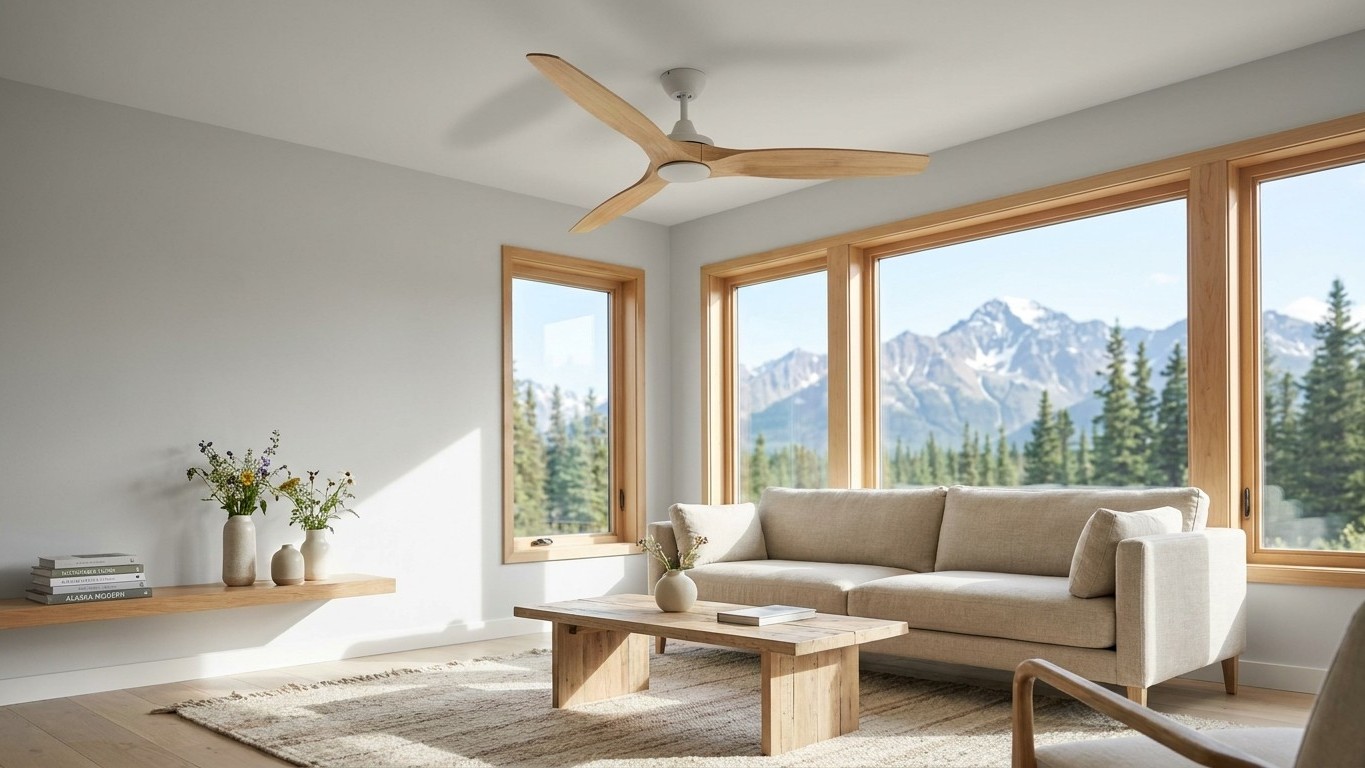

Idaho homes cool mostly with central air conditioning, but not exclusively. Statewide, 81% of homes run some kind of air-conditioning equipment, 64% have a central system, and 19% rely on an individual unit, whether that’s a ductless mini-split, a window or wall unit, or a portable. Another 70% keep ceiling fans running alongside whatever cooling they’ve got.
What homes in Idaho actually cool with
Those four numbers tell a layered story. The 81% figure covers any air-conditioning equipment at all. The 64% figure is narrower: homes with a central system tied into ductwork, usually sharing an air handler with the furnace. That leaves 19% of Idaho homes cooling with an individual unit instead of, or alongside, a central system.
That 19% typically shows up for reasons tied to the house itself rather than the climate: older homes without ductwork, additions never tied into the main system, rentals where central air isn’t feasible, or a single room that runs hot no matter what the rest of the house does. It’s a meaningfully large share, even in a state where central air is clearly the majority approach.
For comparison, Connecticut has 90% of homes with air conditioning but only 34% central, meaning more than half the state’s cooled homes lean on individual units. Alabama, at 94% with air conditioning and 81% central, shows housing stock built for central cooling from the start. Idaho, at 81% and 64%, sits closer to the Alabama pattern, but with a visible gap all the same.
None of this is a verdict on which setup works better; a percentage in a survey table describes what got installed, following what was affordable and available when a house went up. One flag worth noting: when a state’s figure shows up as “Q” in the underlying data, the sample size was too small to publish a reliable number. It is not zero.
The ceiling fan figure, 70% of Idaho homes, matters too. Fans don’t lower a room’s temperature; they move air across skin, speeding evaporation and making a given temperature feel a few degrees cooler. In a state where a fifth of homes manage cooling without a whole-house system, that’s part of how a lot of Idaho households actually get through August.
How much cooling the year actually asks for
The number that measures Idaho’s cooling demand isn’t a temperature. It’s a count: 47.5 days a year that reach 90°F or higher, on average, at the Boise reference station, based on the 1991-2020 climate normals. That’s a single station’s record, not a statewide average, and it’s a count of days, not a degree reading. This is the yardstick climatologists use for heat load, because it drives cooling demand, water demand, and physical heat stress all in one number.
Forty-seven and a half days is not a mild number. It puts Boise’s summer heat load in the “genuinely warm” range for a Mountain West city, and it explains why air conditioning shows up in 81% of Idaho homes rather than being treated as optional. A house that sees close to fifty days above 90°F over a summer is one where mechanical cooling earns its keep most years.
In some states, a high heat-load number pairs with a housing stock still leaning on individual units, because growth happened before central systems were standard. In others, a milder heat load still produces a mostly-central market, because housing was built recently enough that central air came standard from the start.
Idaho’s numbers land closer to the second pattern. A heat load of 47.5 days above 90°F is substantial, and the equipment mix, 64% central against 19% individual, shows a state where whole-house systems are clearly the default. That’s a reasonably good match between how hot the summers run and how homes are set up to handle it, though the 19% on individual equipment is a reminder that a meaningful slice of the state still isn’t on a central system.
Wet heat or dry heat, and what it changes
Idaho’s summers are dry: about 1.1 inches of rain fall across June, July, and August combined, out of 11.5 inches for the whole year. August is the driest month, at just 0.17 inches. That’s a precipitation figure, not a humidity reading or dew point. It says how much water falls from the sky, nothing about how heavy the air feels.
But that dry-summer figure changes what an air conditioner is actually working on. Every air conditioner does two jobs: pulling heat out of the air, and pulling moisture out of the air. Lowering temperature happens fast. Removing moisture takes sustained run time, since water has to condense on a cold coil and drip away.
In a wet summer, that second job eats up a large share of a unit’s run time, and an oversized unit will chill the air, shut off, and never run long enough to finish drying it, leaving a house that feels clammy despite a cold thermostat reading. In a dry summer like Idaho’s, dehumidification is a much smaller job to begin with, so the air conditioner’s task is close to pure temperature control, with less penalty for shorter cycling.
That doesn’t mean sizing stops mattering. It means the priorities shift.
- Size for temperature control first; dehumidification is a smaller share of the job here than in a humid climate.
- Keep the fan on “auto” rather than “on” during the hottest stretch, since a dry climate gets less benefit from continuous air movement for moisture control.
- Resist the urge to oversize “just in case.” A unit that’s too big still short-cycles and wastes energy, even where humidity isn’t the main concern.
These are normals for a single reference station over a thirty-year stretch, not a forecast or a guarantee for any individual yard or block. A slope, a rain shadow, or a spot closer to higher terrain can shift what actually falls on a given property. A rain gauge on-site settles that question better than any regional average.
Sizing a room unit, from the published chart
For anyone leaning on an individual unit, whether one of Idaho’s 19% or adding a unit to a room a central system doesn’t reach well, ENERGY STAR publishes a starting chart matching room area to cooling capacity.
| Area to be cooled (square feet) | Capacity needed (BTU per hour) |
|---|---|
| 100 up to 150 | 5,000 |
| 150 up to 250 | 6,000 |
| 250 up to 300 | 7,000 |
| 300 up to 350 | 8,000 |
| 350 up to 400 | 9,000 |
| 400 up to 450 | 10,000 |
| 450 up to 550 | 12,000 |
| 550 up to 700 | 14,000 |
| 700 up to 1,000 | 18,000 |
| 1,000 up to 1,200 | 21,000 |
| 1,200 up to 1,400 | 23,000 |
Reproduced exactly as published, this table stops at 1,400 square feet, and nothing beyond that line or between listed steps should be assumed by interpolating. It’s a starting point for a single room, published for room air conditioners specifically, not a per-square-foot formula that scales to a whole house.
That matters most in a state where 64% of homes run central air. A central system is sized through a proper load calculation, accounting for the whole house, insulation, window area, orientation, and ductwork, done by a contractor rather than read off a table. This chart is for the room unit behind Idaho’s 19% individual-unit figure, not for the central system behind the other 64%.
The oversizing trap applies regardless of climate. A room unit rated well above what the chart calls for isn’t a safety margin, it’s a fault waiting to show up as a clammy room, cooling the air fast, shutting off, and never running long enough to remove moisture properly, even in a dry-summer state like Idaho.
What actually needs looking after here
In Idaho, with 64% of homes on central systems and 19% on individual units, the two groups need slightly different attention.
ENERGY STAR’s baseline applies to every household with a central system, heat pump, or furnace: “Inspect, clean, or change air filters once a month in your central air conditioner, furnace, and/or heat pump.” That’s once a month, not once a season, covering all three pieces of equipment together.
The payoff is spelled out plainly: ENERGY STAR notes that “airflow problems can reduce your system’s efficiency by up to 15 percent.” A system can be mechanically sound and properly sized and still lose a meaningful chunk of output to a dirty filter choking airflow.
For the 64% running central air, there’s a second issue worth checking that has nothing to do with the unit itself: the ducts carrying cooled air through the house. ENERGY STAR’s figure is sobering: “In a typical house, however, about 20 to 30 percent of the air that moves through the duct system is lost due to leaks, holes, and poorly connected ducts.” That’s air conditioned at real cost, then lost into an attic or crawlspace before reaching a vent. This caveat only applies to ducted systems; a window unit or mini-split has no ducts to leak from.
A seasonal pass built around those three facts covers most of what actually needs doing before and during a hot Idaho summer:
- Check or change filters monthly through the cooling season, for both central systems and any heat pump equipment in the house.
- Have visible ductwork inspected for disconnected joints or damaged sections if the home runs central air, since leak losses in that 20 to 30 percent range compound every month the system runs.
- For homes leaning on individual units, confirm the unit’s rated capacity against the room it’s actually cooling, using the ENERGY STAR chart as the starting reference rather than guesswork.
Beyond that seasonal pass, the site’s equipment-specific guides in the heating and cooling hub go deeper on each piece, from central system upkeep to mini-split care, without repeating the same three facts here.