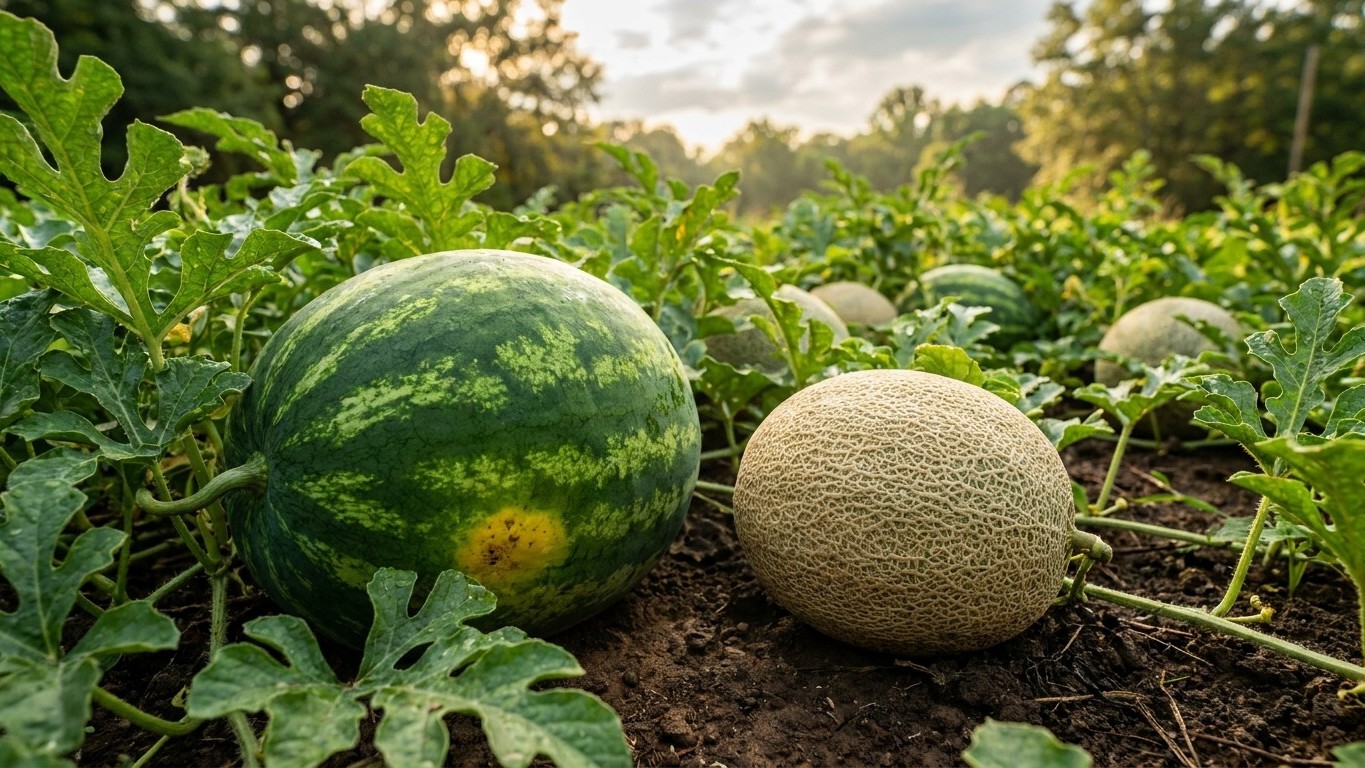

For most of Idaho’s low-to-mid elevation valleys, cantaloupe and muskmelon varieties maturing in 75 to 85 days are the safer bet, with short-season icebox watermelons close behind. Long-season honeydew and full-size heirloom watermelons only pencil out in the warmest, lowest valleys, and that holds for the reference station itself.
The short answer for Idaho
The reference station behind these numbers sits in the Boise valley, and it shows a frost-free window running from a last spring frost of April 23 to May 7, out to a first fall frost of October 7 to October 21. Stack the earliest fall frost against the latest spring frost and the reliable growing season shrinks to about 153 days. Stack the latest fall frost against the earliest spring frost and it stretches to roughly 181 days. That’s the range a gardener at this exact station can plan around, and it’s generous by Idaho standards.
Layer in the heat: 47.5 days a year averaging 90F or hotter at that same station. That’s a real heat load, the kind melons actually want, since fruit sugar development in cantaloupe and watermelon both depend on sustained warm days rather than just a long calendar window. Combine a 153-to-181-day frost-free season with nearly seven and a half weeks of 90-degree-plus weather, and the valley floor is squarely in melon territory.
That combination points toward a decision by type rather than a single named variety. Cantaloupe and muskmelon types maturing in 75 to 85 days fit comfortably inside even the shorter 153-day version of the season, leaving margin for a cool spring or an early fall cold snap. Short-season, icebox-style watermelon varieties in the 70 to 80 day range are the next safest choice, especially where the grower can’t count on the full 181-day stretch. Honeydew types and the larger, slower heirloom watermelons, the ones needing 90 to 100-plus days of warm growing conditions, only make sense where both the season length and the heat load match what the reference station shows. Outside the lowest valleys, that match gets harder to find.
The state’s hardiness range runs from zone 3b to 7b, which means a lot of Idaho gardens sit on ground colder and shorter-seasoned than the numbers above. The type-based logic still applies: shorter season, hotter days, favor fast-maturing melons. The specific day counts just belong to the valley floor, not to every county.
What will not work here

Long-season melons are the first casualty. A netted muskmelon rated at 95 days, or a heirloom watermelon rated at 100 to 110 days, needs every one of those days to actually finish, and a melon still green and hard when the first fall frost hits doesn’t ripen afterward, it just stops. Even at the reference station’s generous end, 181 frost-free days, a 100-day melon leaves only 81 days of buffer for a cool spring, a late transplant, or a stretch of overcast weather to eat into. At the conservative end, 153 days, that same variety has no real margin left at all. Across the wider state, where the hardiness zone drops to 3b and 4b at elevation, a 95-to-110-day melon is simply the wrong tool.
The second failure mode shows up at the hose, not the seed packet. Summer rainfall at the reference station averages about 1.1 inch total across June, July, and August combined, with August, the hottest stretch of the year’s 47.5 days above 90F, delivering just 0.17 inch. June brings 0.75 inch, July drops to 0.21 inch. A watering routine built around one weekly soaking, common advice in wetter parts of the country, leaves melon roots dry through repeated 90-degree afternoons. The visible result is blossom drop, stunted fruit, or fruit that turns bitter under heat stress rather than sweet. Melons need consistent soil moisture through fruit set and sizing, and a state averaging roughly an inch of rain across three summer months can’t supply that on its own; irrigation has to fill nearly the entire gap.
The third mistake is timing, not variety. With the last spring frost running as late as May 7 at the mildest low-valley station, and considerably later at elevation, setting out melon transplants at the first stretch of warm weather is a gamble. Melons are tender in a way tomatoes and peppers aren’t as forgiving about; a light frost that merely nips a tomato leaf can kill a young melon seedling outright, and there’s no side-shoot regrowth to fall back on. Waiting past the local last-frost date, rather than the calendar date, is the difference between a working season and a replanted one.
What changes across Idaho
Idaho’s hardiness range, 3b to 7b under the USDA Plant Hardiness Zone Map, is one of the widest spans any single state carries. That system is built on one number, the average annual extreme minimum winter temperature, so it doesn’t measure summer heat or season length directly, but it’s a useful marker for how differently the same state behaves from one corner to another. A five-zone spread means the coldest pockets and the warmest valleys are separated by something on the order of 30 degrees Fahrenheit in typical winter extremes, and that difference shows up in summer too, in shorter frost-free windows and fewer hot days at elevation.
A gardener working land at the cold end of that range, zone 3b or 4, north Idaho’s higher valleys and the state’s mountain country generally fall into this territory, should plan around a season considerably shorter than the 153-to-181-day figure for the Boise-area reference station. That means leaning on the shortest-maturing melon varieties available, 60 to 75 days rather than 75 to 85, and treating season-extension tools, black plastic mulch to warm the soil early, floating row cover to buy a few extra weeks on either end, as standard practice rather than optional.
There is no single Idaho answer here, only a spread, and the honest version of this section is to say so rather than guess. Finding out which end of that 3b-to-7b range applies to a specific piece of ground means checking the USDA Plant Hardiness Zone Map directly, not reading it off a state-level article.
Where to check this for your own county
Everything above comes from one reference station and one statewide zone range. Neither is a substitute for what University of Idaho Extension has on file for a specific county, and that’s where the next step belongs.
Two things are worth looking for once there. First, a county-level or regional planting calendar, which will translate the frost-date logic in this article into dates that actually apply to that elevation and that valley, rather than to the Boise-area station cited here. Second, a list of melon varieties that extension agents or master gardener programs have actually trialed in that county. Idaho’s growing conditions swing widely enough, from low desert valley to mountain bench, that a variety performing well in one county’s trial plots can struggle in another’s, even within the same general hardiness zone.
A county recommendation beats a state one every time, because it accounts for local microclimate, local soil, and local grower experience in a way a single-state article never can. The extension office is where the state-level answer gets corrected into a county-level one.
Checking this against your own garden
None of the dates above outrank what’s actually happening in a specific garden bed, and three simple checks tend to tell the story better than any calendar.
Soil warmth by feel is the first. Melon seed germinates poorly in cold soil, and a hand pressed into the planting bed in the morning, before the sun has warmed it, gives a rough sense of whether the ground has caught up with the calendar. Soil that still feels cool and damp well into what should be planting season usually means a slower start is coming, regardless of what a printed frost date says.
The first flush of male flowers is the second. Melon plants produce male blossoms before female ones, sometimes by a couple of weeks, and their appearance is a signal that the plant has shifted from vegetative growth into reproductive mode. Watching for the first male flowers gives an early read on whether the season is running ahead of or behind a typical year in that particular spot.
The first true leaves round it out. The seed leaves that emerge first aren’t the plant’s real foliage; the true leaves that follow, shaped like a proper melon leaf rather than the rounded seed leaf, mark the point where the plant is established enough to handle a bit of stress. A slow gap between seed leaves and true leaves in one part of a garden compared to another, planted the same day, is often the clearest sign of a microclimate difference no chart will catch.