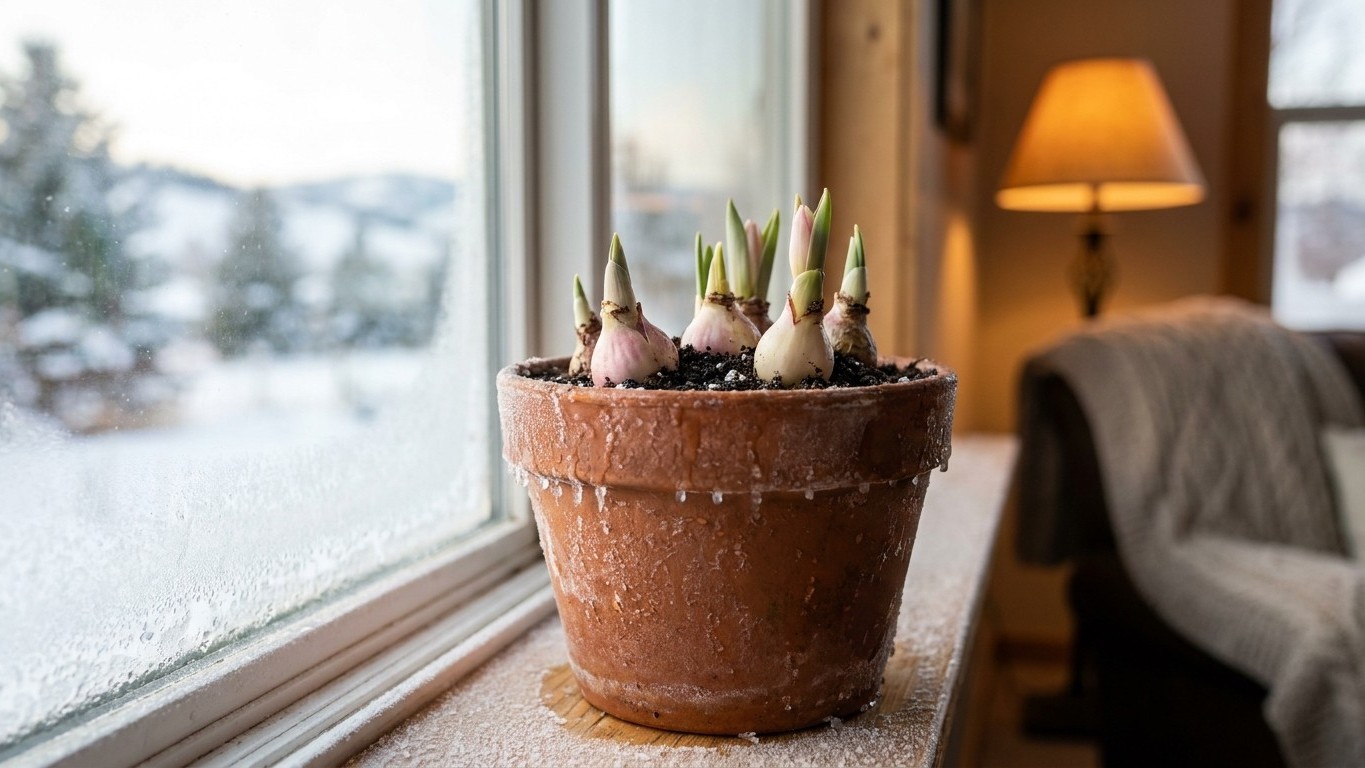

Forcing spring bulbs indoors in Idaho works because the state already has cold to spare outdoors; the trick is getting that same chill into a pot sitting on a warm windowsill or a porch that can freeze solid. Twelve to fourteen weeks under 45°F turns a dormant bulb into a bloom-ready one, and a gardener supplies it artificially whenever the pot itself isn’t buried in frozen ground.
Why this matters in Idaho

Boise’s coldest month averages a daily low of 25.4°F (NOAA NCEI Climate Normals, 1991-2020). That figure sits nearly twenty degrees below the 45°F ceiling a spring bulb needs to break dormancy, and it holds for a full month, not just a single hard night. Ground beds across most of Idaho get far more than the twelve to fourteen weeks of qualifying cold a tulip or daffodil requires. That rules out the scenario that drives forcing in milder states, where gardeners fight a winter too short or too mild to chill a bulb properly. Idaho’s problem isn’t a shortage of cold. It’s getting that cold into a container that never touches the ground.
A bulb planted in a garden bed sits inside a large mass of soil that buffers temperature swings; the top few inches may freeze while the bulb itself, several inches down, stays insulated. A bulb in a pot has no such buffer. Surrounded by a few inches of potting mix on every side, the whole container can freeze through, roots and all, at a temperature the same bulb would shrug off in open ground. That’s the real hazard here, not a lack of winter.
The state’s USDA hardiness range, 3b to 7b on the 2023 Plant Hardiness Zone Map (built on 1991-2020 normals), spans everything from high mountain valleys to the lower Snake River plain. That’s a wide spread for one state, and it means a bulb rated hardy for a given yard in the ground can still die in an unprotected pot at that same address, because a container’s effective exposure runs colder than the zone number printed for the soil beneath it. Anyone forcing bulbs in Idaho needs to treat the pot as its own climate, not an extension of the yard around it.
So why force at all, if the ground already delivers the chill for free? Because forcing is about timing and containment, not chill scarcity. A gardener who wants blooms on an indoor windowsill in midwinter, weeks before anything breaks ground outside, has to give a potted bulb that same 45°F-and-under treatment on purpose, since a heated living room never gets there naturally. The chill has to be supplied deliberately, in a space cold enough to fool the bulb but not cold enough to freeze it solid.
How to do it here
The sequence below assumes a standard spring bulb, potted in fall, meant to bloom indoors well ahead of the outdoor season.
- Pot the bulb in fall, using a container with drainage holes and fresh, well-draining potting mix. Set the bulb with its shoulder just below the soil surface, and water once to settle the mix.
- Find a cold space that stays above freezing. An unheated garage that holds steady somewhere between 35°F and 45°F works well in most of Idaho; a cold basement or an enclosed, unheated porch can also serve, as long as the reading doesn’t drop into the low 20s where a thin-walled pot can freeze through.
- Or use a refrigerator drawer if no cold outbuilding is available. Keep the pot away from ripening fruit; apples, pears, and similar fruit release ethylene gas, and ethylene damages the flower bud forming inside a chilling bulb.
- Hold that cold for twelve to fourteen weeks, checking the soil every couple of weeks and watering lightly if it’s dried out. This is the step nothing can shortcut; a bulb pulled early simply won’t flower.
- Check the container’s zone rating against the bulb’s. If the pot will spend its chill period outdoors rather than in a garage or fridge, it needs to be treated as at least two USDA zones hardier than the bulb calls for, since the container runs colder than the surrounding ground. Where that’s not possible, move the pot indoors to an unheated space, or mulch it heavily against an insulated wall.
- Bring the pot into warmth and light gradually once the chill period is complete and shoots have emerged an inch or two. A sudden jump into a hot, bright room can stall the bloom; a few days in a cool, dim spot first eases the transition.
Which bulbs are worth it
Not every bulb pays back the effort of a twelve-week chill schedule. Short, sturdy bulbs with a modest cold requirement force reliably and hold themselves up well in a lightweight pot. Tall bulbs with a long chill requirement, or top-heavy flower heads, tend to disappoint indoors even when the timing is right.
| Bulb | Cold needed | Why it forces well |
|---|---|---|
| Paperwhite narcissus | None | Blooms without any chilling period at all |
| Crocus | Short | Compact habit, fast bloom once warmed |
| Hyacinth | Moderate | Sturdy stem carries a heavy flower spike |
| Grape hyacinth (muscari) | Moderate | Low, dense growth, rarely flops |
| Standard daffodil | Moderate to long | Reliable bloom, stem strong enough for a pot |
Bulbs bought specifically for forcing, like paperwhites, are usually one-season purchases anyway; they rarely rebloom well outdoors afterward, so treating them as disposable costs nothing extra. That changes the math for a gardener deciding whether the trouble is worth it: a bulb that was never going to return to the garden loses nothing by being forced once and composted.
- Force reliably: paperwhite narcissus, crocus, hyacinth, grape hyacinth (muscari), standard daffodil, dwarf or species tulips
- Sulk indoors: large ornamental alliums, tall trumpet daffodils, Fritillaria imperialis, tall Dutch iris
The bulbs that sulk share a pattern: a long, tall flower stalk that a container can’t brace the way open ground does, or a cold requirement long enough that the bloom arrives well past the point anyone still wants it indoors.
What goes wrong, and when you can still fix it
Leaves but no flower
Plenty of green growth with no bud forming means the cold period ran short, either too few weeks or a fridge or garage that never got reliably below 45°F. This isn’t fixable this season; the bulb has already spent its stored energy on leaves instead of a flower. Plant it out in the garden bed once the ground can be worked, let it rebuild reserves over a full growing season, and try forcing again next fall with a longer, steadier chill.
Flower on a stem too short to see
A bloom that opens buried in the leaves, on a stalk just an inch or two tall, usually means the pot was moved into warmth and light before the roots had fully developed during the cold period. The stem has already set its height by the time this becomes visible, so there’s no rescue for the flower already forming. Note how long the chill ran this time and extend it by a couple of weeks next season before bringing the pot into a warm room.
Rot in the pot
A soft, discolored bulb, often with a sour smell, points to standing water rather than drainage. Once rot has set in, the bulb is lost for this season; there’s no reviving tissue that’s already broken down. The fix is entirely preventive: use a pot with real drainage holes, a mix that doesn’t stay soggy, and water only when the top inch of soil has dried, rather than on a fixed schedule.
Related guides
- Growing Spring Bulbs in Containers in Idaho
- Forcing Spring Bulbs Indoors in Illinois