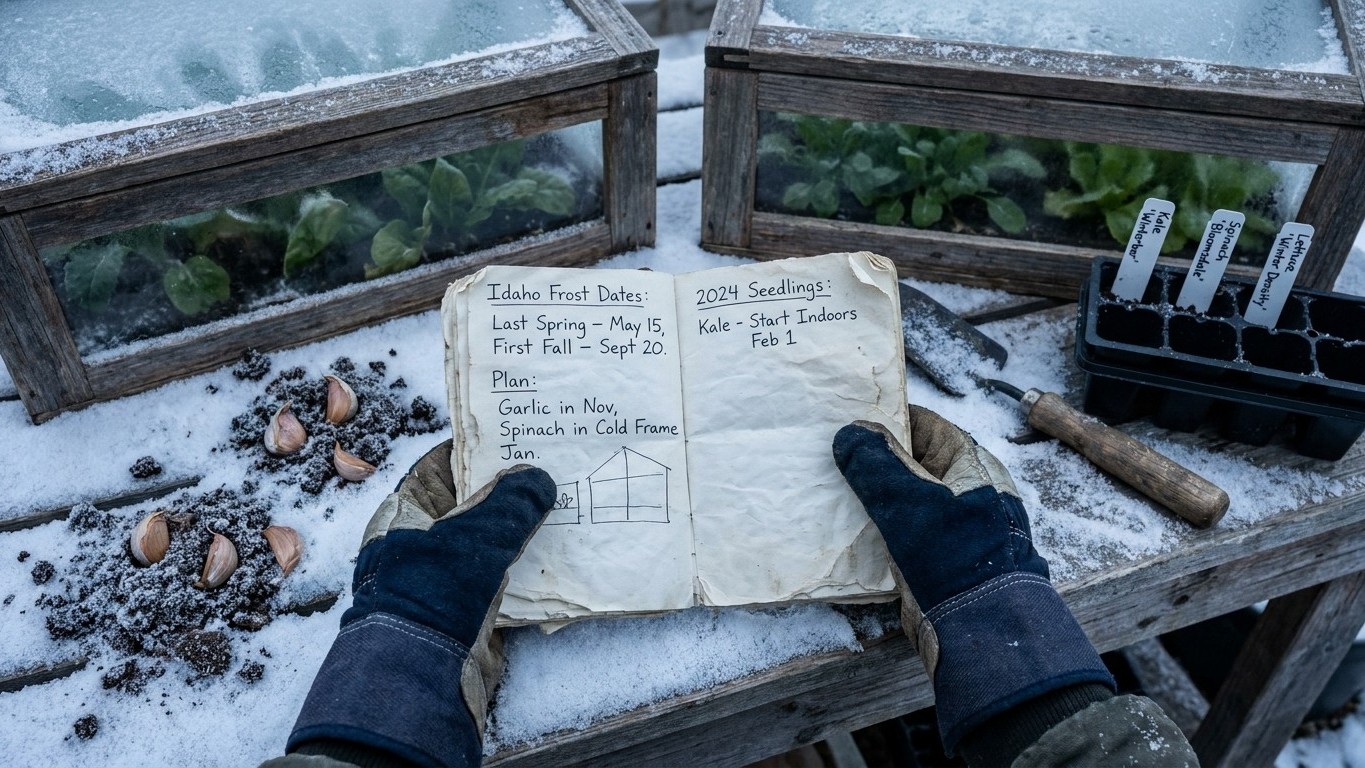

January in Idaho means frozen ground almost everywhere, so open-air planting is off the table for most of the state. What actually moves the needle this month is dormant work: garlic already tucked in from fall, cold frames holding hardy greens, seed starting indoors counted backward from your local frost window, and pruning and planning that decide how the whole season runs.
What goes in the ground in January

The decision here never comes from a calendar page. It comes from soil temperature and the frost window, and in January those two things agree on one answer across nearly all of Idaho: not yet. In Boise, the last spring frost typically falls between April 23 and May 7, and the first fall frost lands between October 7 and October 21, based on NOAA’s 1991-2020 climate normals for station USW00024131. That gives the valley floor a growing season of roughly five to six months. January sits at the far, cold end of that window, and Boise is the mild end of Idaho. Higher elevations, mountain valleys, and the Panhandle run colder and shorter than these numbers suggest.
The USDA Plant Hardiness Zone Map places Idaho anywhere from zone 3b to zone 7b, a spread wide enough to mean two gardens three hours apart can be living in different climates. Boise sits toward the milder end of that range; a garden up near McCall or in the high desert of eastern Idaho is much closer to zone 3b, where the ground stays locked up longer and the safe planting window starts later.
What is actually possible this month
Say plainly what does not belong on this month’s list: no tomatoes, no beans, no squash, nothing tender goes into open soil in January anywhere in Idaho. What does work:
- Garlic and shallots, if they went into the ground in fall and are mulched, can sometimes still be tucked into workable soil in the mildest valley pockets, though this is the exception, not the rule
- Cold frames and low tunnels protecting spinach, kale, or mâche that were established before winter set in
- Bare-root fruit trees and cane fruit, ordered now for planting once soil thaws
- Rhubarb crowns and Belgian endive roots, dug and forced indoors in a dark, cool space for an early harvest
None of that is a consolation prize. It is the actual work of the month.
What to start under cover
Seed starting in January is arithmetic, not habit. Count backward from your local last-frost range rather than from a date on a calendar. For a Boise-area garden with a last frost between April 23 and May 7, onions and leeks started from seed need roughly ten to twelve weeks of indoor growing before they go outside, which puts a January start right on schedule. Peppers, at eight to ten weeks, are also fair game now. Tomatoes, at six to eight weeks before transplant, are borderline this early in most of Idaho; starting them now for a Boise garden usually means leggy, rootbound plants sitting in trays for weeks longer than they should, waiting for soil to warm.
Gardens at higher elevation or farther north face the opposite risk if they wait. A short growing season punishes late starts hard: a gardener near a high-elevation valley who starts peppers in March instead of January may simply run out of frost-free days to bring a crop to harvest before the first fall frost returns in early to mid October.
Both failure modes are worth naming because they pull in opposite directions. Starting too early wastes indoor space and stresses seedlings that outgrow their pots before the ground is ready. Starting too late means a plant that needed twelve weeks to reach transplant size gets six, and never really catches up. The fix in both cases is the same: work out your own frost window first, then count backward, rather than starting on a fixed date every household in the state supposedly shares.
What is ready to pick
Outdoors, the honest answer is close to nothing. That is not a failure of the garden; it is what a January garden in a zone 3b-7b state looks like. What still puts food on the table:
- Kale, leeks, and Brussels sprouts left standing under snow cover, often sweeter after hard cold, dug or cut as needed when the ground allows access
- Spinach, mâche, and other cold-frame greens, harvested a few leaves at a time rather than all at once
- Sprouts and microgreens grown indoors on a windowsill, ready in one to two weeks from seed and a genuine source of fresh greens when nothing outside is moving
The other harvest this month happens in the root cellar or pantry, not the garden bed. Stored squash should be checked weekly: any soft spot, wrinkled skin, or sweet fermented smell means it is on the way out and should be used first, not saved for later. Potatoes need the same check for sprouting eyes and soft, dark patches; pull and use those before they spread rot to the rest of the bin. Onions that have gone soft at the neck or started sprouting green shoots are past their storage life. None of this is glamorous work, but a five-minute check through storage crates now is the difference between eating well through the rest of winter and losing half a harvest to rot no one noticed.
The jobs that matter this month
Dormant pruning is the single biggest job on the January list, and timing is not flexible. Apple, pear, and stone fruit trees, along with raspberry and blackberry canes, should be pruned while fully dormant and before buds begin to swell. Pruning too late, once sap is moving, stresses the plant and invites disease into fresh cuts; pruning now, while the wood is asleep, is the lowest-stress moment of the year to do it.
Seed ordering belongs on this month’s list for a practical reason: the varieties bred for short seasons and cold nights, the ones that matter most in a zone 3b or 4 Idaho garden, are also the ones that sell out first. Ordering early is not enthusiasm, it is inventory management.
Soil, tools, and structure
A soil test sent to a lab now comes back with results well before spring planting decisions need to be made, giving time to source and apply lime or amendments before the ground is workable. Compost piles need turning even in cold weather to keep them from going anaerobic and stalling out. Tools benefit from a real cleaning and sharpening session while there is no pressure to be outside using them. And any raised bed frame or section of fencing that took damage from snow load or freeze-thaw cycling is far easier to repair now, while nothing is planted, than in April with seedlings already in the ground.
Rotation planning also happens now: mapping which beds grew tomatoes, brassicas, or alliums so this coming season’s plantings move to different ground and avoid the disease buildup that comes from growing the same family in the same soil year after year.
What not to do in January
The most common mistake this month is starting warm-season seeds too early because a mild stretch of weather feels like a preview of spring. It is not. A run of 50-degree days in January says nothing about the soil temperature in April, and tomato or pepper seedlings started six weeks too soon end up rootbound and stressed long before the actual transplant date arrives.
A close second is uncovering cold frames or removing mulch after a warm spell, only to have a hard freeze move back in and kill growth that had just been coaxed into tender new leaves. Cold frames exist precisely to buffer these swings; opening them up on the one mild afternoon defeats the purpose.
Feeding nitrogen to dormant plants or lawns is a third recurring error. Dormant plants are not using that nitrogen for growth, and fertilizer applied to frozen or waterlogged soil is far more likely to wash away in runoff than to do anything useful once things wake up. Fertilizing has a season, and this is not it.
Last, walking or working on frozen or saturated garden beds compacts soil in a way that takes a full season of amendment to undo. If a bed is frozen solid or squelching underfoot, the better move is to stay off it and find the January job that does not require standing on it.
Checking this against your own county
Every number in this article is a starting point, not an instruction for your specific yard. The Boise frost dates cited here come from a low-valley weather station; a garden at higher elevation, in a mountain valley, or in the Panhandle can run weeks colder on either end of the season, and lake effect near larger bodies of water shifts things further still. Idaho’s zone 3b-7b hardiness range is not one climate, it is at least four or five distinct ones stacked across the state.
The most reliable next step is University of Idaho Extension, which publishes county-level guidance and a state planting calendar built around local conditions rather than a single statewide average.
Common questions
Can I still plant garlic in Idaho in January?
Garlic is normally a fall-planted crop that overwinters in the ground. If it went in before the ground froze, no action is needed until spring. If it was missed entirely, the ground is generally too cold to plant now in most of the state, and it is better to wait for a spring-planted variety or try again the following fall.
What USDA hardiness zone is Idaho?
Idaho spans USDA zones 3b to 7b, according to the USDA Plant Hardiness Zone Map. Boise sits toward the milder end of that range; mountain and high-desert areas run much colder, closer to zone 3b or 4.
When is the last frost date in Idaho?
For Boise, NOAA’s 1991-2020 climate normals put the last spring frost between April 23 and May 7. That figure comes from a low-valley station; higher and more northern parts of Idaho typically see frost persist later into spring.
What can I start indoors in Idaho in January?
Onions and leeks, which need roughly ten to twelve weeks before transplanting, are well suited to a January start for most of the state. Peppers, needing eight to ten weeks, also fit. Tomatoes are often better started slightly later to avoid leggy, rootbound plants by transplant time.