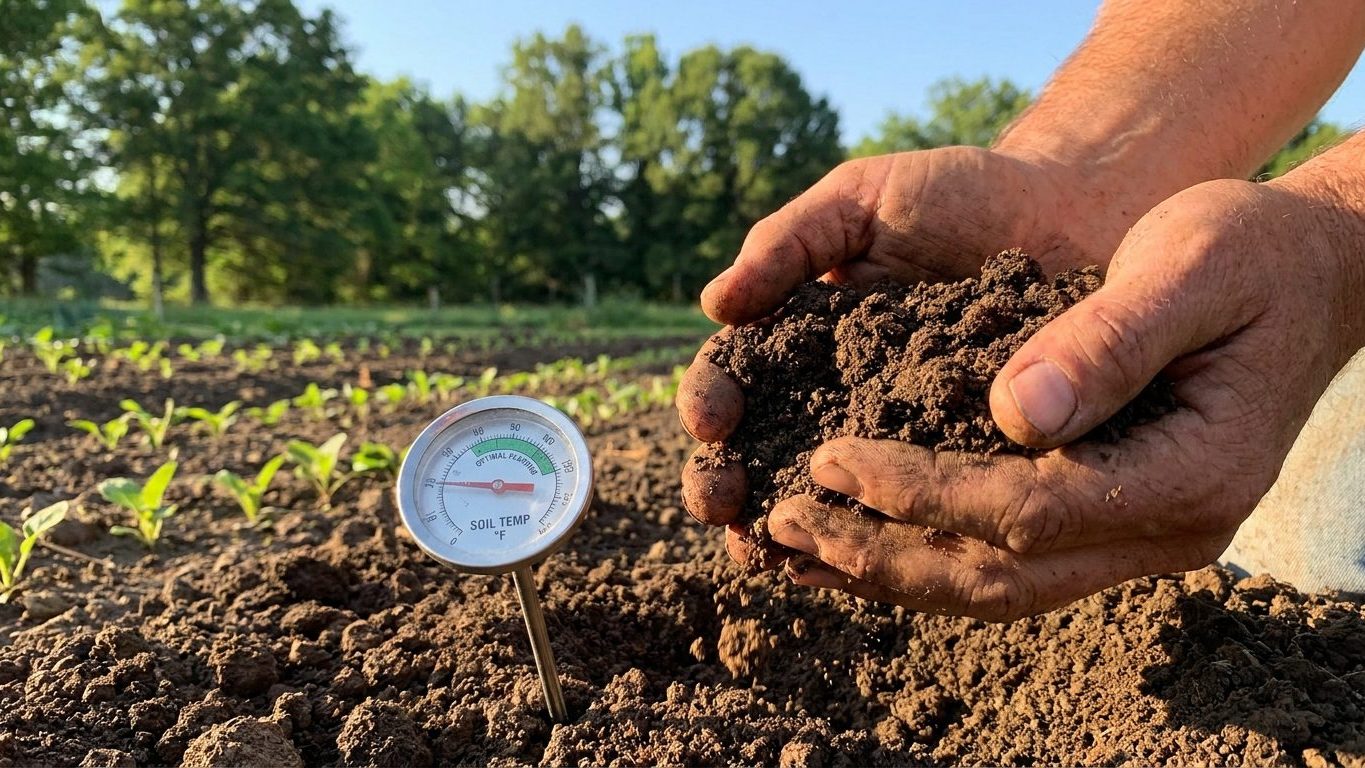

Winter Squash in Ontario goes into the ground once the soil has warmed past the average last frost, which Environment and Climate Change Canada places at April 30 for the Toronto area. The growing window that follows runs roughly 169 days, plenty for full-season types, but heat is scarce and rain is the default, not the exception.
When the soil is warm enough in Ontario

Gardeners ask for a date, but soil temperature is what winter squash actually responds to, not a number on a calendar. Environment and Climate Change Canada’s Canadian Climate Normals (1981-2010) put the average last spring frost at the Toronto Lester B. Pearson International Airport station at April 30. That figure is a mean, not a promise: in roughly one year out of two, frost arrives after that date. Treat it as the midpoint of a risk window rather than a green light.
Frost is also only a proxy for what matters, which is soil warmth several inches down. Squash seed sown into cold, wet soil rots or sits dormant for weeks while slugs find it. Waiting a week or two past the average last frost, until the soil itself has lost its spring chill, does more for germination than watching the sky for one more cold night. Direct-sown seed and transplants both benefit from that patience, though transplants let a gardener get a head start indoors while the ground outside is still catching up.
The Toronto station is a reference point, not a forecast for every backyard in the province. Ontario spans a lot of ground between the Niagara Peninsula and the districts north of Georgian Bay, and inland, upland or northern gardens routinely lag the reference station by one to three weeks. A garden near a large lake often runs milder in spring than one twenty miles inland, because the water buffers temperature swings. None of that shows up in a single provincial date, which is exactly why the Toronto normal should be read as a starting estimate to adjust against local experience, not a rule to apply everywhere.
Ontario sits in Canadian Plant Hardiness Zone 7a at the reference city used for these figures, according to Natural Resources Canada’s Plant Hardiness Site. That number is worth flagging clearly: it is not a USDA zone, and the two systems don’t convert directly. The Canadian system draws on seven climate variables, the USDA system on one, and NRCan itself notes that a single Canadian zone can overlap nine different USDA zones. Anyone comparing Ontario to a US state on this site should compare frost dates and heat data, not zone numbers, since the zone label alone tells a different story depending on which system produced it.
Skip pesticide brand names and application rates when reading seed-starting advice online. The practice that matters here, whatever the source, is timing sowing to soil temperature and thinning seedlings early, not any particular product on the shelf.
How long the season lasts here
Subtract the two average frost dates from Environment and Climate Change Canada’s normals and the frost-free window comes out to about 169 days, from April 30 to October 16. That is a genuinely long season by northern-garden standards, and it changes what’s worth attempting, not just when to start.
A window that size gives winter squash room to mature fully on the vine, which is non-negotiable for this crop: an immature fruit at frost neither cures properly nor stores through winter, so the season has to run its full course rather than being cut short. With close to six months between the two mean frost dates, most full-season types have enough time to flower, set fruit and finish curing on the vine before the average October 16 frost arrives, provided the sowing happens promptly once soil has warmed rather than being delayed into late May or June.
That length also opens the door to succession sowing for gardeners growing more than one squash type, or stretching harvests of quicker crops that share the same bed earlier in spring. The general logic of staggering sowing dates to spread out harvest, and to hedge against a bad week of weather at any one planting, is covered in more detail in this site’s succession sowing guide, which applies the same reasoning across territories with different window lengths.
Where the window runs shorter, the first sowing effectively becomes the only sowing, and transplanting versus direct seeding becomes a bigger decision, because winter squash resents root disturbance and a poorly timed transplant can lose a week it doesn’t have. Ontario’s roughly 169-day average window is generous enough that this tradeoff matters less: a gardener has room to direct-sow, to replant if an early planting fails, or to start seed indoors for an earlier harvest without much risk of running out of season. The caution from the frost dates still applies, though. Both April 30 and October 16 are averages, so a planting plan built on either date as a certainty, rather than a midpoint, is the plan that gets caught out in the years the frost runs late in spring or early in fall.
Heat and water in Ontario

Heat load, not just season length, decides how a squash crop actually performs, and by that measure Ontario is not a hot-climate territory. The Canadian Climate Normals for the Toronto reference station record 0.0 days a year at or above 90°F. That is not a rounding artifact; it means the summer heat spikes that drive heavy water demand and heat stress in warmer US territories essentially don’t happen here on average.
What replaces heat stress as the concern is the opposite problem: a cool, damp summer slows ripening and creates conditions where mildew and other fungal disease take hold on squash leaves and vines. Summer rainfall averages about 8.9 inches across June, July and August, broken down as 2.81 inches in June, 2.98 inches in July and 3.07 inches in August, according to the same Environment and Climate Change Canada normals. That is a fairly even, moderate rainfall pattern rather than a dry summer needing regular irrigation, and it means the more common failure mode in Ontario squash beds is foliar disease and slow fruit development, not drought stress.
Airflow between plants, morning sun to dry dew off the leaves quickly, and avoiding overhead watering late in the day all matter more here than any irrigation schedule. A gardener moving advice from a hot, dry US state, where the priority is keeping soil moisture up through consistent watering, should recalibrate: in an Ontario summer with close to 9 inches of rain and no reliable 90°F days, the priority flips toward managing excess moisture and giving vines room to breathe, not compensating for heat.
None of this means Ontario summers are uniformly mild or wet. Rainfall normals are averages at one reference station, and any single season can run drier or wetter, just as a particular garden’s soil type changes how far that rainfall actually goes: clay holds water for a week where sandy soil lets the same rain drain through in a day. A rain gauge on the actual plot, over a season or two, tells a gardener more than the regional average ever will, but the average is still the right starting assumption when nothing else is known.
Which winter squash suit Ontario
Ontario’s numbers point toward earlier-maturing types over long-season ones, and toward disease resistance over drought tolerance. With no meaningful stretch of 90°F-plus days and a frost-free window averaging about 169 days rather than 200 or more, the types that finish reliably are the earlier-maturing squash categories, not the ones bred for the longest, hottest growing seasons in the country. A grower who wants to push toward a longer-season type is working against both the calendar and the climate here, and should expect to lean on transplants and season-extension tricks rather than a straightforward direct-sown planting.
The rainfall and humidity pattern makes disease resistance the more urgent selection criterion than it would be in a dry territory. Types and seed lines bred or selected for resistance to common vine and foliar diseases hold up better through a wet Ontario summer than ones chosen purely for size or storage length. Spacing plants for airflow, and choosing resistant stock where it’s available, does more practical work here than any spray program.
This is also the point where a general guide has to stop short of naming a specific variety, and that limit is deliberate, not an oversight. Seed catalogs and provincial extension programs test squash varieties under actual Ontario conditions across multiple seasons, tracking which ones actually mature, resist disease and yield reliably at specific research stations and demonstration gardens around the province. That kind of trial data, tied to real growing seasons and real disease pressure, is the only recommendation worth trusting, and it belongs to Ontario’s Ministry of Agriculture, Food and Rural Affairs, not to a general climate comparison page. A cultivar name dropped in without that local trial history is a guess dressed up as advice, and it’s usually the first thing an experienced gardener spots as wrong.
The useful next step, then, is straightforward: pick a type category based on the season length and disease pressure laid out here, then check the province’s current variety trial results or a local seed supplier’s Ontario-tested list before choosing the actual seed packet.