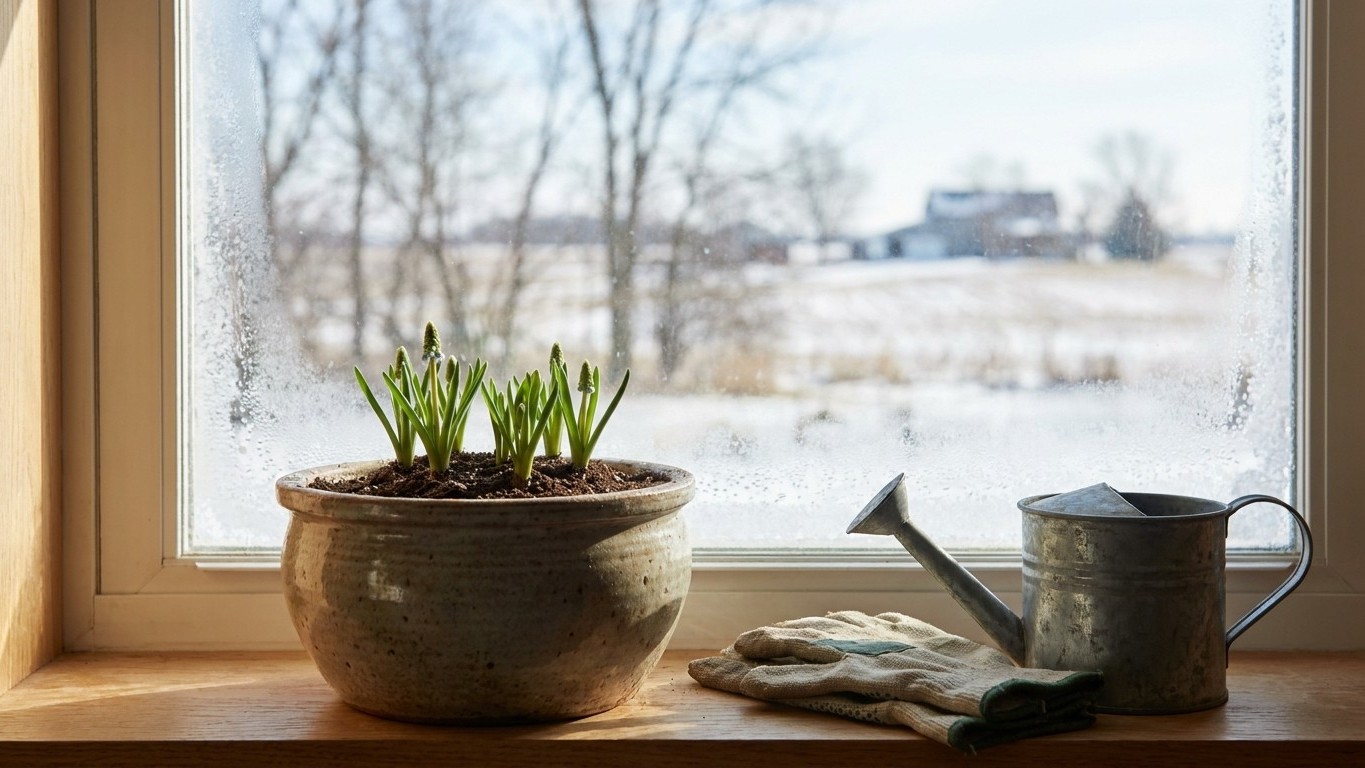

Forcing spring bulbs indoors means chilling them artificially so they bloom weeks before their outdoor season would ever start. In Illinois, that’s not because winter here fails to deliver cold: it delivers plenty. The point of forcing is timing indoor bloom to your own calendar, and protecting potted bulbs from a freeze that behaves very differently than a freeze in the ground.
Why this matters in Illinois

Start with the number that actually decides this: 18.8°F, the average nightly low for the coldest month at the Chicago reference station (NOAA NCEI Climate Normals, 1991-2020). A spring bulb needs roughly twelve to fourteen weeks below 45°F to flower properly. At 18.8°F average overnight lows, Illinois ground is nowhere near short on that requirement. This is not a territory where forcing exists to make up for a mild winter that never gets cold enough. Bulbs planted in the ground here get more chill than they need, for longer than they need it.
So why force bulbs at all in a state this cold? Two reasons, and they’re different problems. The first is simple preference: forcing lets you have hyacinths or crocus blooming on a windowsill in the dead of winter instead of waiting for the ground to thaw. The second is the one that actually trips people up, and it’s about containers, not the ground.
A bulb bed in the soil freezes from the top down. The soil mass below insulates the bulb, and even in a hard Illinois winter, roots several inches down rarely see the full brunt of that 18.8°F air temperature. A bulb in a pot has no such protection. Cold reaches it from every side at once, root ball included, so a pot left outside can freeze solid clear through while a bed six feet away stays workable a few inches down. That’s the mechanism that matters here: the USDA Plant Hardiness Zone Map places Illinois across a 5a-7b range (USDA Plant Hardiness Zone Map, 2023, based on 1991-2020 normals), and a bulb rated hardy for that zone in the ground can still die in a pot in the same zone, because the pot exposes it to a colder effective condition than the map was built to describe. That range spans the whole state, from the Chicago area toward the state’s northern edge down to warmer stretches in the south, so a gardener near Chicago and one near the southern tip are not managing quite the same outdoor risk, even though both face the same container problem.
That’s the practical split worth carrying into the rest of this: in-ground bulbs in Illinois already get their chill for free. Forcing here is a choice about bloom timing and container management, not a rescue from a mild winter.
How to do it here
The steps below assume you’re forcing bulbs in containers for indoor bloom, which is the situation that actually applies in this state. Each step is something you can check yourself, without guessing.
- Pot bulbs in fall, in containers with real drainage holes, using a well-draining potting mix. Set bulbs with their tips just at or slightly below the soil surface, close enough together that they nearly touch but aren’t stacked.
- Water once, thoroughly, until it runs out the drainage holes, then let the surface dry slightly before moving the pot to cold storage.
- Choose your cold spot. An unheated garage works in most of Illinois as long as it stays reliably above freezing; a spot that dips well below 32°F will freeze the pot through, given how cold the outside air already runs in the coldest month here. A refrigerator crisper drawer is the other standard option, and it’s more reliable because the temperature doesn’t swing with the weather.
- Keep the refrigerator drawer away from ripening fruit. Apples, pears, and bananas give off ethylene gas as they ripen, and ethylene damages the flower bud developing inside the bulb. A bulb chilled next to a fruit bowl can leaf out with no flower at all.
- Hold the cold for the full period your bulb type requires, checking the tag or supplier information for the specific number of weeks, and don’t cut it short because the pot looks ready. The flower bud finishes forming late in the chilling period, not at the start.
- Check for readiness by looking for roots showing at the drainage holes and pale shoots an inch or two tall pushing up through the soil.
- Move the pot to a cool, bright room first, not straight to a warm, sunny spot. A few days of indirect light lets the stem lengthen before the leaves and flower push into full growth.
- Water as the soil dries and move to a warmer, brighter spot once growth is underway. Bloom typically follows within a few weeks of that final move.
If you’d rather leave potted bulbs outdoors through winter instead of forcing them indoors, the container needs to be treated as roughly two hardiness zones colder than the bulb’s rating, or moved into an unheated but enclosed space and mulched heavily. Given the 5a-7b range across Illinois, that’s not a step to skip.
Which bulbs are worth it
Some bulbs force easily because their chilling requirement is short or their stems stay low and sturdy in a pot. Others fight you the whole way, either because they need a longer, undisturbed cold period than a home refrigerator schedule allows, or because their stems grow tall and top-heavy without the wind resistance and root anchoring they’d get outdoors.
It’s also worth remembering that several of the most reliable forcing bulbs, paperwhites especially, aren’t hardy in Illinois ground anyway. They were never going to survive a winter here outdoors, so forcing them indoors costs nothing in terms of a bulb you’re giving up for future years. You were buying a one-season bloom either way.
Force reliably here
- Paperwhite narcissus (needs no cold period at all, blooms fastest of any common option)
- Hyacinths
- Crocus
- Grape hyacinth (muscari)
- Dwarf iris (Iris reticulata)
- Species and short-stemmed tulips
Sulk or disappoint
- Large trumpet daffodils (tall stems flop without outdoor wind resistance)
- Darwin and other tall hybrid tulips (top-heavy indoors)
- Fritillaria imperialis (long, uninterrupted cold requirement that a home fridge cycle rarely matches)
- Ornamental alliums (height makes them unstable in a pot)
What goes wrong, and when you can still fix it
Leaves but no flower
This means the cold period was cut short, and the flower bud inside the bulb never finished forming before growth started. Once leaves are up without a bud, there’s no adding the missing weeks back into that cycle; the bulb has moved on to vegetative growth. It isn’t fixable this season. Note the shortfall and give the same bulb type the full recommended chilling period next time, checking the tag rather than estimating.
Flower on a stem too short to see
This one happens when the pot moved from cold storage straight into a warm, bright spot instead of a cool transitional one. The flower bud was ready, but the stem never got the few cool, dim days it needs to elongate before growth accelerates. The bloom still opens, just low and half-hidden in the foliage. Nothing to do for that pot this season beyond enjoying it as is; next round, hold the pot in a cool, indirectly lit room for several days before moving it to full brightness and warmth.
Rot in a pot
Soft, mushy bulbs or moldy soil mean water sat around the roots instead of draining through. If you catch it early and the bulb still feels mostly firm, repotting into fresh, well-draining mix after trimming away the soft tissue can sometimes save it. Once a bulb has gone fully soft and dark, it’s finished, and no amount of drying out brings it back. Either way, the fix for next time is the same: a pot with functioning drainage holes and a mix that doesn’t stay soggy between waterings.
Related guides
- Growing Spring Bulbs in Containers in Illinois
- Forcing Spring Bulbs Indoors in Indiana