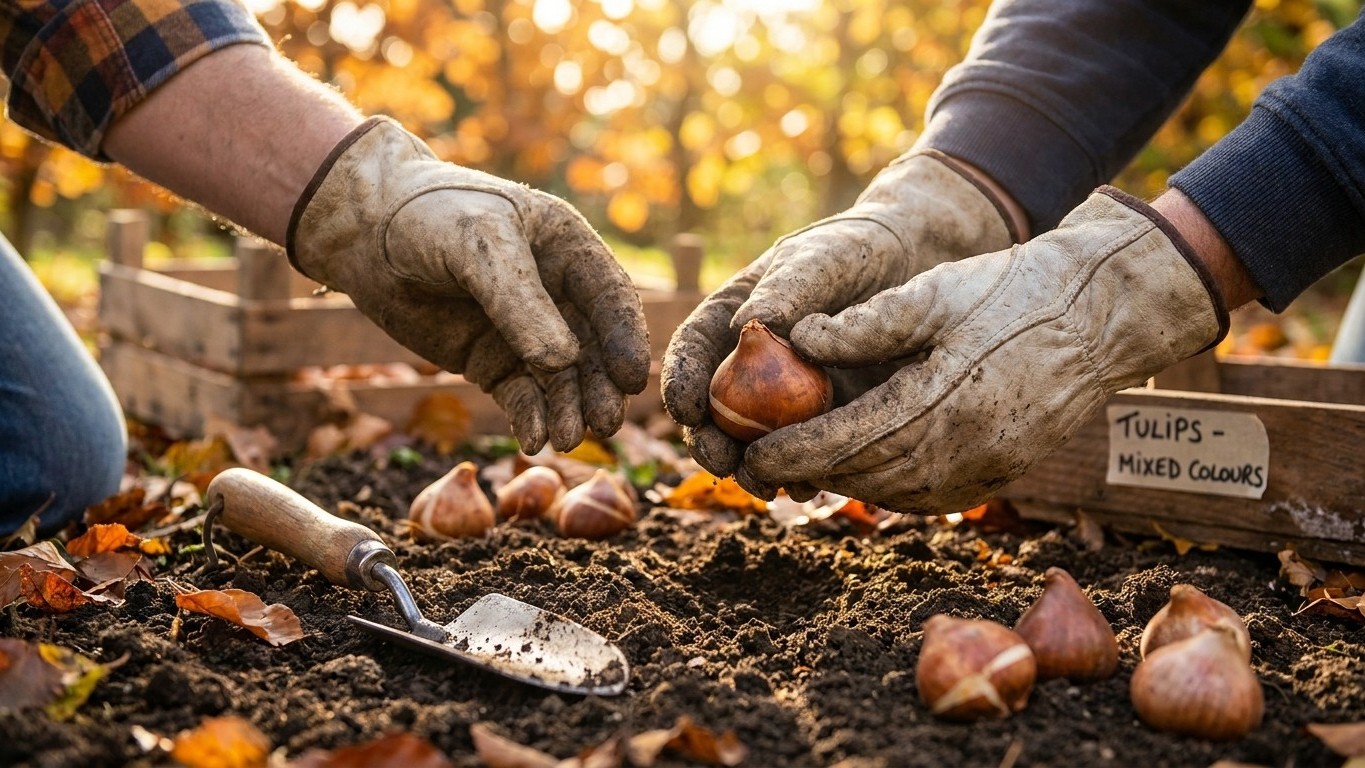

Illinois gardeners get one real question before they touch a trowel: is the winter here cold enough, long enough, for the bulb in hand to actually flower next spring? The state clears that bar for most classic bulbs with room to spare, but not for all of them, and knowing the difference before you plant saves you a wasted bag of tulips.
When to plant bulbs in Illinois

The planting window in Illinois runs roughly from mid-September through late October, closing hard around the average first fall frost, which lands between October 24 and November 3 at the Chicago reference station (NOAA NCEI 1991-2020 Climate Normals). The rule of thumb extension offices use is to get Spring Bulbs in the ground about six weeks before the soil freezes solid, which in most of Illinois means starting the job while the calendar still says “fall,” not waiting for a cold snap to remind you.
Plant too early, while soil temperatures are still sitting in the 60s, and a bulb can push soft top growth before winter arrives. That growth gets killed back by the first hard freeze, and the bulb spends energy recovering instead of building the root system it needs to flower well. Plant too late, after the ground has already begun to lock up, and the bulb goes in without enough time to root. It may still send up a leaf or two in spring, but the flower is often stunted or absent entirely, because rooting, not the cold itself, is what the bulb needs that six-week window for.
A date you can plan around, not depend on
That October 24 to November 3 frost date is an average pulled from thirty years of records. Half of all years fall on one side of it, half on the other, which means in any given season your actual first freeze could show up two weeks early or two weeks late. Suburban and rural gardens away from the Chicago airport weather station typically see frost arrive even earlier, sometimes by a week or two, and more at higher elevation. Treat the window as a planning tool, not a guarantee, and lean toward planting on the earlier side if your fall has already turned cool.
Soil temperature is the better guide if you want to be precise. Once the soil at a 6-inch depth consistently reads in the 40s and 50s, most spring bulbs are ready to go in. A simple soil thermometer, the kind sold for compost piles, does the job better than watching a calendar. If your bulbs miss that outdoor window entirely, Forcing Spring Bulbs Indoors in Illinois is a reliable fallback for getting blooms anyway, and Growing Spring Bulbs in Containers in Illinois offers another way to sidestep timing issues with your garden soil altogether.
Whether your winter is cold enough
This is the question that decides whether a bulb blooms at all, and it gets skipped more often than it should. A spring bulb is not just a seed with a head start. It is a storage organ that needs a sustained cold period to trigger flowering, and most spring-blooming bulbs require somewhere between twelve and fourteen weeks with soil temperatures below about 45F. Skip that exposure, or cut it short, and the bulb typically responds by growing leaves with no flower, or a flower bud that never clears the soil line on a stem too short to see.
Illinois measures up well against that requirement. The mean daily minimum for the coldest month, taken at the Chicago reference station, is 18.8F (NOAA NCEI Climate Normals 1991-2020), and the state spans USDA Hardiness Zones 5a to 7b. Winter here runs long enough, and cold enough, that the standard fourteen-week chill period is met with weeks to spare across nearly the entire state. That margin means most gardeners never need to think about pre-chilling: the ground does the work.
Where the margin narrows is in the southern tip of the state, near Zone 7b, where winters are shorter and milder. Bulbs with a higher chill requirement can still come up short there in an unusually warm winter, and gardeners in that stretch of Illinois are the ones who benefit most from choosing varieties with a shorter cold requirement or from pre-chilling anything borderline.
| Bulb | Weeks of cold required | What Illinois delivers | Verdict |
|---|---|---|---|
| Tulips (Tulipa) | 12-16 weeks below 45F | 14+ weeks across most of the state | Reliable statewide; borderline in the far south in mild years |
| Daffodils (Narcissus) | 12-15 weeks below 45F | 14+ weeks across most of the state | Reliable statewide |
| Hyacinths | 12-14 weeks below 45F | 14+ weeks across most of the state | Reliable statewide |
| Crocus | 8-15 weeks below 45F | 14+ weeks across most of the state | Reliable statewide |
| Alliums | 8-10 weeks below 45F | 14+ weeks across most of the state | Reliable statewide, easily met |
If a bulb ever falls short of what a given winter delivers, the fix is a refrigerator, not a greenhouse. Pre-chilling means storing bulbs at 35F to 45F for the full twelve weeks before planting, and it has to happen away from ripening fruit. Apples, pears, and other fruit release ethylene gas as they ripen, and ethylene damages the flower bud already formed inside a chilling bulb, so a crisper drawer shared with produce can undo the whole process. For nearly all of Illinois, though, this step is unnecessary. Planting tulips or daffodils where the ground can’t deliver their chill is money wasted; planting them here, on the standard fall schedule, is not a gamble at all.
Which bulbs suit Illinois
The bulbs below have hardiness ranges that cover Illinois’s Zone 5a-7b span and cold requirements the state’s winter satisfies without help:
- Daffodils (Narcissus), hardy zones 3-8
- Tulips (Tulipa), hardy zones 3-7
- Crocus, hardy zones 3-8
- Hyacinths, hardy zones 4-8
- Alliums, hardy zones 3-8
- Grape hyacinth (Muscari), hardy zones 3-8
- Fritillaria, hardy zones 3-8
None of these ranges are a hard line drawn in the dirt. A tulip rated to zone 3 will generally sail through an Illinois winter without effort, but a bulb sitting at the warm edge of its range, or planted in a low spot where cold air pools and water collects, behaves differently than the same bulb in a raised, sheltered bed. Microclimate moves the outcome more than the map does.
What disappoints here, and how
Tender, tropical-origin bulbs are the ones that let Illinois gardeners down, and they do it in a specific way. Ranunculus, anemone (Anemone coronaria), and freesia are rated to roughly zones 8-10, well south of anything Illinois offers, and left in the ground over winter they rot outright rather than surviving weakened. Gardeners who want these have to treat them as annuals, planting in spring and either digging them up in fall or writing them off.
Tulips carry a different, quieter failure. In heavy clay soil that stays wet through winter, bulbs rot before the cold ever gets the chance to do its job, which is why well-drained soil or a raised bed matters more for tulips here than the temperature does. And tulips as a group are notorious for a strong first-year show that fades in years two and three, particularly in the state’s warmer southern counties, so treating them as a multi-year investment rather than a permanent planting is the realistic approach.
What digs them up here
Squirrels and voles are selective, and the pattern comes down to chemistry rather than chance. Daffodils and members of the onion family, including alliums, contain compounds that make them bitter or mildly toxic to rodents, so they get left alone in the ground almost without exception. Tulips and crocus carry no such defense. Both are genuinely palatable to squirrels and voles, and a freshly planted bed of either is treated like a buffet unless something intervenes.
- Bulbs squirrels and voles dig up: tulips, crocus
- Bulbs squirrels and voles leave alone: daffodils, alliums, hyacinths, grape hyacinth (Muscari), fritillaria
The one measure that consistently works is physical, not chemical: lay galvanized wire mesh flat over the planting bed, pinned down at the edges, and leave it in place until the ground freezes. Rodents can’t dig through it, and once the soil is frozen solid the bulbs are no longer worth the effort. Repellent sprays and granules made from capsaicin or predator urine are sold widely for this problem, but they wash off with the first rain or heavy dew and need reapplying constantly to do anything at all, which makes them a poor match for a fall planting window that runs six weeks or more.
Where to check for your own county
Every figure above, the frost dates, the coldest-month minimum, the hardiness zone, comes from the Chicago reference station, and Illinois stretches across roughly five and a half degrees of latitude and three USDA hardiness zones. A planting window built around Chicago’s fall frost date can run two to three weeks off the mark by the time you reach the far southern counties near the Kentucky border, where the growing season runs longer and the ground stays workable well into November.
The University of Illinois Extension maintains county-level offices across the state, and they’re the source to check before finalizing a planting date, especially if you garden anywhere outside the Chicago metro area. A county extension office can confirm local frost timing, soil conditions, and which bulb varieties perform best in that specific corner of the state, details no statewide average can capture with real precision.