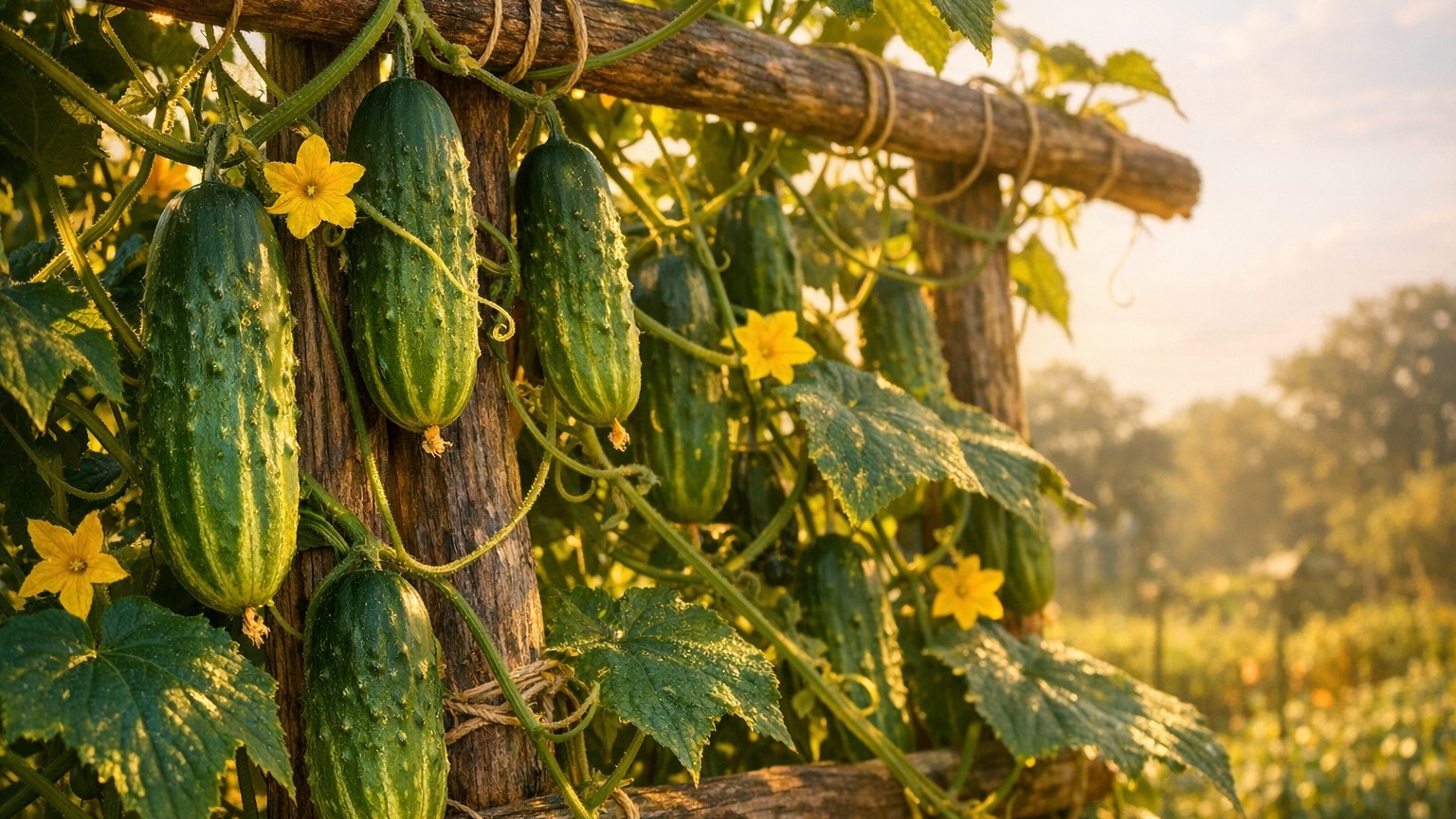

Illinois gardeners don’t need to chase exotic cucumber types. With a frost-free window running from mid-to-late April through late October, and only about two weeks a year above 90F, the decision comes down to matching a type (bush, vining, pickling, slicing, parthenocarpic) to your space and your summer’s humidity, not to whether the state’s season is long enough.
The short answer for Illinois
Start with the math. NOAA’s 1991-2020 normals put the last spring frost at the reference station between April 11 and April 22, and the first fall frost between October 24 and November 3. That’s a frost-free stretch of roughly 185 to 206 days, depending on the year. Cucumbers need only a fraction of that to fruit. So the real question isn’t length of season, it’s which type suits how you’ll use the harvest and how you’ll manage the state’s summer humidity.
Illinois summers bring about 12.1 inches of rain across June, July and August, with July as the driest month at 3.71 inches. That’s not a dry-climate rainfall pattern. It means foliage stays damp longer after storms, and fungal pressure on cucumber leaves is a real factor here, more so than in a drier plains state. Heat load is moderate too: only 14.0 days a year reach 90F or higher at the reference station, so this isn’t a desert-summer garden. Types bred for extreme heat tolerance don’t buy you much; types bred for disease resistance in humid air do.
That leaves a practical split by type rather than by named variety, since the specific cultivars trialled and recommended change year to year and county to county:
| Type | Best fit | Space needed | Humidity consideration |
|---|---|---|---|
| Vining, slicing | Fresh eating, trellised gardens | Vertical support, 4-6 ft rows | Trellising improves airflow, cuts leaf disease |
| Bush, pickling | Containers, small beds, canning | 2-3 ft compact spread | Keep fruit off wet soil to avoid rot |
| Parthenocarpic | Row-cover starts, low-pollinator spots | Trellis or bush form | Fruit sets without bees, useful under early cover |
None of these categories is named to a specific brand or cultivar on purpose. The University of Illinois Extension trials and recommends specific varieties for Illinois conditions, and that’s the list worth checking before buying seed, since it changes as new disease-resistant lines get tested.
What will not work here

Certain choices fail here for specific, traceable reasons, not because they’re bad cucumbers everywhere.
First, cucumber types bred for arid, low-humidity climates (the kind of long, thin-skinned slicer marketed for greenhouse or Mediterranean growing) tend to struggle against powdery and downy mildew once Illinois’s humid air sets in after a June or July rain. With summer rainfall around 12.1 inches and a driest month still delivering 3.71 inches, leaves rarely get a long dry stretch. A cucumber selected for a climate that assumes dry air has no built-in defense against that.
Second, planting cucumbers directly on bare soil without a trellis is a bigger gamble here than it sounds. Rain splash off wet soil carries fungal spores onto the underside of leaves, and fruit sitting on damp ground rots faster in a summer averaging over 4 inches of rain in both June and August. Vertical growing isn’t cosmetic in this climate. It’s airflow management.
Third, banking on a very late second planting to stretch the harvest into fall risks running out of runway. First fall frost at the reference station falls between October 24 and November 3, and that’s the airport figure. Suburban and rural gardens away from that station typically see frost arrive one to two weeks earlier. A late-summer planting that assumes the full window to early November, rather than mid-October, can get caught by an unusually early frost, especially outside the immediate Chicago area.
Fourth, treating the state’s moderate heat load (14 days a year above 90F) as an excuse to skip watering discipline is a mistake. Rain totals sound generous on paper, but they arrive as thunderstorms that often run off rather than soak in, particularly on clay soil common across much of central Illinois. A week without rain during a stretch of 85-90F days can stress a cucumber vine faster than the seasonal averages suggest.
What changes across Illinois
Illinois is not one climate. The USDA Plant Hardiness Zone map places the state across zones 5a to 7b, a spread of five half-zones from the far north to the southern tip. That’s built entirely on average annual extreme minimum winter temperature, so it speaks to what survives a winter, not to a summer annual like a cucumber. But it’s still a useful signal: a state with that much winter-temperature range also has a comparable range in frost-free season length and summer heat load from north to south.
The frost dates and the 14-day heat count used above come from a single reference station. A garden near the southern tip of the state, closer to zone 7b territory, can expect an earlier last frost, a later first frost, and more days above 90F than a garden near the northern border, closer to zone 5a. The gap between the two ends of the state can mean several extra weeks of usable growing season and a noticeably higher summer heat load in the south.
That has real consequences for cucumber timing. A gardener in the northern third of the state should treat the April 11-22 window as optimistic and lean toward the later end, watching soil temperature rather than the calendar. A gardener farther south may be able to start earlier and add a second planting later in summer with less frost risk. The USDA map itself, searchable by ZIP code, settles that question, not a statewide average.
Where to check this for your own county
Everything above is a state-level picture built from one reference station’s climate normals. The real answer for a specific garden lives with the University of Illinois Extension, which publishes county-level guidance rather than a single statewide calendar.
Two things are worth pulling up there before buying seed. First, the local planting calendar for the specific county or region, since Illinois Extension office staff track frost data closer to the actual garden than an airport station two counties away can. Second, the list of cucumber varieties currently trialled and recommended for Illinois conditions, which reflects updated disease resistance data (particularly for the powdery and downy mildew pressure the state’s humid summers create) that a general type description can’t capture.
A county-level recommendation will always beat a state-level one. The mechanism, the frost dates, the heat load and the type categories make sense here in general terms. It has not, and cannot, name the specific variety trialled to perform best in a specific county’s soil and disease pressure this season. That’s a local extension office’s job, and it’s worth the ten minutes it takes to look it up before the seed order goes in.
Checking this against your own garden
None of the dates above beat what’s actually happening in the soil. Three observations, checked by hand and eye, tell a gardener more than any calendar figure.
- Soil warmth by feel: cucumber seed germinates poorly in cold soil. If a handful of soil at planting depth still feels cool to the touch in late April, that’s a sign the local microclimate is running behind the reference station’s average, and waiting another week costs nothing compared to a poor germination stand.
- First flush of male flowers: cucumbers typically produce several male flowers before the first female flower (the one with a tiny swelling at its base) appears. Watching for that first female flower is a better sign that fruit set is imminent than counting days since planting, especially in a cool or cloudy stretch that slows things down.
- First true leaves: the seed leaves (cotyledons) come up first, but the first true leaves, the ones that actually look like a cucumber leaf, signal the plant has settled in and started real growth. A slow gap between cotyledons and true leaves often points to soil that’s still too cool or nights that are still too cold for that spot.
Any one of these observed a week or two off from what the state averages predict isn’t a problem with the plant. It’s information about that particular yard’s microclimate, and it’s worth more than the reference-station date for planning next year’s planting.