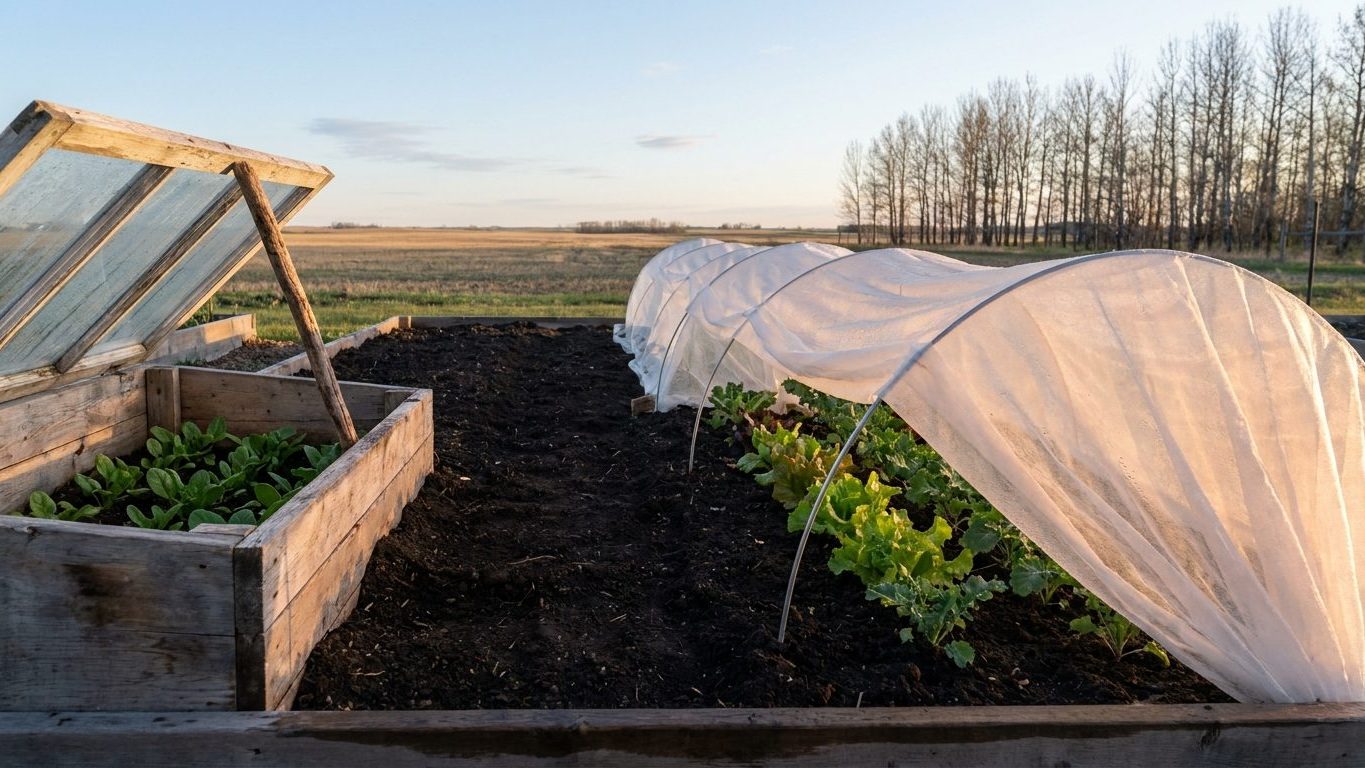

Lightweight row cover over hoops, low tunnels and cold frames handle most of what a West Virginia garden needs, and they cost little. An unheated high tunnel pays off only if you want fresh greens in January. Heated structures rarely earn their keep. The right choice depends on your goal: planting earlier in spring, stretching fall past the first freeze, or harvesting hardy greens in winter.
The short answer for West Virginia
Start with row cover and hoops, then add a cold frame if winter greens appeal to you. At the Charleston reference station, the 1991-2020 NOAA Climate Normals put the last spring freeze between April 9 and April 23. The first fall freeze falls between October 18 and November 1. Those windows mark where the odds of a 32°F freeze sit between 30 and 70 percent. Inside them, a freeze is a real possibility on any given night, and a cover is cheap insurance.
A cover works by holding a few degrees of warmth against the soil and the plants. That is enough to shift both windows by a couple of weeks, sometimes more with a tunnel. Cabbage, lettuce and peas can go out in early spring. In fall, peppers and late beans get extra time before a first light freeze. All of it is the small gain the Charleston dates leave on the table, which is why cheap tools fit.
Which season extender fits which job?
The four common options differ mostly in how much cold they hold off and how much attention they demand.
| Extender | What it does | Best job | Watch for |
|---|---|---|---|
| Lightweight row cover | Adds a few degrees, blocks light frost | Early spring transplants, fall tomatoes and peppers | Wind lifting the edges |
| Low tunnel (hoops with heavier fabric or plastic) | Adds more warmth than fabric alone | Spring starts, fall greens | Heat on sunny days, wet snow on the hoops |
| Cold frame | Traps sun heat in a fixed box | Winter spinach, lettuce, kale | Opening the lid on mild days |
| Unheated high tunnel | Shelters a walk-in space | Year-round greens, early tomatoes | Cost, snow load, humidity |
Can you garden through a West Virginia winter?
Yes, with hardy crops. The mean daily minimum of the coldest month at Charleston is 26.1°F. Nights fall below freezing in midwinter, but most of them stay in the mid-20s, which spinach, kale and mâché tolerate under a cold frame or double layer. The full picture is in Extending the Growing Season in West Virginia.
What will not work here
Tender summer crops will not carry into winter, whatever you put over them. Tomatoes, peppers and basil stop growing at the first hard freeze. Fall days are shortening by then, and the Charleston freeze window of October 18 to November 1 leaves little warmth to ripen fruit. A cover buys about two weeks of extra picking. Expecting more leads to green tomatoes in a frozen bed.
Sealed plastic with no venting is the next failure. West Virginia has humid summers and damp falls, and the same moisture hangs around in spring and fall. A closed tunnel on a sunny 60°F afternoon climbs fast, then stays wet overnight. That combination brings gray mold, downy mildew on lettuce and slugs under the fabric. Open the ends or lift the sides every mild morning and close them again before dusk.
Planting winter crops late fails for a reason that has nothing to do with cold. At Charleston’s latitude, 38.38 degrees north, midwinter daylight runs under ten hours, and growth slows to a crawl no matter how warm the cover keeps the air. Greens sown in November sit as small seedlings until February. Plan to have them near harvest size by the time the first freeze arrives. After that, the cover keeps them alive rather than making them bigger. Gardeners well north or south of Charleston should check their own latitude, since day length shifts with it.
Light hoops and flat covers also struggle in the mountains. Wet, heavy snow bends thin hoops and crushes fabric lying across them, and ridgetop wind tears loose anything held down by a few rocks. Use sturdier hoops, anchor the edges with soil or sandbags, and brush off snow after a storm.
The last mistake is applying valley dates to a hilltop. Cold air drains downhill and pools in low spots, so a garden at the bottom of a hollow can freeze when the ridge above it stays above 32°F. Higher elevations across the state freeze noticeably earlier in fall, so a gardener there should treat the Charleston dates as the outer limit, not the plan.
What changes across West Virginia
West Virginia has no single answer. The USDA Plant Hardiness Zone Map (2023 edition, built on 1991-2020 data) shows 5a to 7a across the state. That is three full zones, and the system rests on one number: the average annual extreme minimum temperature. Zone 5a sits in the high Allegheny country, and 7a sits in the warmest, lowest parts of the south and the Ohio River valley. A cold frame that is generous in one corner of the state may be marginal in another.
A reader in the northern Panhandle or at altitude should shift in three ways. First, count on an earlier fall freeze than Charleston’s October 18 to November 1 window, and start fall cover and fall planting earlier. Second, use heavier fabric or a tunnel layer where the winter minimum runs colder than the 26.1°F reference. Third, wait longer to set tender spring transplants, since the April 9 to April 23 window is a valley figure and the mountains thaw later. Treat the Charleston figures as a starting point to adjust, not a promise.
Latitude matters too. The 38.38 degrees north belongs to Charleston. The far northern end of the state sits farther north, with slightly longer summer days and shorter winter ones, and readers near the state’s edges should look up their own latitude.
To find your own zone, use the USDA Plant Hardiness Zone Map and enter your ZIP code. Zones can change across a few miles of hills, and the map handles that better than a statewide guess.
Where to check this for your own county
The best local source is West Virginia University Extension, the state’s land-grant extension service. Its county offices know local conditions, such as which hollows hold frost and which slopes warm early. Find your county office there and ask for two things: the local planting calendar and the varieties trialed in your county.
The calendar tells you when to sow and transplant for your own freeze dates, which may sit a few weeks off the Charleston ones. Variety trials are more useful still for season extension. They show which lettuces, spinach and kale hold up in your county’s winters and which hybrids bolt or rot in damp spring cover. Master Gardener volunteers attached to the county office often have notes from years of local hoop-house experience, and they answer questions by phone or email.
A county recommendation beats any statewide guidance, including the dates above. Those dates come from one river-valley station, and the state runs from low valleys to high ridges. If the extension calendar and the Charleston figures disagree, follow the calendar and use the statewide dates only as a rough frame.
Checking this against your own garden
Your own observations outrank any date on a calendar. Three of them need no tools.
- Soil warmth by feel. Push your hand two inches into the bed in the morning. If it feels cold, wait to set out transplants. A bed that warms earlier than your neighbor’s sits on a south slope or near a wall. One that stays cold is probably in a frost pocket.
- The first male squash flowers. Squash and cucumbers open male flowers a week or more before female ones. Their arrival tells you the bed is warm enough for tender crops, and how early under cover that happened compared with last year.
- The first true leaves. The first pair of leaves are seed leaves, and the true leaves come next. Seedlings that stall at that stage for weeks are in cold soil or too much shade. When true leaves appear, vent or pull the cover on mild days to harden them off.
Write down the date each of the three shows up. Two or three seasons of your own dates will tell you more than any statewide average, and they show you when to cover, as laid out in When to Cover Your Garden in West Virginia.
Common questions
Is row cover enough to grow lettuce through a West Virginia winter?
Not by itself, except in mild spots. Row cover adds a few degrees, and midwinter nights at Charleston average 26.1°F at the coldest. A cold frame or a second fabric layer over hoops gives lettuce a better chance. Higher elevations are colder, so expect slower growth and some losses.
How late can I plant fall crops under cover?
Sow early enough that plants are near harvest size before the first freeze. Radishes, spinach and lettuce are sown directly, so count the days on the seed packet from sowing. Transplants such as broccoli count from the day they go in the ground. The Charleston first-freeze window runs October 18 to November 1, and higher ground freezes earlier, so count back from your own local date.
Do I need to cover plants every night in spring?
Only on nights when the forecast is near freezing. At Charleston the last spring frost falls between April 9 and April 23, and mountain gardens freeze later. Pull covers back on sunny days, or vent them, so the plants do not overheat and the soil can warm.
Is a high tunnel worth it for a home garden?
Only if you want winter greens or very early tomatoes, and you can afford the cost and the work of venting and clearing snow. A low tunnel does most of the same work for much less money. Make sure the frame can carry West Virginia snow before you build one.