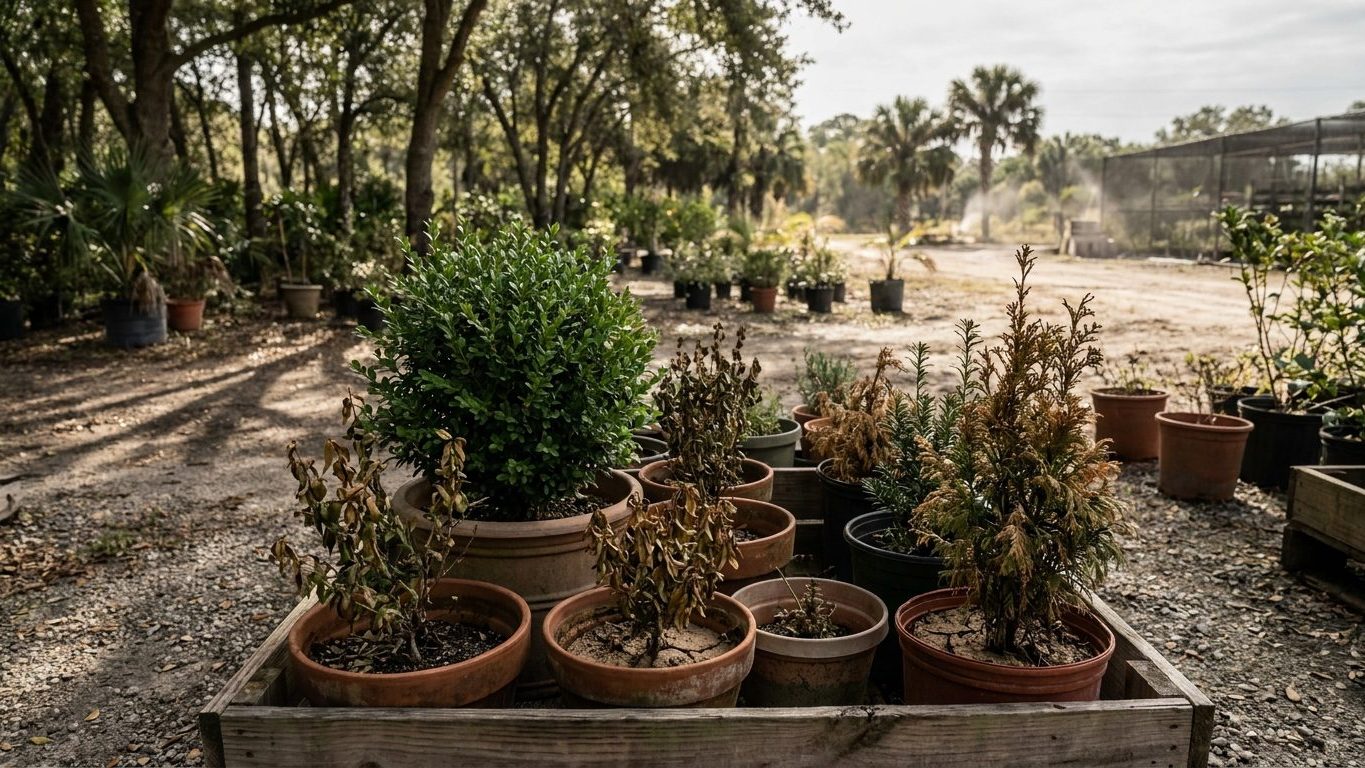

Ten of the twelve hedge plants on this site hold across all of Illinois, which runs from USDA zone 5a to 7b. Two do not. Leyland cypress and cherry laurel survive only in zones 6a through 7b, so a gardener in the colder zones can lose a whole row to one winter. None of the twelve fails everywhere. The subtler trap is that three of the twelve can never be cut back down once they outgrow their space.
What actually holds in Illinois
Start with the plants that won’t make it, because that is the half a gardener can’t afford to guess at. The zone system behind every plant tag is the USDA Plant Hardiness Zone Map (2023 edition, built on 1991-2020 normals), and it rests on a single variable: the average annual extreme minimum temperature. Illinois doesn’t sit in one zone. It spans 5a to 7b, six half-zone steps, so “hardy in Illinois” means very little until you know which end of the range your yard falls in. The USDA map lets you look it up by ZIP code, and that lookup should come before any purchase. This page belongs to a wider look at Hedges, and the same zone logic drives every state list in it.
The two that need a zone number
Leyland cypress (x Hesperotropsis leylandii) is the fast one: 3 to 4 feet a year, reaching 15 to 25 feet as a screen. It is hardy only in zones 6a, 6b, 7a and 7b. It also does not regrow from old wood, and that detail matters more than the zone limit, as the next section explains. Cherry laurel (Prunus laurocerasus) has the same zone limit, 6a through 7b, but it grows slower at 1 to 2 feet a year, tops out at 6 to 15 feet as a hedge, and does regrow from old wood. It is pruned in late spring, after flowering.
If your ZIP code lands in 5a or 5b, neither plant belongs on your list. Neighbors across state lines face different zone ranges, which is why the Hedge Plants for Michigan: What Holds, and What Only Looks Hardy and Hedge Plants for Pennsylvania: What Holds, and What Only Looks Hardy pages run on their own numbers.
Survives is not thrives
The ten that hold statewide are boxwood, American hornbeam, inkberry holly, winterberry holly, Eastern red cedar, privet, yew, arborvitae, Eastern hemlock and arrowwood viburnum. “Hold” here means the plant survives the winter minimum. It says nothing about vigor. The upper end of a plant’s range is often a heat limit, not a cold one, and a zone number can’t tell you how a plant handles a long July stretch. Expect the ten to look different from one end of the state to the other, and judge a new hedge by how it comes through its first August, not just its first January.
The hedges you can never cut back down
Three of the twelve will not sprout from old wood: Leyland cypress, Eastern red cedar and arborvitae. Cut past the green growth into the bare brown interior and the gap stays a gap. No amount of patience fixes it. A hedge that has outgrown its space can’t be cut back to the size you wanted. It can only be pulled out.
Each of the three has its own version of the problem. Leyland cypress adds 3 to 4 feet a year and is meant for 15 to 25 feet, so it outgrows a suburban property line faster than almost anything else here. Its window to prune is late spring to midsummer, and it can’t be pruned back into shape later. Eastern red cedar grows 12 to 24 inches a year, reaches 8 to 20 feet as a screen, and takes light cuts only, in late winter. Arborvitae is slower at 6 to 9 inches a year and stays within 4 to 15 feet as a hedge. It can be pruned in late winter before growth starts, or in midsummer.
The other nine forgive more. Boxwood, yew, privet, hornbeam, both hollies, arrowwood viburnum, cherry laurel and Eastern hemlock all regrow from old wood. Hemlock is the interesting case: it takes light cuts only, like red cedar, yet it does regrow, so an occasional mistake won’t cost you the plant.
The practical rule is to pick the plant whose mature size matches the space, because you can’t shrink it later. If the spot allows 6 feet, don’t plant something built for 25. Boxwood works at the opposite end: it grows only 3 to 6 inches a year, so gaining a foot takes two to four years, but it can be renovated. Privet sits in between at 2 to 3 feet a year and wants two trims a season, spring and midsummer. Some privets escape into woodlands, so ask your county extension office whether it is a problem plant near you before you plant a row.
Matching the plant to the job
Start with the calendar, because this page is being read on September 29. Look at the pruning windows in the table below: late winter, late spring, midsummer, or right after flowering. None of the twelve falls in autumn. Shearing a hedge this month isn’t on any of those calendars, so the job now is choosing and planting. For reference, the Chicago-area airport station in NOAA’s 1991-2020 normals puts the first fall freeze between October 24 and November 3, and the last spring freeze between April 11 and April 22. Suburban and rural yards usually see the last spring frost later and the first fall frost earlier, often by one to two weeks, so check your own county.
| Plant | Height | Growth a year | Prune | Regrows from old wood |
|---|---|---|---|---|
| Leyland cypress (zones 6a-7b only) | 15 to 25 ft screen | 3 to 4 ft | Late spring to midsummer | No |
| Cherry laurel (zones 6a-7b only) | 6 to 15 ft | 1 to 2 ft | Late spring, after flowering | Yes |
| Boxwood | 2 to 6 ft | 3 to 6 in | Late spring, after last frost | Yes |
| American hornbeam | 6 to 15 ft | 12 in | Midsummer, after first flush | Yes |
| Inkberry holly (evergreen) | 5 to 15 ft | 6 to 12 in | Late winter | Yes |
| Winterberry holly (leafless in winter) | 5 to 15 ft | 6 to 12 in | Late winter | Yes |
| Eastern red cedar | 8 to 20 ft screen | 12 to 24 in | Late winter, light cuts | No |
| Privet | 4 to 12 ft | 2 to 3 ft | Spring and midsummer | Yes |
| Yew | 3 to 8 ft | 6 to 12 in | Late spring, after new growth hardens | Yes |
| Arborvitae | 4 to 15 ft | 6 to 9 in | Late winter, or midsummer | No |
| Eastern hemlock | 10 to 20 ft | 12 to 24 in | Late spring, light cuts | Yes |
| Arrowwood viburnum | 6 to 10 ft | 12 to 24 in | Right after flowering | Yes |
Tall screens
For a screen of 10 feet or more, the real candidates are Eastern hemlock (10 to 20 feet, regrows), Eastern red cedar (8 to 20 feet, does not) and arborvitae (up to 15 feet, does not). If you want height without an evergreen, hornbeam and the two hollies reach 15 feet, and privet reaches 12.
Low lines and softer edges
Boxwood (2 to 6 feet) and yew (3 to 8 feet) are the classic clipped choices, and both regrow. They are slow, at 3 to 6 and 6 to 12 inches a year, so buy larger plants if you’re short on patience. For a looser, informal boundary, arrowwood viburnum (6 to 10 feet, pruned right after flowering) grows 12 to 24 inches a year and fills in quickly.
The ground you are planting into
Illinois’s official state soil, named by state law in 2001, is the Drummer series, a Mollisol: the deep, dark prairie soil that built the Corn Belt. USDA NRCS records its representative surface values at a pH of about 6.7, close to neutral, with 5.5 percent organic matter and a texture of 8 percent sand, 31 percent clay and 61 percent silt. It is poorly drained. Those figures come from the surface layer of 106 mapped components, sampled through USDA’s Soil Data Access and queried on August 29, 2026. They describe the mapped series, not a worked garden bed.
What that ground tends to do is hold water. A silty, clayey soil that drains poorly stays wet after rain, and a hedge is a long line of roots, so one soggy low spot can sicken several plants in a row. Before you plant a long run, dig a test hole, fill it with water and watch how long it takes to empty. If water is still standing the next day, the row needs a different plan, such as a raised planting strip or another location.
Your own ground may be nothing like Drummer. River bottoms, hill country and any lot a builder has scraped, filled or compacted can behave completely differently, and a new subdivision often sits on subsoil rather than topsoil. Treat the state soil as a hint about the region, not a reading of your yard. A soil test gives you your real numbers, and your county extension office, part of University of Illinois Extension, can point you to how to take and submit a sample.
Common questions
Can I grow Leyland cypress or cherry laurel in northern Illinois?
Only if your address falls in zone 6a or warmer. Both are hardy in 6a, 6b, 7a and 7b, and not in 5a or 5b. Check your ZIP code on the USDA map before buying. Leyland also can’t be cut back once it gets too big.
Which hedge plants can I cut back hard?
Nine of the twelve regrow from old wood: cherry laurel, boxwood, American hornbeam, both hollies, privet, yew, Eastern hemlock and arrowwood viburnum. Leyland cypress, Eastern red cedar and arborvitae do not. Hemlock and red cedar both take only light cuts, but only hemlock recovers from a mistake.
When should I prune a new hedge?
It depends on the plant: late winter for the hollies and red cedar, late spring for boxwood, yew and hemlock, midsummer for hornbeam, and right after flowering for arrowwood viburnum. Privet gets two trims, spring and midsummer. None of these windows falls in autumn.
Is my soil like the Illinois state soil?
Maybe, maybe not. Drummer is the official state soil, but the state has hundreds of soil series. A soil test on your own yard tells you your pH and texture, and the extension office can help you read the results.