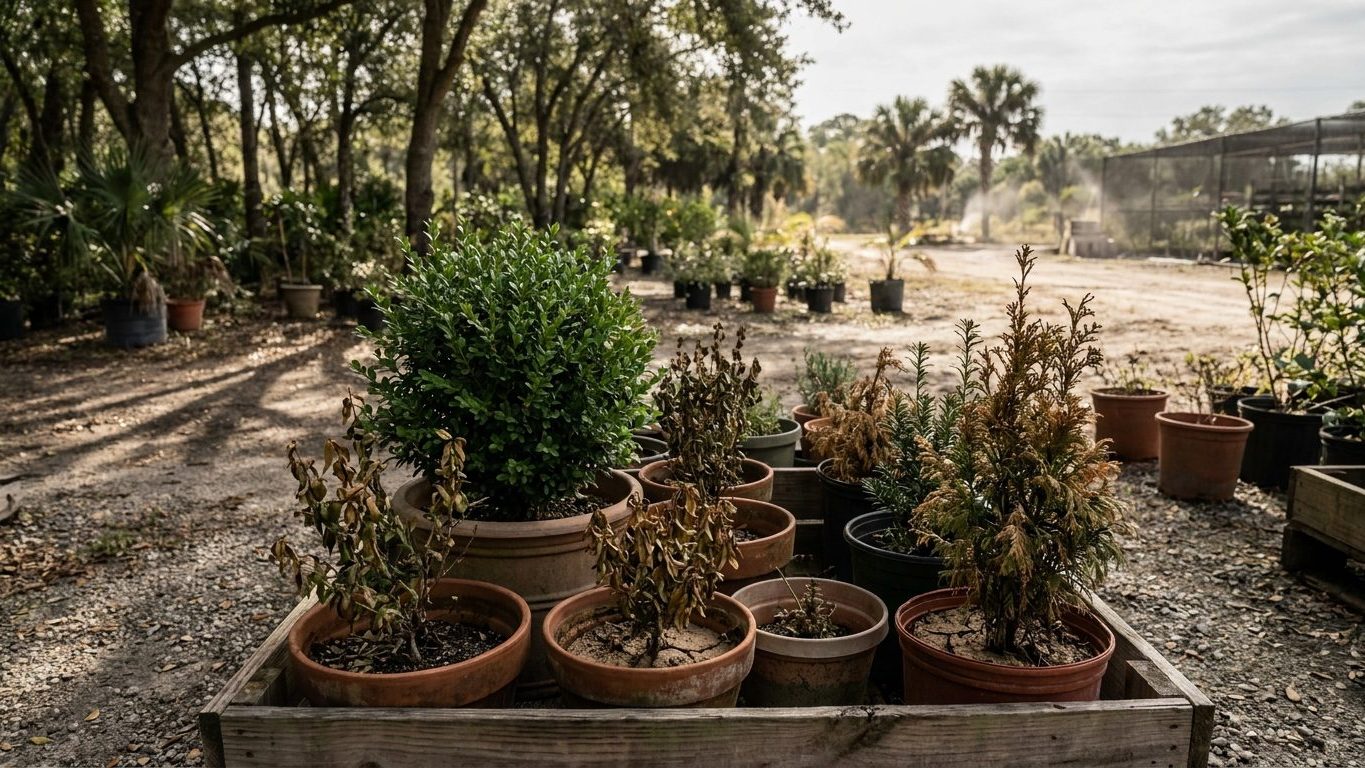

Nine of the twelve hedge species documented on this site hold across all of Iowa. Three do not. Boxwood needs zone 5a or warmer, and Leyland cypress and cherry laurel survive only in 6a. No species fails everywhere. But “holds” means it survives a cold winter, nothing more, and three of the nine can never be cut back once they outgrow their spot. Choose by zone first, pruning tolerance second, looks third.
What actually holds in Iowa
Start with the losses, because they cost the most money. Iowa spans USDA zones 4b to 6a on the 2023 Plant Hardiness Zone Map, built on 1991-2020 normals. That system rests on a single variable, the average annual extreme minimum temperature. It says nothing about ice storms, desiccating wind or wet feet. It is also a range for the whole state, so your yard may sit at either end of it, and the USDA map will show your exact zone by ZIP code.
The three that need a zone number
Boxwood (Buxus sempervirens) is listed for 5a, 5b and 6a only, so it stops short of 4b. A gardener in the coldest part of the state is gambling, not planting. Leyland cypress (x Hesperotropsis leylandii) and cherry laurel (Prunus laurocerasus) are listed for 6a alone, the warmest zone on Iowa’s map. Neither is a safe statewide choice.
Leyland cypress is the riskiest of the three. It grows 3 to 4 feet a year toward a 15 to 25 foot screen, and it does not regrow from old wood, so it is fast, hard to correct and marginal in the cold, all at once. Cherry laurel is slower, at 1 to 2 feet a year to 6 to 15 feet, and it does regrow. Boxwood adds just 3 to 6 inches a year and stays at 2 to 6 feet.
The nine that hold statewide
American hornbeam, inkberry holly, winterberry holly, eastern red cedar, privet, yew, arborvitae, eastern hemlock and arrowwood viburnum are all listed as hardy across the whole 4b to 6a span. One distinction matters when you shop: inkberry holly is evergreen, while winterberry holly loses its leaves in winter. They look nothing alike in January, even though the same pruning window applies to both.
“Hardy statewide” still does not mean “thriving.” The upper end of a hardiness range is often a heat limit, not a cold one, and a plant can survive a zone 4b winter and still sulk in a wet spring or a windy exposure. Other states run different lists, as the pages on Hedge Plants for Rhode Island: What Holds, and What Only Looks Hardy and Hedge Plants for South Carolina: What Holds, and What Only Looks Hardy show. The broader Hedges hub covers the basics that apply everywhere.
The hedges you can never cut back down
Three plants on the Iowa list will not sprout again from old wood: arborvitae, eastern red cedar and Leyland cypress. Cut into bare, leafless interior and that section stays bare. Every other species in the data does regrow, which makes this the most useful single fact for anyone with a fence line to fill.
Arborvitae (Thuja occidentalis) is the gentlest of the three. It adds 6 to 9 inches a year and reaches 4 to 15 feet as a hedge. Prune it in late winter before growth starts, or in midsummer. The slow pace is forgiving, but a hedge planted too close to a walkway will eventually push into it, and there is no repair.
Eastern red cedar (Juniperus virginiana) moves faster, 12 to 24 inches a year, toward 8 to 20 feet as a screen. Its window is late winter, with light cuts only. Light cuts only is the operative phrase: this is a plant you trim every year to hold a size, not one you rescue after five years of neglect.
Leyland cypress covers 3 to 4 feet a year, prunes from late spring to midsummer, and cannot be cut back. Add the 6a-only listing and it is the plant most likely to disappoint a homeowner who chose it for speed.
For all three, the practical rule is to plant at spacing that suits the mature size, then trim a little every year. Never plan a hard reset. If you want that option, look at the ones that do regrow: yew, eastern hemlock, privet, hornbeam, arrowwood viburnum and both hollies. Even among those, hemlock takes light cuts only in late spring, so “regrows” does not mean “take it to a stump without a second thought.”
The calendar helps too. First fall frost falls between October 14 and October 25 in the NOAA normals discussed below, and none of these plants has a fall pruning window. Late September is a good time to plan the year’s cuts, not to make them. Most of the work waits for late winter or late spring.
Matching the plant to the job
Each hedge has a job, and most disappointments come from asking a plant to do the wrong one. A 3-foot formal edge and a 15-foot windbreak call for different species, and the growth rates in the table below show why the swap rarely works.
| Plant | Where in Iowa | Height as hedge or screen | Growth a year | Regrows from old wood | Prune |
|---|---|---|---|---|---|
| Boxwood | 5a, 5b, 6a | 2 to 6 ft | 3 to 6 in | Yes | Late spring, after last frost |
| Yew | Statewide | 3 to 8 ft | 6 to 12 in | Yes | Late spring, after new growth hardens |
| Arborvitae | Statewide | 4 to 15 ft | 6 to 9 in | No | Late winter or midsummer |
| Privet | Statewide | 4 to 12 ft | 2 to 3 ft | Yes | Spring and midsummer |
| Inkberry holly | Statewide | 5 to 15 ft | 6 to 12 in | Yes | Late winter |
| Winterberry holly | Statewide | 5 to 15 ft | 6 to 12 in | Yes | Late winter |
| American hornbeam | Statewide | 6 to 15 ft | 12 in | Yes | Midsummer, after first flush |
| Arrowwood viburnum | Statewide | 6 to 10 ft | 12 to 24 in | Yes | Right after flowering |
| Eastern red cedar | Statewide | 8 to 20 ft | 12 to 24 in | No | Late winter, light cuts |
| Eastern hemlock | Statewide | 10 to 20 ft | 12 to 24 in | Yes | Late spring, light cuts |
| Cherry laurel | 6a only | 6 to 15 ft | 1 to 2 ft | Yes | Late spring, after flowering |
| Leyland cypress | 6a only | 15 to 25 ft | 3 to 4 ft | No | Late spring to midsummer |
For a tall screen, eastern red cedar and eastern hemlock both cover 12 to 24 inches a year and top out at 20 feet, though the cedar cannot be cut back and the hemlock can. For a low, tidy edge, yew is the statewide choice at 3 to 8 feet, with boxwood as an option only where zone 5a or warmer applies. Privet is the quick fix at 2 to 3 feet a year, but it wants pruning twice a season, spring and midsummer, so the speed comes with a chore.
For a looser, informal hedge, arrowwood viburnum (trimmed right after flowering), American hornbeam and the two hollies all reach 6 to 15 feet. Hornbeam grows about 12 inches a year and wants a midsummer cut after the first flush.
Spring cuts also depend on the last frost. NOAA’s 1991-2020 normals put it between April 12 and April 24, but those numbers come from a single airport station. Iowa State Extension county figures (1950-2021) run about 4 days later in spring and 10 days earlier in fall, so treat the airport dates as the optimistic end.
The ground you are planting into
The soil USDA lists as representative of Iowa is the Tama series, a Mollisol: the deep, dark prairie soil that built the Corn Belt. Its surface layer runs about pH 6.5, slightly acid, with 4 percent sand, 26 percent clay and 70 percent silt, and about 3.5 percent organic matter. It is well drained. Those are USDA’s representative values for the surface horizon of the major components of the series, drawn from 246 mapped components and queried on August 29, 2026.
Read that as a tendency, not a promise. Ground like this tends to shed excess water rather than hold it, and the silt-heavy texture usually gives roots an easy start. A pH near 6.5 sits in a comfortable middle for most shrubs, with no acid or alkaline extreme to correct for.
Your yard may look nothing like that. A state spans hundreds of soil series, and river bottoms, hill country and any lot a builder has scraped or filled will differ completely. Subsoil left behind after construction can be far tighter than the Tama surface layer, and a hedge planted in it will behave accordingly. Never treat 6.5 as your own pH.
The fix costs little. A soil test gives you your own number for pH and organic matter, and Iowa State University Extension can point you to how to collect a sample and where to send it at extension.iastate.edu. Test before you buy plants, not after, because a result that surprises you can change which species you choose.
Common questions
Can I grow boxwood in northern Iowa?
Boxwood is listed hardy only in zones 5a, 5b and 6a, so it does not cover zone 4b. If your yard sits in 4b, choose yew instead. It reaches 3 to 8 feet, holds statewide and, unlike some evergreens, regrows from old wood.
Which hedge plants can never be cut back hard?
Arborvitae, eastern red cedar and Leyland cypress do not regrow from old wood. Eastern red cedar and hemlock also take light cuts only, though hemlock does regrow. Plan spacing for mature size and trim lightly each year.
What is the fastest hedge that holds all over Iowa?
Privet, at 2 to 3 feet a year, is the fastest of the nine statewide species. Eastern red cedar, eastern hemlock and arrowwood viburnum follow at 12 to 24 inches a year. Leyland cypress is faster still at 3 to 4 feet a year, but it survives only in 6a and cannot be cut back.
Do I need to amend Iowa soil before planting a hedge?
Not necessarily. The state’s representative soil, Tama, is well drained and slightly acid at about pH 6.5, but that describes a mapped surface layer, not your bed. A soil test tells you what your own ground needs, and it is worth doing especially on new construction lots, where fill and compaction can differ sharply from the state average.