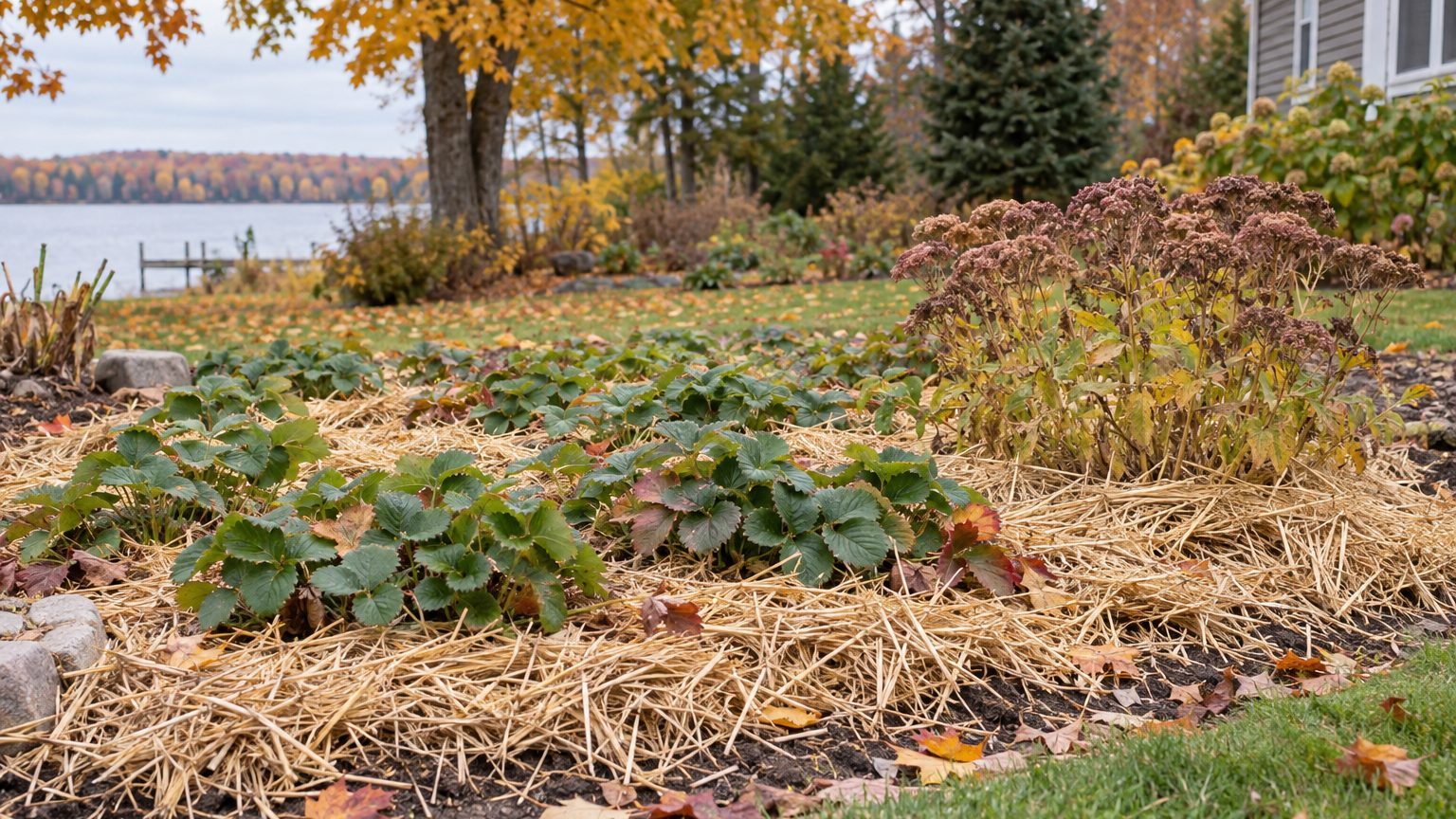

In Milwaukee, winter mulch for strawberries and perennials goes on after the first fall frost, not with it. NOAA’s 1991-2020 normals put that first 32°F freeze between October 17 and October 29. The mulch waits until the soil surface begins to freeze and hard frosts have settled in. Gardeners farther north mulch earlier on the calendar, and lakeshore gardeners can run a bit later.
When to put winter mulch down in Wisconsin
The soil sets the date, not the air
Most people think of mulch as a blanket that keeps plants warm. In a Wisconsin winter it does close to the opposite job. The goal is to keep the soil frozen once it freezes, so it doesn’t thaw on a sunny afternoon and refreeze that night. Those repeated cycles are what heave crowns and shallow roots up out of the ground.
The cold here is more than enough to freeze the ground. The NOAA NCEI Climate Normals for 1991-2020 give the mean daily minimum of the coldest month at Milwaukee as 17.2°F. That is well below freezing, so the northern logic applies across the state: freeze-thaw swings are the enemy, and steady cold is what you want to protect.
Mulch applied while the soil is still holding fall warmth does the wrong thing. It insulates warm, damp ground, which invites crown rot and gives mice and voles a cozy place to set up housekeeping before the cold arrives. A plant that has not yet gone dormant can also stay soft and wet under a heavy cover.
Putting the window on the calendar
For Milwaukee, NOAA’s station data (USW00014839, 1991-2020 normals) show the first 32°F freeze falling in a range of October 17 to October 29. That range is the 30-70% probability band, the stretch when a freezing night goes from unlikely to likely. The first frost is only the opening act. Plants need time to harden off, and the ground needs a run of hard frosts before it stiffens.
Wait until the first-frost range of October 17 to October 29 has passed and the soil surface has started to freeze, then mulch. In practice that means the stretch after that range, when nights stay cold, strawberry leaves have flattened or reddened, and the top of the soil is crusty in the morning. If a warm spell comes after the first frost, the mulch can keep waiting in the shed.
Those dates are Milwaukee’s, and they shift across the state. Lake Michigan delays the first fall freeze at the lakeshore. Inland southern Wisconsin typically freezes in early October, and the north freezes far earlier than either. So in the colder north the mulching window opens earlier on the calendar, and along the lake it opens later. Each place follows its own frost, which is why a look at First and Last Frost Dates in Wisconsin for your own county is worth a minute before you spread anything.
Strawberries
Why the crowns need cover
A strawberry plant keeps its growing point, the crown, right at soil level. Everything for next June’s crop sits there, including the buds that will become flowers. Two things hurt it over a Wisconsin winter. One is heaving, when freeze-thaw cycles push the crown up and leave roots dangling in the air. The other is bare cold, when a crown with no cover takes the full force of a dry, windy, below-freezing night.
Mulch can’t stop the cold, but it can steady the soil temperature and hold the crowns in place. That’s why timing matters as much as material. Put it on after the ground has started to freeze, as laid out above, and it keeps the freeze from letting go in a January thaw.
Straw, depth, and spring removal
Clean straw is the standard material for good reason. It stays fluffy, lets air through, sheds water and doesn’t pack down into a soggy mat the way whole leaves or grass clippings do. Look for straw that’s free of weed seed (hay is full of it), and spread it loosely over the plants and between the rows so the leaves are covered but not crushed.
On depth, the one figure I’ll stand behind comes from the NC State Extension Gardener Handbook: “A 2-inch to 3-inch layer of mulch suppresses most annual weed seeds and makes it easy to hand-pull any that do germinate.” That line is about weeds, not winter cold, but it shows the order of depth that works. Straw is bulky and settles over winter, so a loose layer in that range is plenty. More is not better. A thick, wet pile is what rots crowns. The full story on how much and where is in Mulching Without Killing the Plant.
Spring is where many beds go wrong. Pull the straw off the crowns as soon as new leaves show pale yellow growth underneath, and rake it into the aisles. Leave it there as clean mulch for the berries to rest on and to hold down weeds. Don’t wait for green leaves, because plants smothered under straw turn leggy and pale, and they flower late. Keep a little straw handy so you can pull it back over open blossoms on a frosty night. A bloom killed by frost won’t set fruit, and the crown underneath will be fine.
If you’re still planning the bed itself, the broader Growing Strawberries guide covers varieties, spacing and renovation after harvest.
Perennials and borderline plants
Which plants actually need it
A tough, established perennial in the right zone mostly shrugs off Wisconsin winters. The USDA Plant Hardiness Zone Map 2023 (built on the average annual extreme minimum temperature) places the state in a range from 3b to 6a, so the north is far colder than the south. For dated advice, Milwaukee is the safer reference, with its 17.2°F mean daily minimum in the coldest month. Your own backyard may differ, particularly inland or far to the north.
Winter mulch pays off most for plants in a few categories: perennials planted this fall that haven’t built roots, shallow-rooted plants that heave easily (garden mums and coral bells are common victims), and anything rated near the edge of your zone. Lavender and thyme fall into that last group, and Getting Perennial Herbs Through the Winter walks through what to protect and what to leave alone.
A ring, not a pile
Shredded leaves, straw and chopped bark all work. What matters is where it goes. Make a ring around the plant and keep the mulch a few inches clear of the crown or stems. Piling it directly on the crown holds moisture against the plant, softens the tissue and gives rodents a sheltered path to the very part you want to protect.
For depth, the NC State Extension Gardener Handbook is the source I’d use. Its sentence on suppressing weeds gives a “2-inch to 3-inch layer,” and its woody ornamentals chapter says, “Provide a 3-inch layer of mulch to reduce water loss and maintain uniform soil moisture and temperature around roots.” Two purposes, one order of depth. A perennial bed doesn’t need more than that, and it can do with less if the material is fluffy.
Mulch newly planted and borderline perennials only after the soil begins to freeze, in a ring that stops short of the crown. If the fall is long and mild, resist the urge to finish early because the weekend is free. A job done on the wrong date is worse than a job done a little late.
What goes wrong
Winter mulch fails in a handful of predictable ways, and almost all of them trace back to timing or depth. The table below lays out what each one looks like and how to head it off.
| Problem | What you see | How to prevent it |
|---|---|---|
| Mulching too early | Soft, damp crowns; rot in spring; rodent tunnels in the bed | Wait until after the first-frost range and the soil surface is freezing |
| Matted, soggy mulch | A slick layer of whole leaves or clippings, sour smell, stems gone mushy | Use clean straw or shredded leaves, and keep the layer loose |
| Voles in the mulch | Runways under the layer, chewed crowns and bark | Skip thick piles, keep mulch off stems, and avoid early application |
| Forgetting spring removal | Pale, stretched growth; late flowers | Pull mulch back when new growth shows under it |
Early, matted and rodent-friendly
Putting mulch down while the ground is still warm is the most common mistake, and it sets up the next two. A warm, damp layer is the kind of place voles move into, and a deep pile of wet leaves mats into a sheet that traps water against stems. Voles are especially fond of mulch piled against woody stems, where they can feed on bark out of sight under snow.
Left on too long
The mistake on the other end is leaving the cover on. Uncover crowns in spring as soon as growth starts under the mulch, because plants kept in the dark stretch and weaken fast. Take it off in stages if the forecast is shaky, and keep some on hand for a frost night. A bed uncovered on time and re-covered for a single cold night is in better shape than one that stayed smothered for a week too long.
Common questions
Should I mulch right after the first frost?
No. In Milwaukee the first 32°F freeze falls between October 17 and October 29, per the NOAA normals, but a single frost doesn’t freeze the ground. Wait until the soil surface is stiffening and the nights stay cold. Mulch put down right after one frost, followed by a warm week, ends up insulating warm soil.
Can I use fall leaves instead of straw?
Shredded leaves work around perennials, where a loose ring is fine. On strawberries, whole leaves tend to pack into a wet mat over the crowns, so clean straw is the better pick. If you do use leaves, chop them first and keep the layer light.
How thick should the layer be?
The NC State Extension Gardener Handbook says: “A 2-inch to 3-inch layer of mulch suppresses most annual weed seeds and makes it easy to hand-pull any that do germinate.” For roots and moisture, it recommends a 3-inch layer around trees. Stay in that range. Deeper mulch doesn’t protect better, and it holds more water against the plant.
Does the date change across Wisconsin?
Yes. The northern part of the state freezes much earlier than Milwaukee, so gardeners there mulch earlier on the calendar, while Lake Michigan delays the first freeze along the lakeshore. Inland southern Wisconsin typically freezes in early October. Local conditions vary enough that it helps to browse the other Wisconsin guides and use your own first-frost timing as the starting point.