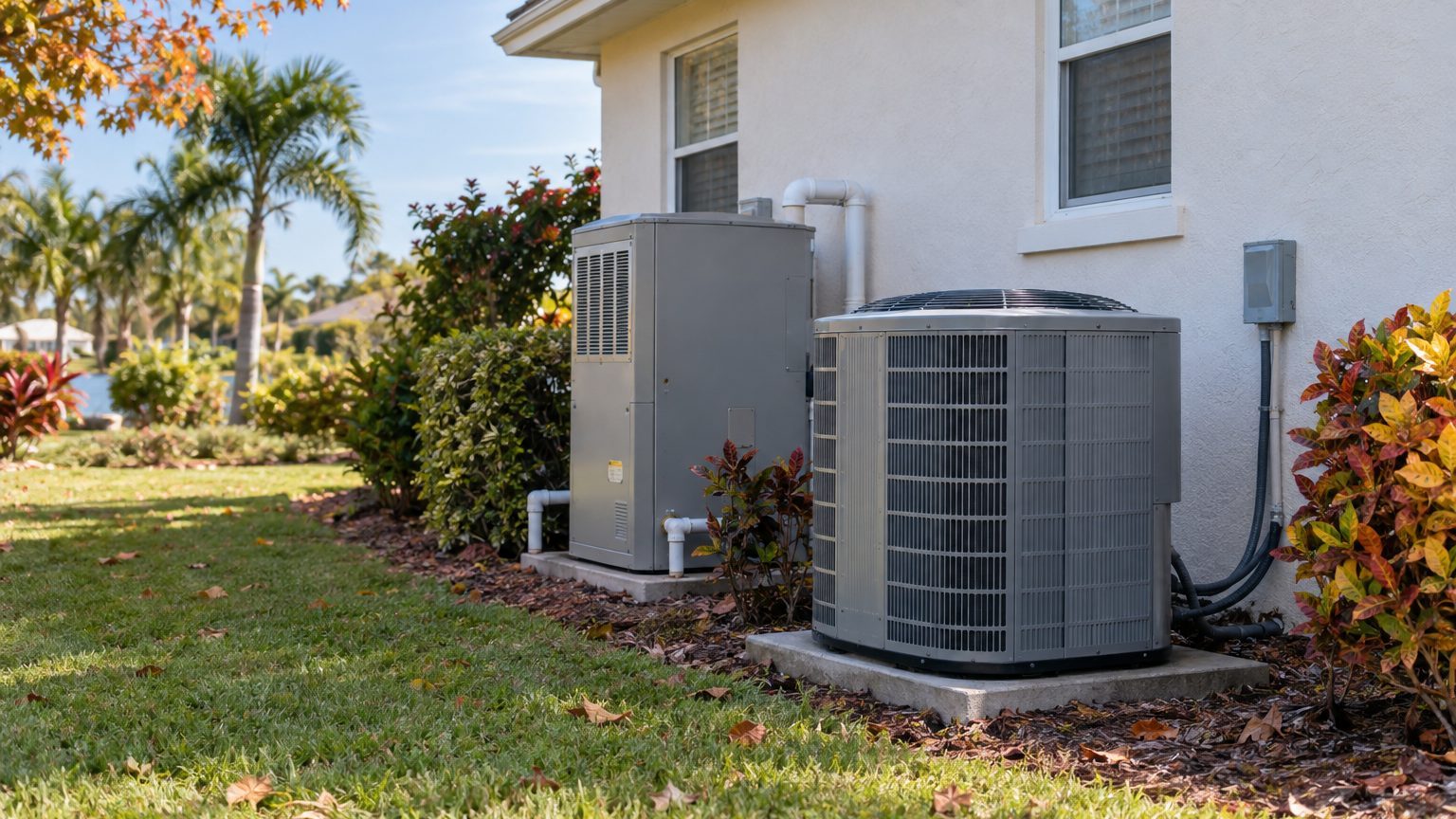

On the numbers available for Indiana, a natural gas furnace costs less to run than a heat pump, and electric baseboard costs the most. That ranking holds for a home that already has gas service. Whether it should settle your next purchase is a separate question. Cooling needs, a missing gas line, and the age of your current equipment can all flip the call.
The short answer for Indiana
The comparison uses one yardstick: the cost of a million Btu of heat actually delivered into the house. Computed from EIA average residential prices and ENERGY STAR efficiencies, a natural gas furnace at 97% AFUE delivers it for $11.42. A heat pump at 8.1 HSPF2 (a seasonal COP of about 2.4) delivers it for $21.04. Electric resistance baseboard, at 100% efficiency, comes in at $49.94.
That puts the furnace $9.62 per million Btu below the heat pump. The heat pump sits far below baseboard, which is the real story for any home that can’t get gas. Where gas service is available, the furnace is the cheaper system to run in Indiana, and a heat pump is the cheaper electric option by a wide margin.
Two limits matter. These are running costs for the same unit of heat, not a yearly bill. A yearly bill depends on your square footage, insulation, and thermostat habits. And nothing here is the price of equipment or installation, which is where heat pumps and furnaces can look very different. The heat pump figure also assumes the ENERGY STAR minimum. A unit that beats the minimum would come in under $21.04, though the figure here is what the sourced inputs support.
What each option costs to run in Indiana
| System | Efficiency used | Cost per million Btu delivered |
|---|---|---|
| Natural gas furnace | 97% AFUE | $11.42 |
| Heat pump | 8.1 HSPF2 (seasonal COP about 2.4) | $21.04 |
| Electric resistance (baseboard) | 100% | $49.94 |
Behind the table sit two government price series. Electricity is the average residential price from the U.S. Energy Information Administration’s Electric Power Monthly, Table 5.6.B: 17.04 cents per kWh, a year-to-date average through July. Natural gas uses the EIA average residential price for the state, converted at about 1,037 Btu per cubic foot, with electricity converted at 3,412 Btu per kWh. This article does not quote a gas price per unit, so your utility bill is the place to check your own rate. Both inputs are statewide averages. Your utility and rate plan can land above or below them.
Fuel price alone misleads, because the two fuels are sold in different units and used at different efficiencies. A furnace turns most of the gas it burns into heat. A resistance heater turns one unit of electricity into one unit of heat. A heat pump moves heat that already exists outdoors, so at a seasonal COP of about 2.4 each unit of electricity brings in about 2.4 units of heat. That multiplier is why electricity at 17.04 cents per kWh still lands well under baseboard. Compare cost per million Btu delivered, never the price per kWh against the price per cubic foot.
One detail helps when you read spec sheets. ENERGY STAR asks 8.5 HSPF2 of a non-ducted (ductless) split system but 8.1 for a ducted one, because a ductless unit has no duct losses and has to be more efficient to earn the same label. Both need 15.2 SEER2, but SEER2 rates cooling and HSPF2 rates heating, so compare the same letter on both units. The full story is in What HSPF2 Measures, and Why Ductless Asks for More.
How cold it gets, and what that does to a heat pump
Indianapolis, the reference city here, averages about 5,250 heating degree days a year (base 65 F) in NOAA’s 1991-2020 normals. Heating degree days add up, across every day, how far the average temperature sat below 65 F, so they translate climate directly into fuel burned. Twice the degree days means roughly twice the fuel for the same house. A figure of about 5,250 describes a long heating season rather than a brutal one.
The coldest month tells the other half. The mean daily minimum in the coldest month at the same station is 20.9 F. That is an average of the lowest reading each day, not a record low, so individual nights run colder. Farther north in the state, winters tend to run colder than at this one station, which is a reason to treat the figures as a reference point rather than a promise about your county.
This matters because the $21.04 heat pump figure rests on a seasonal average. Heat pump efficiency falls as outdoor air gets colder, and on the coldest nights the unit leans on backup heat: electric resistance strips inside the air handler, or a furnace in a dual-fuel setup. Strips deliver heat at the resistance rate, which is the $49.94 line in the table. For a house in a climate with a mean coldest-month low of 20.9 F, the backup does real work some of the time, though not all winter. How much it runs depends on the unit, the house, and how the controls are set. For the cold-weather behavior in detail, see How Cold Is Too Cold for a Heat Pump.
When you collect heat pump quotes, ask what the backup heat is and when the controls bring it on. A quote that cannot answer that is leaving out the part of the bill most sensitive to a cold January.
What homes in Indiana already heat with
The EIA’s 2020 Residential Energy Consumption Survey gives state shares for main heating equipment. In Indiana, 82% of homes use a furnace, 7% a central heat pump, and 3% a steam or hot-water boiler. By fuel, natural gas leads at 65%, electricity follows at 26%, and propane serves 7%. Fuel oil or kerosene shows no figure because the survey suppressed the estimate as unreliable. That means the survey does not publish a number, not that nobody uses it.
These shares describe what was installed, which mostly reflects which fuel was cheap and available when homes were built. They are not a recommendation. They are also state shares from a national survey, not a count for your county. Still, they show that a gas furnace is the ordinary setup here, and a gas-heated home can use the table above as it stands. For the wider picture of how Hoosiers heat, see Heating a Home in Indiana.
The 26% of homes on electricity and the 7% on propane are in a different position. Without a gas line, the gas furnace figure is off the table, and the comparison becomes a heat pump against electric resistance (or propane, whose price you must get from a local supplier). Against baseboard, $21.04 versus $49.94 makes the heat pump the clear running-cost winner. A boiler home with radiators is a different conversion again: there are no ducts, so a ducted heat pump would mean new ductwork, while a ductless system avoids it. If your home has no gas line, the furnace’s running-cost advantage does not apply to you, and the heat pump becomes the system to price first.
When the other choice wins
Cheapest to run is not always the right call. The first exception is the obvious one: no gas service. A furnace that costs $11.42 per million Btu on paper is worth nothing at an address the gas main does not reach, and running a new line has its own cost, which only a utility can quote.
Cooling is the second. Indianapolis averages about 1,139 cooling degree days a year in the same NOAA normals, enough that nearly every Indiana home wants air conditioning. A heat pump is an air conditioner that also runs in reverse, so one system covers both jobs. A furnace needs a separate AC. If the AC is failing along with the furnace, pricing a heat pump as a single replacement can beat buying two machines, even though its running cost per million Btu is higher. If you have no ducts, Ductless or Central walks through that choice.
Dual fuel is the third. A heat pump paired with a gas furnace lets the heat pump handle the mild hours and hands the coldest nights to the furnace, which avoids the resistance-strip backup. It costs more up front, since you own two systems, but it uses each fuel where it works best.
The fourth is an old system with years left. A furnace that still runs safely does not need replacing because a table says another system is cheaper to run. The question of fixing it or swapping it is covered in Repairing a Furnace or Replacing It. If the furnace works and the AC has years left, keep both and revisit when one of them fails.
Common questions
Is a heat pump cheaper than a gas furnace in Indiana?
On the computed figures, no. A 97% AFUE gas furnace delivers a million Btu for $11.42, against $21.04 for a heat pump at 8.1 HSPF2. The furnace is $9.62 cheaper per million Btu. That is a running cost on the same unit, not a yearly bill.
Is a heat pump cheaper than electric baseboard?
Yes, by a large margin. The same million Btu costs $49.94 with electric resistance and $21.04 with a heat pump at the ENERGY STAR minimum of 8.1 HSPF2.
Do heat pumps work in Indiana winters?
Yes, with a backup. Indianapolis averages about 5,250 heating degree days and a coldest-month mean low of 20.9 F. Efficiency drops in deep cold, so resistance strips or a furnace carry the coldest nights.
What does ENERGY STAR require for a heat pump?
Ductless split systems need at least 8.5 HSPF2 and 15.2 SEER2. Ducted split and single-package units need at least 8.1 HSPF2 and 15.2 SEER2. These are minimums to earn the label, not typical values.