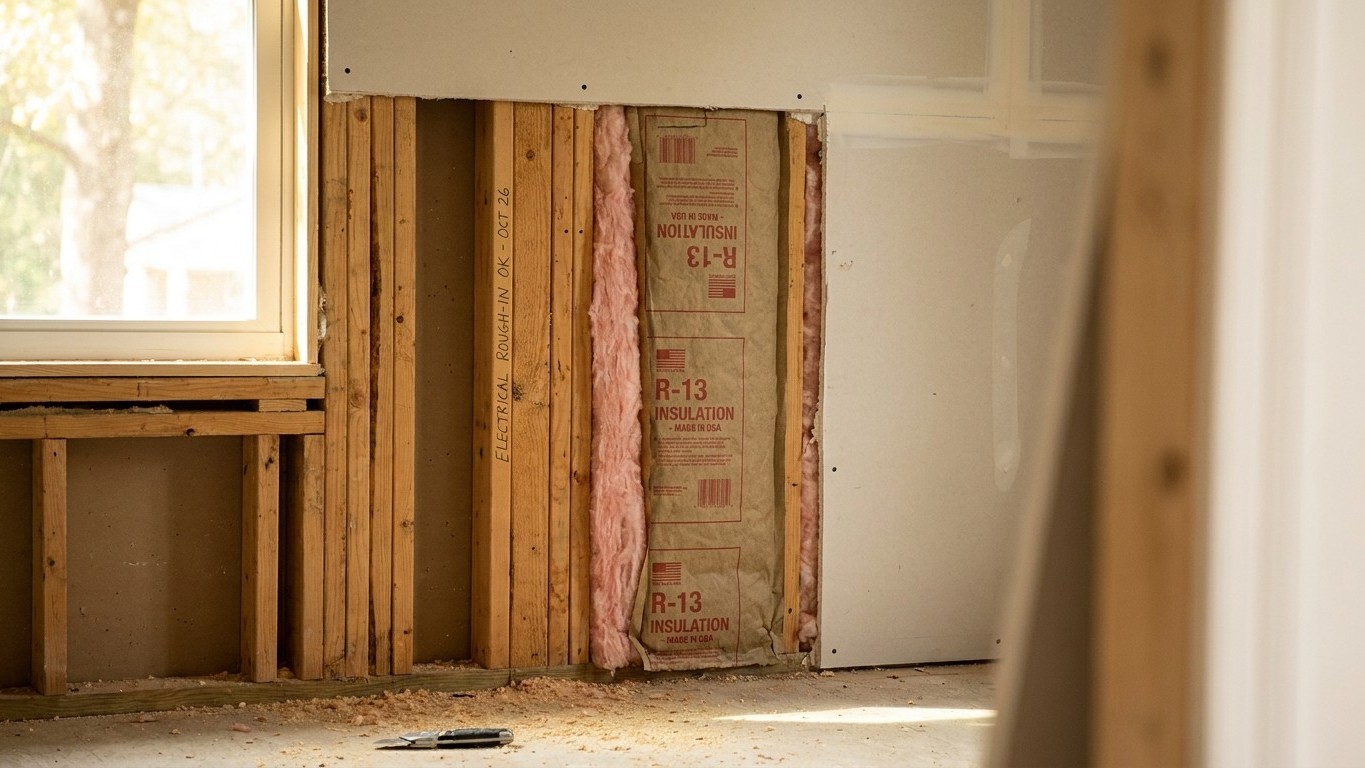

Yes, in most of Indiana a wall needs an interior vapor retarder under the 2021 International Residential Code. The state’s counties sit in Climate Zones 4A and 5A, and the code’s exception for skipping a retarder only applies to Zones 1, 2 and 3. Which class of retarder, though, depends on the wall assembly, and that’s a decision for a local building department, not a website.
What the code asks for in Indiana

The rule itself is short. Under Section R702.7 of the 2021 IRC, “a vapor retarder of the class given by Table R702.7(2) shall be provided on the interior side of frame walls.” That single sentence is the whole obligation, and everything else in the code section exists to define which class applies and when the obligation disappears.
Indiana’s 92 counties split between two climate zones: 47 counties sit in Zone 5A, and 45 sit in Zone 4A. Both carry the moisture-regime letter “A,” meaning moist, not marine and not dry. That distinction matters for insulation tables, but for this particular question it doesn’t change the outcome. The code’s exception reads: “A vapor retarder shall not be required in Climate Zones 1, 2 and 3.” Indiana has no counties in those three zones. A county in the 5A group and a county in the 4A group land on the same side of that line, even though they’re treated differently for other code requirements.
So the practical picture for Indiana is unusual among states that span two zones: there isn’t a split answer here. A homeowner in a 4A county near the Ohio River and one in a 5A county near the Michigan line are both, in principle, under the same interior vapor retarder requirement, because neither zone qualifies for the exemption. What differs county to county is which class of retarder a given wall assembly needs, and whether the local jurisdiction has adopted the 2021 IRC as written or amended it.
That last point is not a technicality to skip. Model codes get adopted, sometimes years late, sometimes with local amendments that change a table or add a requirement. A wall built to satisfy the model code on a website is not the same as a wall built to satisfy the code a county actually enforces. The only way to know which class applies to a specific wall, in a specific house, in a specific Indiana county, is to ask the local building department. That’s not a formality. A wall assembled with the wrong vapor control doesn’t announce the mistake with a crack or a stain the week after drywall goes up. It shows up years later, as rot inside a stud bay nobody opens until something else forces the wall apart.
Why the answer is the opposite in a warm climate
The reason Indiana’s answer differs so sharply from a Gulf Coast state’s answer isn’t arbitrary. It comes down to which direction the water vapor is moving through the wall, and that direction flips with climate.
In a cold climate like Indiana’s, the warm, moisture-laden air sits inside the house. Heated indoor air holds more water vapor than cold outdoor air, and that vapor pushes outward through the wall assembly, toward the cold sheathing where it would condense if nothing stopped it. An interior vapor retarder intercepts that vapor before it reaches the cold surface. That’s the entire logic behind Zones 4A and 5A requiring one.
Flip the climate, and the vapor drive flips too. In a warm, humid region, the moisture-loaded air is outside, and it’s pushing inward through the wall. If a builder installs the same kind of impermeable interior retarder there, out of habit or because it’s what the code required somewhere else, that sheet becomes the coldest, least permeable surface the vapor meets, only now it’s meeting it from the wrong side. The U.S. Department of Energy’s Building America program describes exactly what happens next: “If the wall contains a vapor retarder on the interior side of the insulation, the water vapor will condense on this cool, impermeable surface.” The result, in the DOE’s own words, is “ruined insulation, mold, and structural rot of framing members.”
That’s not a minor caveat buried in a footnote. It’s the reason the code doesn’t write one rule for the whole country. In Zones 1, 2 and 3, the same interior polyethylene sheet that protects a wall in Indianapolis would trap moisture against the framing in a warm-humid climate and accelerate the damage it was supposed to prevent. The code exception isn’t the government declining to regulate something it doesn’t care about. It’s the code following the water. A retarder that helps in one direction of vapor drive actively harms in the other, so the requirement has to depend on where a wall sits, not on a single national default.
The three classes, and why the word matters
“Vapor barrier” gets used loosely, but the code doesn’t recognize a single material by that name. It defines three classes by how much moisture they let pass, measured in perms, and the class, not the presence or absence of some generic barrier, is what a builder is actually required to match to the wall.
| Class | Example materials | Permeance |
|---|---|---|
| Class I | Sheet polyethylene, nonperforated aluminum foil | 0.1 perm or less |
| Class II | Kraft-faced fiberglass batts, vapor retarder paint | Above 0.1 up to 1.0 perm |
| Class III | Latex or enamel paint | Above 1.0 up to 10.0 perm |
Polyethylene sheeting is Class I, but calling it simply “a vapor barrier” without naming the class hides the point of the whole table. The disagreement between a wall built in a cold state and one built in a warm-humid state isn’t over whether to include something. It’s over which class belongs on that interior surface, and a Class I sheet in the wrong climate is the exact mechanism the DOE describes above.
Most homeowners already have a vapor retarder on their walls and don’t think of it that way. Ordinary latex paint qualifies as a Class III retarder. It’s permeable enough to let a wall dry, which is why it’s the class most often paired with lower-risk assemblies, but it still counts under the code’s definition.
One more distinction gets blurred constantly: a vapor retarder is not an air barrier. A vapor retarder controls the slow diffusion of water vapor through a material. An air barrier stops bulk air, carrying much more moisture, from moving through gaps and cracks. Some products do both jobs on the same sheet, which is exactly why the two get confused, but they’re solving different problems.
Where the rule stops
Section R702.7 doesn’t apply everywhere in a house, even in a state where the interior retarder requirement is in force. The code lists four situations where it stops:
- Basement walls
- The below-grade portion of any wall
- Construction where accumulation, condensation or freezing of moisture will not damage the materials
- Any wall in Climate Zones 1, 2 and 3 (not applicable to Indiana, as covered above)
The basement exception is the one most Indiana homeowners will actually run into, because it’s counterintuitive at first glance. A poured concrete foundation wall behaves nothing like a framed wall above grade. Concrete holds moisture from the pour and from contact with damp soil for years, and it releases that moisture slowly through the interior face. A wall assembly built against it has to be able to dry toward the inside. Seal that surface with an impermeable interior sheet, and the moisture the concrete keeps giving off has nowhere to go, trapped right where framing and insulation meet the foundation. This site’s guide to vapor barrier rules for basement walls covers that assembly in more detail.
The below-grade exception works on the same logic, extended to any wall, not just a basement, wherever part of it sits underground. The third exception is broader and depends on the specific materials and assembly rather than a fixed rule, which is one more reason a local inspector’s read on a specific wall matters more than a general answer.
Who actually decides, in Indiana
Everything above describes the model code, and Indiana adopts, amends and enforces building codes through state and local processes that don’t always match the model code word for word or edition for edition. The 2021 IRC is the reference used across this cocon, but the code edition actually in force for a given permit, in a given county, is the one that jurisdiction has adopted, sometimes with local amendments layered on top.
The reference station for the state, Indianapolis, averages about 5,250 heating degree days a year against a base of 65°F, alongside about 1,139 cooling degree days. Degree days measure demand, not temperature. That heating figure is the sum, across every day of the year, of how far below 65°F the day’s mean temperature sat, and a number that size describes a long, real heating season, which is exactly the condition the interior vapor retarder requirement is built around. It’s also why the question carries weight in Indiana in a way it wouldn’t in a state whose reference city logs a fraction of those heating degree days.
None of that changes the fact that this page can’t tell an individual reader what to install in a specific wall. It can say what the rule is, what it depends on, and where the exceptions fall. The person who can answer for a particular house, on a particular lot, under whatever code edition that county has adopted, is the local building department. A call before framing closes up costs nothing. A wall built with the wrong class of vapor control doesn’t fail in a way anyone notices right away. It rots quietly behind the drywall, and the discovery usually comes years later, during a renovation or a sale, when the damage is no longer a question of code but of repair.