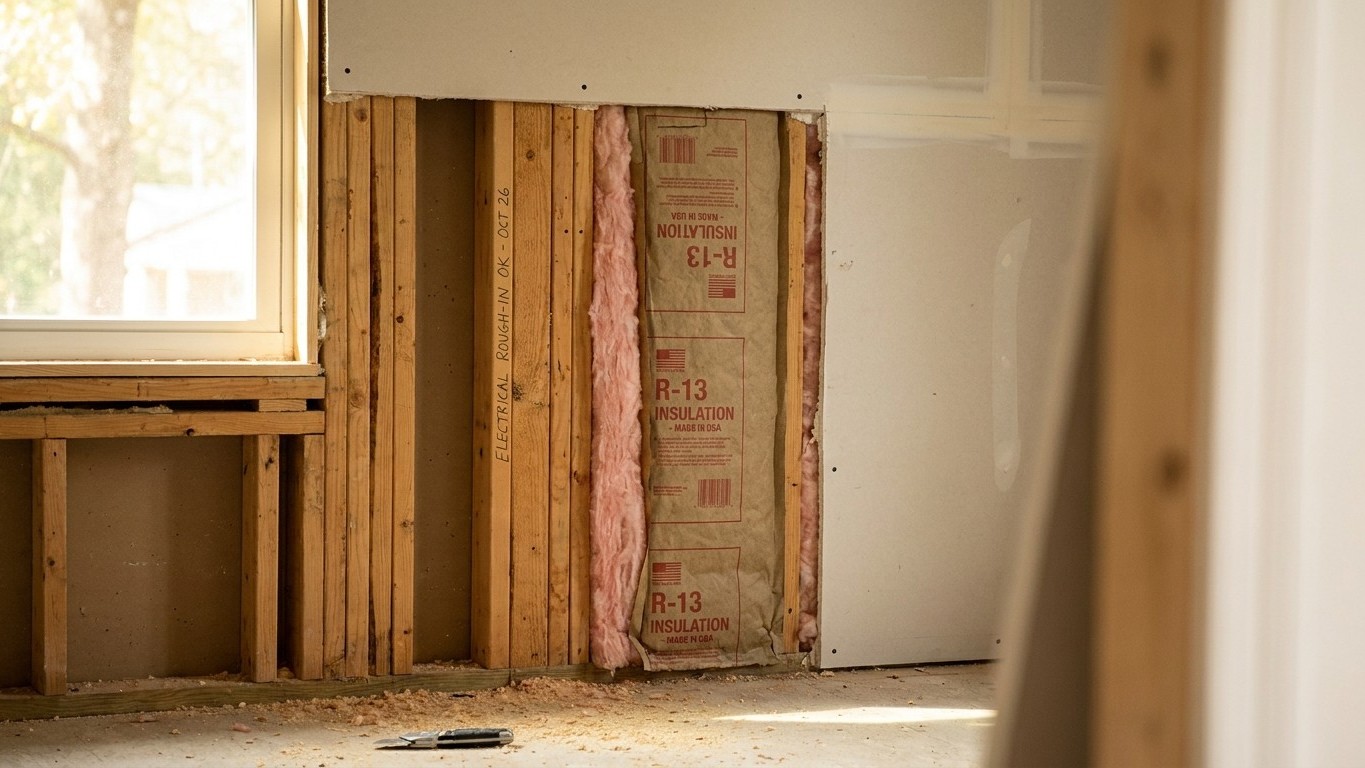

Delaware sits entirely in IECC climate zone 4A, and the 2021 International Residential Code exempts only Climate Zones 1, 2 and 3 from the interior vapor retarder requirement. That means a frame wall built to Delaware’s adopted code needs a vapor retarder of the class set out in Table R702.7(2) on its interior side. The state’s single zone makes this one of the more straightforward answers in the country.
What the code asks for in Delaware

The rule, as written in the 2021 International Residential Code, Section R702.7, is blunt: “A vapor retarder of the class given by Table R702.7(2) shall be provided on the interior side of frame walls.” No ambiguity, no local dialect. The table sorts vapor retarders into three classes by how much moisture they let through, and the code assigns which class applies based on climate zone. Delaware’s entire footprint, all three counties, falls under IECC Table R301.1 as “4A (all),” with no county-by-county split. That’s worth pausing on, because it’s rare. Plenty of states straddle two or three zones, which means a homeowner in one county lives under a different rule than a neighbor forty miles away. Delaware doesn’t have that problem. New Castle, Kent, and Sussex counties all share the same zone designation, so the code’s answer doesn’t shift as you cross the state.
Since zone 4A is not on the list of exempted zones (only 1, 2, and 3 get that exception), the baseline expectation for Delaware is that frame walls carry an interior vapor retarder of the appropriate class. That’s the rule as the model code states it. It doesn’t mean every wall assembly in the state looks identical, and it doesn’t mean a builder can’t use an approved alternative method recognized elsewhere in the code. It means the starting position, absent a specific exception, is that a retarder of some class belongs on the interior side.
Here’s the part that trips people up: “required” and “one specific material” are not the same thing. The code doesn’t say “install polyethylene.” It says provide a vapor retarder of the class the table specifies, and that class can be satisfied by several different products or even a coat of paint, depending on which class applies. The class matters more than the brand or the thickness, and that distinction gets its own section below.
None of this is something a homeowner should self-diagnose from an article. The rule in force in New Castle, Kent, or Sussex County is whatever that jurisdiction has formally adopted, which may lag behind the model code or carry local amendments. A wall built with the wrong vapor control doesn’t announce the mistake with a leak or a stain the week it’s finished. It rots quietly, from the inside, and the damage usually surfaces years later when someone opens up a wall for an unrelated reason. That’s the reason this question deserves a call to the local building department, not a guess based on a general article.
Why the answer is the opposite in a warm climate
The reason Climate Zones 1, 2 and 3 get a pass on the interior vapor retarder isn’t bureaucratic housekeeping. It’s about which direction the moisture is actually moving through the wall. In a cold climate, the warm, damp air lives inside the house. Without a retarder, that indoor moisture would push outward through the wall cavity, hit the cold sheathing near the exterior, and condense there. The interior vapor retarder exists to stop that moisture before it ever reaches the cold surface.
Flip the climate, and the physics flips with it. In a warm, humid region, the damp air is outside, pressing inward against the wall. If that same wall has an impermeable layer on the interior side, that layer becomes the cool surface the vapor hits first, not the sheathing. The U.S. Department of Energy’s Building America program spells out exactly what happens next: “If the wall contains a vapor retarder on the interior side of the insulation, the water vapor will condense on this cool, impermeable surface,” resulting in “ruined insulation, mold, and structural rot of framing members.” That’s not a minor cosmetic issue. It’s the same kind of hidden, slow-building damage that a misapplied retarder causes anywhere, just triggered from the opposite direction.
This is why the code doesn’t apply one rule nationwide. It’s not inconsistency for its own sake. The requirement tracks where the water vapor is coming from and where it will end up condensing, and that direction depends on climate. In Delaware’s zone 4A, a mixed-humid climate with real winters and real summers, the code lands on the side that requires the retarder, because the risk calculus in a zone with a substantial heating season points toward protecting the wall from interior-generated moisture reaching cold sheathing. In a zone 1, 2 or 3 climate, the same logic points the opposite way, and requiring a Class I retarder there would create the exact failure the DOE describes. Same code, same document, two different instructions, because the water is traveling in two different directions depending on where the wall sits.
The three classes, and why the word matters
The code doesn’t hand out one generic label. It defines three classes of vapor retarder, sorted by permeance, and the class assigned to a given climate zone is what actually governs the wall assembly.
| Class | Example materials | Perm rating |
|---|---|---|
| Class I | Sheet polyethylene, nonperforated aluminum foil | 0.1 perm or less |
| Class II | Kraft-faced fiberglass batts, vapor retarder paint | Above 0.1 up to 1.0 perm |
| Class III | Latex or enamel paint | Above 1.0 up to 10.0 perm |
Sheet polyethylene, the material most people picture when they hear “vapor barrier,” is only one option, and it belongs specifically to Class I, the least permeable category. Calling it “a vapor barrier” without naming the class skips the part that actually decides whether it belongs in a given wall. A Class I product in the wrong climate is precisely what produces the condensation problem the DOE describes above. The whole disagreement between a builder working in a cold zone and one working in a warm-humid zone isn’t about whether to include a vapor retarder at all. It’s about which class belongs on that particular wall.
There’s a detail here that surprises most homeowners: ordinary latex paint qualifies as a Class III vapor retarder. Anyone who’s painted an interior wall with a standard latex finish already has a vapor retarder on that wall, whether they knew it or not. It’s the least restrictive class, letting through the most moisture, but it still counts under the code’s definition.
One more distinction worth keeping straight: a vapor retarder and an air barrier are not the same thing, even though a single sheet of material sometimes does both jobs at once. A vapor retarder slows moisture diffusion through the material itself. An air barrier stops bulk air movement, and air movement carries far more moisture than diffusion ever does. They solve different problems, and a wall assembly can satisfy one without satisfying the other.
Where the rule stops
The interior vapor retarder requirement isn’t universal even within a zone that requires it. The code carves out specific situations where the rule doesn’t apply:
- Basement walls
- The below-grade portion of any wall
- Construction where accumulation, condensation, or freezing of moisture will not damage the materials
The basement exception is the one most Delaware homeowners actually run into, since so many homes in the state have some form of basement or below-grade foundation wall. A poured concrete or block foundation wall behaves nothing like a framed wall. Concrete holds moisture and releases it slowly, sometimes over years, as groundwater migrates through the material and evaporates on the interior face. If that basement wall were sealed with an impermeable interior vapor retarder the way an above-grade frame wall might be, the assembly would lose its only path for drying inward, and moisture would simply accumulate behind the barrier instead of escaping. That’s the same condensation-and-rot mechanism described above, just triggered by a different source of water. For the specifics of how basement wall assemblies are supposed to handle this, the basement wall guide on this site covers the detail.
Who actually decides, in Delaware
Everything above describes the 2021 International Residential Code as written and the IECC climate zone table that assigns Delaware to zone 4A statewide. Neither of those documents is automatically the law in New Castle, Kent, or Sussex County. States and municipalities adopt model codes on their own schedule, sometimes with amendments, sometimes years behind the edition currently being discussed nationally. The only source that can tell a homeowner which code edition and which amendments actually govern a specific address is the local building department.
This matters more in Delaware than in a lot of places, precisely because the state’s single climate zone means the code answer is consistent everywhere within its borders, but the adopted edition and any local amendments can still vary by jurisdiction. Around 4,647 heating degree days a year at the Wilmington reference station give a sense of how much winter heating demand the state actually carries, a season long enough that the interior vapor retarder question isn’t academic. Degree days measure demand for heat, not a temperature reading, but they translate roughly into fuel use: a state with heavy heating demand has real motivation to keep its wall assemblies performing the way the code intends.
None of this adds up to a recommendation for what to install in any particular wall. The rule exists, it depends on climate zone and class, and the authority that applies it locally is the building department with jurisdiction over the property, not a model code committee. A wall assembly built with the wrong vapor control doesn’t fail on inspection day. It fails quietly, over years, and the owner usually finds out only when something else forces the wall open.