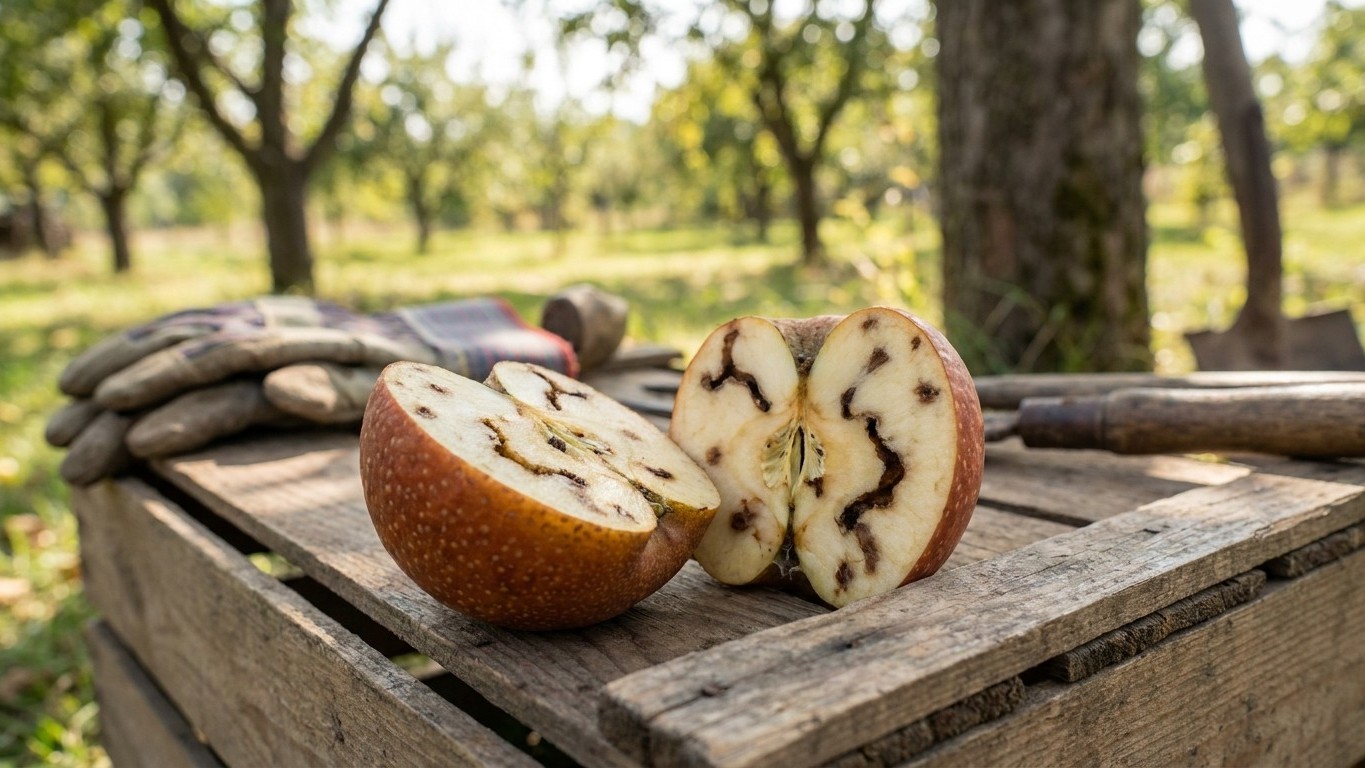

Harvest in Indiana runs from mid-August for the earliest varieties through late October for the latest, and how long any given apple lasts afterward depends far more on which variety you picked than on anything you do to store it. A crisp, late-season apple can hold for months in a cold garage. An early one is done in a couple of weeks no matter what you do.
When apples are ready to pick in Indiana
Picking date isn’t really a calendar question. It’s a question of what stage the fruit and the tree have reached, and that stage is set by the same seasonal clock that governs frost risk statewide. At the Indianapolis reference station, NOAA’s 1991-2020 Climate Normals put the last spring frost (32°F) between April 9 and April 21, and the first fall frost between October 21 and October 30. Those two windows bracket the growing season that apple trees have to work with, and they shift by roughly two weeks or more across the state: southern Indiana warms up earlier in spring and stays frost-free later into fall than the north, so a grower near the Ohio River is often picking and even finishing harvest before someone near the Michigan line has started.
Early-season varieties like Ginger Gold or Paula Red typically come off the tree from mid-to-late August, well ahead of any frost concern. Mid-season apples such as Gala or Honeycrisp follow in September. The latest cultivars, things like Fuji, GoldRush, or Granny Smith, hang on into October and are usually the last fruit off the tree before that first fall frost window arrives. Growers in southern counties get a bit more runway here; growers up north are working against a tighter clock and may need to bring in late apples a touch earlier to avoid a hard freeze hitting fruit still on the branch.
Two different filters: hardiness and chill
Winter hardiness and chilling hours are not the same question, and conflating them leads to the wrong variety choice. Hardiness is about survival: can the tree’s wood take the coldest nights of an Indiana winter without dying back? The relevant figure here is the mean daily minimum of the coldest month at Indianapolis, which NOAA’s Climate Normals put at 20.9°F. That’s a moderate cold load. Apple trees as a group tolerate far lower than that without structural damage, so hardiness isn’t the limiting factor for standard cultivars anywhere in the state.
Chill accumulation is a different filter entirely, and it governs whether a tree flowers properly rather than whether it survives. Indiana’s winters, cold enough to sit an average night in the low 20s throughout the coldest month, comfortably deliver the chill hours that nearly every common apple variety needs. That matters because it removes a trade-off that shows up in milder climates: there’s no real case for reaching for a low-chill variety here, since low-chill selections break dormancy early and flower before the last frost date has passed, which is exactly the wrong trait to import into a state where that April 9-21 window still carries roughly a 10% chance of a freeze afterward, per Purdue’s own caution on the data. The safer play in Indiana is a variety with an ordinary-to-later bloom time, not an early one.
Which ones keep, and which must be eaten
Keeping quality is a trait bred into the apple, not something storage technique can add after the fact. Some varieties are built to hold; others are built to be eaten within a few weeks of picking, and no amount of careful handling changes that ceiling.
| Keeping category | Typical varieties | Rough window |
|---|---|---|
| Short keepers | Gala, McIntosh, Paula Red, Ginger Gold | A few weeks, even refrigerated |
| Medium keepers | Honeycrisp, Jonagold, Cortland | Roughly one to three months in cold storage |
| Long keepers | Fuji, GoldRush, Granny Smith, Enterprise, Arkansas Black | Several months, sometimes into spring, under proper cold storage |
The pattern behind this table has to do with skin thickness, acidity, and how slowly the fruit respires after picking. Thin-skinned, high-respiration apples like McIntosh soften and lose crispness fast, so they’re best treated as a fall-eating apple rather than a stockpile. Thicker-skinned, higher-acid varieties like GoldRush or Granny Smith respire slowly and hold their texture for a long stretch, which is exactly why orchards and home growers alike lean on those names when the goal is an apple that’s still good in February.
What this means for a mixed home orchard
Most home growers in Indiana end up planting at least one short keeper for fresh eating in September and one long keeper meant for the cellar or the fridge crisper through winter. That split matters more here than in places with a longer harvest season, because Indiana’s own picking window closes with that first fall frost arriving between October 21 and October 30 at the Indianapolis reference point, earlier up north. Once that date passes, whatever’s still on the tree needs to come in regardless of variety, so a grower who wants a genuinely long-keeping harvest needs to plant varieties that finish ripening before, not after, the local frost date arrives.
Local Purdue Extension offices can help identify which named cultivars perform reliably in a given county’s soil and microclimate; general variety trial information is available through Purdue Extension, though county-by-county storage-life data for home growers isn’t something this source publishes in detail, so specific week-by-week keeping claims beyond the general categories above should be treated as a starting estimate rather than a guarantee.
Storing them through a Indiana winter
Cold, humid, and dark: those are the three things a stored apple wants, and an Indiana winter can supply the cold part for free, if you manage it right. The trouble is that “free cold” swings wildly. An unheated garage or shed sits at roughly the outdoor air temperature, and with the coldest month’s mean daily minimum at Indianapolis running 20.9°F, that space will regularly dip well below freezing on ordinary nights, not just in a cold snap. Apples held at that temperature don’t chill politely; they freeze, and a frozen-then-thawed apple turns mealy and starts breaking down within days.
The workable target for long-term storage is close to 32-40°F with high humidity, which is colder than a kitchen but warmer than an unheated outbuilding on a typical January night here. A root cellar, an insulated basement corner, or a refrigerator set aside for produce gets closer to that range than a garage does. Growers who rely on an attached but unheated garage need some kind of buffer, insulated bins, a thermometer to catch a hard drop, or simply moving fruit indoors when overnight lows threaten to go well below the mid-20s, since that’s roughly what the coldest-month average already looks like before factoring in an unusually sharp cold snap.
Humidity matters as much as temperature
Dry basement air is the quiet failure mode in a lot of home storage setups. Apples lose moisture through their skin even when the temperature is right, and a dry Indiana basement heated slightly by the furnace below can pull enough moisture out of fruit over a winter to leave apples shriveled well before they’d otherwise have gone soft. Perforated plastic bags, damp sand, or simply storing fruit in a container with a loosely fitted lid all slow that moisture loss. Checking stored fruit every few weeks and pulling out anything starting to soften keeps a single spoiling apple from taking down the ones stored next to it, since apples release ethylene gas as they age and speed up ripening in whatever’s nearby.
What goes wrong here
The most common failure in Indiana isn’t a storage mistake at all. It’s a spring frost catching bloom at exactly the wrong moment. Because the last spring frost date at Indianapolis runs April 9 to April 21, and there’s still roughly a 10% chance of a 32°F reading after that window closes, a tree that flowers on the early edge of its normal range can lose a meaningful share of its crop to a late cold snap most years don’t even register as unusual. This is precisely why chasing early-blooming, low-chill varieties doesn’t pay off in Indiana the way it might in a warmer state: the chill hours are already abundant here, so there’s nothing to gain and a real frost risk to lose by choosing an early bloomer.
The second common problem shows up after harvest, in storage. Fruit brought in bruised from a fall to the ground, or picked while still slightly underripe and then held too warm, breaks down faster than the variety’s reputation would suggest. Enterprise and GoldRush have a real claim to months of storage life, but that claim assumes careful picking and cold, humid conditions from day one, not a few weeks sitting in a warm kitchen before being moved to the basement.
Humidity and disease pressure specific to the Midwest also play a role. Indiana’s summer humidity favors apple scab and fire blight in years with a wet spring, and infected fruit or foliage won’t store or ripen normally even if the timing and temperature were otherwise right. Local county Extension offices, reachable through Purdue Extension, are the right first call for a diagnosis if leaves or fruit show unusual spotting before harvest, since a disease problem needs different handling than a straightforward storage or frost issue.
Common questions
Can apple trees survive an Indiana winter without special protection?
Standard apple cultivars tolerate winters far colder than what Indiana delivers. With the coldest month’s mean daily minimum at Indianapolis sitting at 20.9°F, hardiness isn’t the concern for common varieties anywhere in the state; the bigger risk to the crop is a late spring frost hitting bloom, not winter cold killing the tree.
Does southern Indiana have a longer apple season than the north?
Yes. NOAA’s Climate Normals show southern Indiana running roughly two weeks or more ahead in spring and behind in fall compared with the Indianapolis reference point, so both the last spring frost and the first fall frost arrive later there, stretching the usable growing window.
How do I know when a specific apple variety is ready to pick?
Watch the tree’s stage rather than the date: background skin color shifting away from green, seeds turning brown, and fruit separating easily from the branch with a gentle twist. These signs, not a fixed date on the calendar, are what actually mark readiness, and they arrive earlier for short-keeping varieties and later for long-keeping ones.
Is it worth planting a low-chill apple variety in Indiana?
No, and it can backfire. Indiana’s winters already supply plenty of chilling hours for standard varieties, so a low-chill selection gains nothing on that front while flowering earlier, right into the window where a late frost still has a documented chance of occurring.