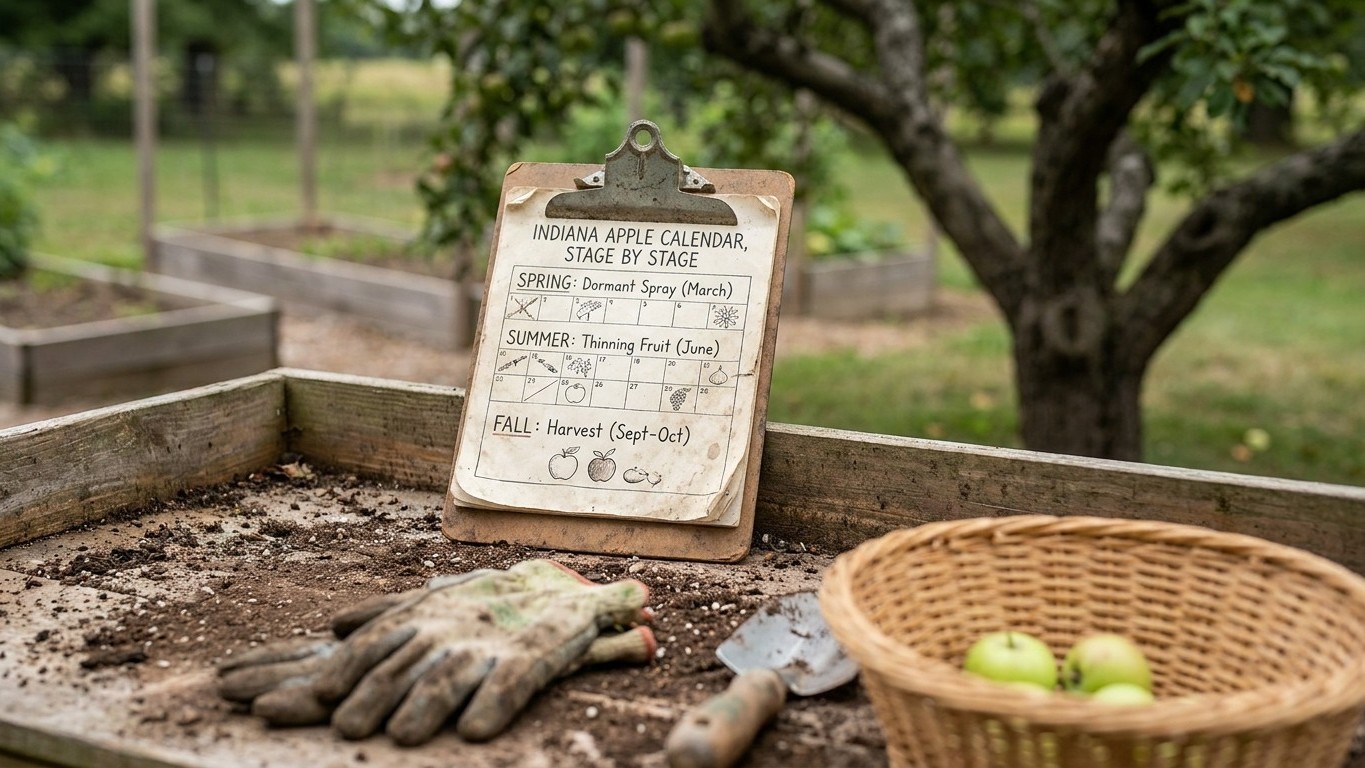

There’s no single date on an Indiana apple calendar. What matters is the tree’s stage, and in central Indiana that stage lines up against NOAA’s 1991-2020 climate normals for Indianapolis: a last spring freeze window of April 9 to April 21, and a first fall freeze window of October 21 to October 30. Check your trees for green tip before that spring window closes, and keep frost cloth ready if bloom lands inside it.
The short answer for Indiana
Gala trees bloom early enough to land right on Indiana’s frost line most springs, while a late cultivar like GoldRush or Enterprise can clear the same cold snap without a scratch. So the same April can wreck one tree and barely touch the one beside it. Add the state’s geography — southern counties running two weeks ahead of Indianapolis, the far north lagging behind — and a single fixed calendar stops being useful. What matters is your cultivar, your county, and the stage the buds are actually in.
What the answer depends on is which cultivar you planted and how far you are from Indianapolis. A cultivar that blooms early, like many Gala strains, sits closer to the frost line than a late bloomer such as GoldRush or Enterprise, so the same spring can be a non-event for one tree and a lost crop for its neighbor. It also depends on where in the state you’re standing. Purdue Extension’s own caution on this frost data notes that southern Indiana runs earlier in spring and later in fall than the Indianapolis normal by two weeks or more, while parts of the far north lag behind it by a similar margin. A grower near the Ohio River reading this calendar as written for Indianapolis is working with stale numbers by the time bloom actually happens.
None of this touches whether the tree survives winter in the first place. NOAA’s 1991-2020 normals put the average low of the coldest month at Indianapolis at 20.5°F, a threshold that almost every apple cultivar sold in the region clears without trouble. The frost windows above are about flower survival, not tree survival, and the two get confused often enough that it’s worth saying plainly.
Working through it

This calendar assumes you already have a tree in the ground, planted and past its first year or two. If you’re still at the site-and-cultivar stage, Growing Apples in Indiana covers what comes before any of this. From here, the calendar runs the same seven stages every apple tree passes through in a year, and each one is what decides the timing, not the date on the wall.
Dormancy

The tree sits leafless from the first hard fall freeze until the buds start to swell in late winter. This is the only stage with real cold tolerance to spare, and it’s also the stage for structural pruning. Cutting when the wood is bare shows the branch framework clearly and the tree has no live growth to interrupt. Prune too late, once sap is moving toward green tip, and cuts bleed and heal slower.
Green tip

Buds split and show a sliver of green leaf tissue. Growth this early has very little frost tolerance left, so a hard freeze at green tip can still set the tree back, though the wood and dormant buds mostly ride it out. This is when the first fungicide cover spray for scab typically goes on, timed to the stage rather than a set date, because a warm February can push green tip well ahead of a cold one.
Pink

Flower buds show deep pink but stay closed. Pink is the last stage where a grower can still act before the flowers are exposed: thinning sprays, the last scab cover, and any frost-protection prep should be finished by here, because once the buds crack open there’s no walking anything back.
Bloom

Open white blossoms are the single most frost-vulnerable stage in the whole calendar, and for the Indianapolis area this stage typically arrives inside or just after NOAA’s April 9 to April 21 last-frost window. A 32°F freeze at full bloom can kill the open flowers outright and take the year’s crop with them, which is why Purdue Extension’s caution about a roughly 10 percent chance of frost even after the published date matters here. A tree that blooms on the early edge of that window is gambling on the wrong side of the odds most years.
Petal fall

Petals drop and the small ovary left behind starts to swell. Frost tolerance improves a little at this stage, though a hard freeze right after petal fall can still abort the young fruit before it’s visibly damaged, showing up two or three weeks later as fruit that never sized up.
Fruit set and thinning

Fruitlets reach marble size within a few weeks of petal fall. This is the window for thinning, whether by hand or with a chemical thinner, and it’s timed to fruit size rather than a date, because a cool, slow spring pushes the whole sequence later without changing the order of events.
Harvest
Harvest timing is set by the cultivar’s own days-from-bloom figure, printed on the catalogue tag, counted forward from whichever week bloom actually happened rather than from a fixed calendar date. An early cultivar like Gala can finish six to eight weeks after bloom. A late one like GoldRush or Arkansas Black needs most of the growing season and is often the last fruit off the tree before NOAA’s October 21 to October 30 first-freeze window closes it out. The table below lines up bloom timing and season length for cultivars commonly planted in Indiana. For a fuller rundown of which cultivar suits which situation, see The Best Apple Varieties for Indiana.
| Cultivar | Bloom timing | Disease resistance | Season length |
|---|---|---|---|
| Gala | Early | Moderate | Short, finishes early |
| Liberty | Early to mid | Scab-immune, resistant to fire blight and cedar apple rust | Mid-season |
| Honeycrisp | Mid | Moderate, prone to fire blight | Mid to late |
| Enterprise | Late | Resistant to scab, fire blight and cedar apple rust | Late |
| GoldRush | Late | Scab-resistant | Very late, long keeper |
What changes across Indiana
The Indianapolis normals above are a starting point, not a state-wide answer. Purdue Extension’s own caution on the frost data is direct: southern Indiana, along the Ohio River from around Evansville east toward Madison, typically runs a last frost two weeks or more ahead of the Indianapolis date and a first fall frost two weeks or more behind it, stretching the growing season by close to a month compared with the central part of the state. Trees in these river counties can carry an earlier-blooming cultivar with less risk than the same tree planted near Indianapolis.
The far north runs the other way. Counties near Lake Michigan, including LaPorte and the shoreline around Michigan City, sit under the lake’s moderating influence. The water mass delays spring warming, so bud break and bloom there tend to lag the Indianapolis date, but the same lake effect also holds off the first hard freeze in fall, which favors late-season cultivars that need every extra week to finish. Inland northern counties without that lake buffer, further from the shoreline, don’t get the fall benefit and can see a first freeze arrive closer to or ahead of the Indianapolis normal.
Elevation and terrain matter on a smaller scale everywhere in the state. Low ground where cold air pools, a valley bottom, the foot of a slope, a frost pocket behind a windbreak, will read several degrees colder on a clear, still night than an orchard block just a few hundred feet upslope. An orchard site chosen on a gentle slope with open air drainage below it will dodge a light frost that flattens bloom in the hollow next door, even though both sit in the same county and the same NOAA normal applies to both on paper.
The mistakes this climate punishes
The most common failure is a bloom that lands ahead of the frost, not behind it. An early-flowering cultivar planted without accounting for this can hit full bloom before NOAA’s April 9 to April 21 window has even closed, and Purdue Extension’s note that roughly one spring in ten still brings a freeze after that window means the early bloomer stays exposed even in years the calendar looks safe. This shows up as a normal-looking bloom followed by a crop that simply never sets, because the open flowers were killed before anyone noticed a freeze had happened at all.
Chill mismatch and dormancy timing
The opposite mismatch costs a year in a different way. A cultivar bred for a mild-winter chill requirement can respond to any unusually warm stretch in late winter by breaking dormancy early, right into a stage with no frost tolerance, only to be caught by the next cold snap. Chill requirement and cold hardiness are not the same filter. A tree can survive an Indianapolis winter’s 20.5°F average minimum, per NOAA’s 1991-2020 normals, and still bloom at the wrong moment because its dormancy-release trigger was tuned for a warmer, more even climate than Indiana actually delivers.
Feeding late in the season is a slower version of the same mistake. Nitrogen applied in July or August pushes soft new shoot growth that hasn’t hardened off by the time the first fall freeze arrives, and that window, October 21 to October 30 at Indianapolis per NOAA, comes fast once September ends. The signs of this mistake are specific:
- Blackened shoot tips on new growth the week after the first freeze
- Bark that splits at the base of the current season’s growth
- Buds that fail to break the following spring on wood that looked fine in fall
Pruning on a warm January afternoon carries a smaller version of the same risk. Cutting itself doesn’t trigger early bud break, but a run of unseasonably warm days in late winter can pull dormant buds toward green tip weeks before the last-frost window even opens, and a grower who assumes the tree is still safely asleep can be caught by an ordinary cold snap the tree is no longer built to handle.
Checking this against your county
Every figure above is anchored to Indianapolis, and the caution attached to NOAA’s own data is that other parts of the state can run two weeks or more ahead or behind it in either season. Purdue Extension maintains county-level guidance that will narrow these ranges for wherever you’re actually growing. Check their site at Purdue Extension before locking in a spray date, a planting date, or a frost-protection plan based on the Indianapolis normal alone.
Common questions
What do I do if a frost warning comes right when my tree is in full bloom?
Cover small trees overnight with row cover, an old sheet, or a frost blanket, pulled off again once temperatures climb the next morning. Overhead sprinkler irrigation run continuously through the freeze can also hold blossom tissue nearer 32°F on a larger planting, but it’s a rescue for one bad night, not something that fixes an early-blooming tree’s odds over the years.
Can I still plant a bare-root apple tree once the buds have started showing green?
You can, but it’s riskier than planting while the tree is fully dormant. Bare-root stock handles best before green tip, when it has no active leaf growth demanding water the roots aren’t yet in place to supply. Once buds show green, a container-grown tree, which keeps its root system intact through transplant, is the safer choice.
Do I need two different apple trees for pollination, or will one tree fruit on its own?
Most apple cultivars need pollen from a different cultivar blooming at roughly the same time, so a single tree alone often sets little or no fruit. A few cultivars are marketed as self-fertile, but even those typically set a heavier crop with a compatible partner nearby, whether that’s a second tree in your own yard or a neighbor’s tree within bee range.
If frost kills the blossoms, will the tree bloom again that year and give me a second chance?
No. An apple tree blooms once per season from the buds it set the previous summer, so a bloom lost to frost is that year’s crop lost, full stop. The tree itself isn’t harmed long-term by a single bad spring, and it will set buds normally again for the following year unless the freeze was severe enough to damage the wood itself.