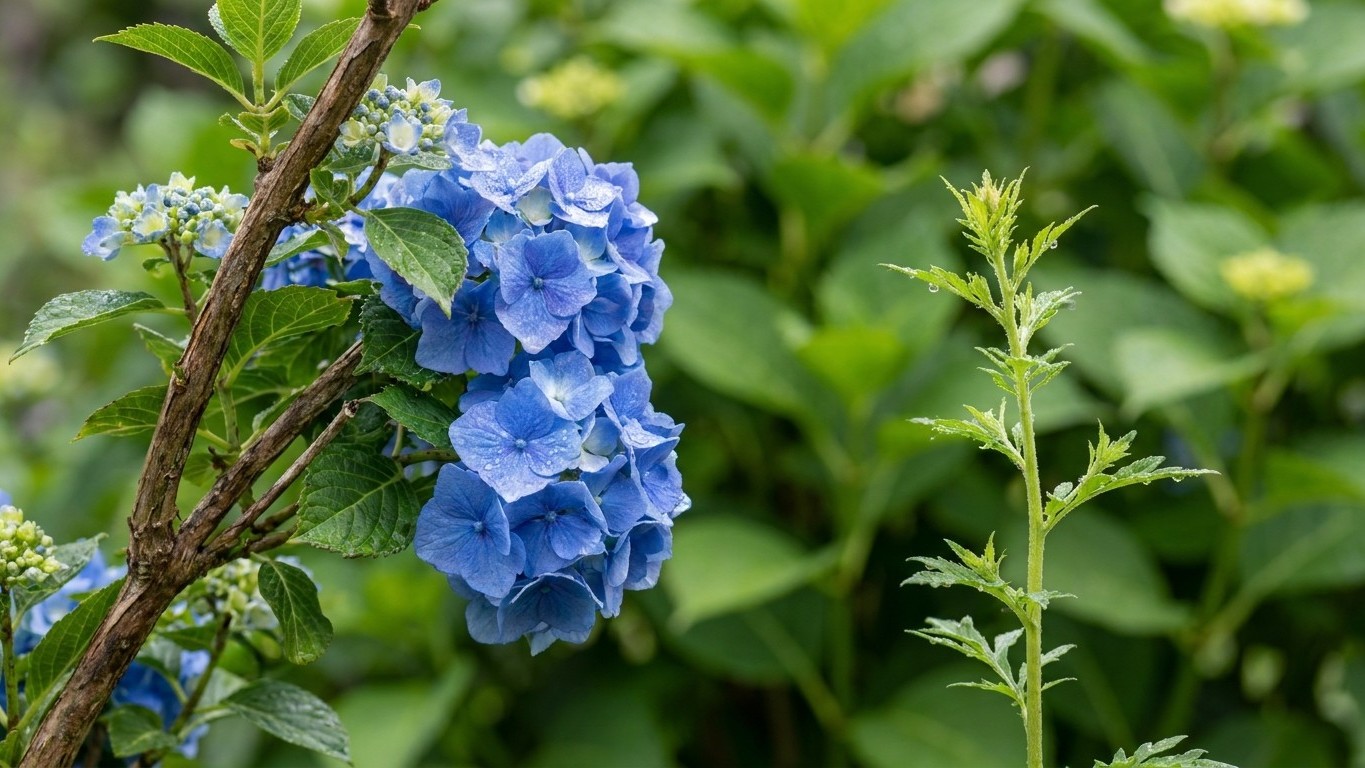

Prune by type. Hydrangeas that flower on old wood, such as bigleaf, mountain, oakleaf and climbing, get trimmed right after the blooms fade in summer. Hydrangeas that flower on new wood, such as panicle and smooth types, get cut in late winter or very early spring. In Indiana, the other deadline is spring: leave dead-looking stems alone until the last freeze has passed.
What this comes down to in Indiana
Pruning dates in Indiana are set by the frost window at Indianapolis, where the last spring freeze falls between April 9 and April 21 and the first fall freeze between October 21 and October 30 (NOAA NCEI 1991-2020 Climate Normals). Old-wood types need their cuts made well before that fall window. New-wood types need theirs made before buds break, and ahead of the spring window if you can manage it.
The reason is where the flower buds sit. A hydrangea that blooms on old wood sets next year’s buds on this year’s stems, from late summer into fall. Cut those stems in September or April and you remove the flowers before they open. A hydrangea that blooms on new wood grows fresh stems each spring and forms its buds on them, so a hard cut in March only changes how tall and sturdy the stems are by summer.
Which hydrangeas bloom on old wood, and when do you prune them?
Bigleaf hydrangeas (the mophead and lacecap kinds) and mountain hydrangeas carry their buds on last year’s stems. So does oakleaf hydrangea, which has lobed leaves shaped like oak leaves, and so does climbing hydrangea. Prune all of them within a few weeks after flowering, which in most Indiana gardens means July. Finish by early August. Reblooming bigleaf types such as the Endless Summer line also flower on new growth, but they still do best when pruning is light and early. Treat them as old-wood plants and you will not go wrong.
Oakleaf and climbing hydrangeas need very little. Remove dead stems, shorten what has outgrown its space, and stop.
Which hydrangeas bloom on new wood, and when do you prune them?
Panicle hydrangeas, with cone-shaped flower heads (Limelight and Quick Fire are well-known examples), and smooth hydrangeas, with big round white heads (Annabelle is the best known), bloom on the current season’s growth. Cut them in late winter, roughly February into March, while the plant is still dormant. A trim in early April also works. After the leaves open, a heavy cut costs you bloom time, because the plant has to rebuild stems before it can set flowers.
Cold-hardy panicle and smooth types are the most forgiving group in the state, which is one reason they dominate northern Indiana yards. For the full comparison of which types handle the winters, see Which Hydrangeas Survive a Indiana Winter.
Working it out for your own garden
A calendar date only works for one climate and one year. A method works after a move, after a brutal January, or after a spring that comes three weeks early. The method has two parts: know which group your plant belongs to, then anchor each cut to the frost window instead of a fixed day.
How do you tell which pruning group your hydrangea is in?
Start with the flower. A round or flat head in pink, blue or purple on a plant with big glossy leaves is bigleaf or mountain, so it blooms on old wood. A long cone of small flowers that turns from white or lime to pink is panicle, so it blooms on new wood. A white snowball on soft green stems that die back in winter is smooth hydrangea, also new wood. Leaves with deep lobes, like an oak’s, mean oakleaf, which is old wood. If the tag is long gone and you cannot tell, treat the plant as old wood and prune lightly right after it flowers. That costs nothing if you guessed wrong, and a heavy cut at the wrong time can cost you a whole season of blooms.
How do you set the pruning date from the frost window?
For old-wood types, work backward from the first fall freeze. At Indianapolis that falls between October 21 and October 30. If you finish pruning by early August, the plant has roughly eleven to thirteen weeks to form buds before the freeze arrives. Prune in September and you leave a few weeks at most, and you may cut off buds that are already set.
For spring cleanup, work forward from the last freeze. The window runs April 9 to April 21, and Purdue notes a roughly 10% chance of a 32F freeze after the published spring date. Add two to three weeks to that range and you land in late April to mid-May. That is when the buds on a bigleaf have swollen and leafed out enough to show you which stems are alive. Pruning dead wood before then is guesswork.
For new-wood types, the clock runs the other way. Make the cut before buds swell, which in central Indiana usually means late winter. A cold snap after pruning does little harm, since the plant has not yet pushed tender growth.
The scratch test settles any doubt about a stem. Nick a bit of bark with a thumbnail. Green underneath means alive. Brown and dry means dead, and you can cut back to the first pair of healthy buds.
What changes across the state
The Indianapolis dates are a middle-of-the-state reference. Indiana covers USDA hardiness zones 5b to 7a (a system built on the average annual extreme minimum temperature, nothing else), and that spread shows up in pruning. Southern Indiana, along the Ohio River, runs earlier in spring and later in fall than the north by a fortnight or more. A gardener near Evansville can see bigleaf buds swelling while a gardener near South Bend still has frozen soil.
In the south, shift the spring cleanup earlier and the cutoff for old-wood pruning a little later, because the season gives the plant more time to set buds. In the north, do the opposite. Prune old-wood types promptly after bloom and do not wait for a leisurely mid-August session. The northern fall freeze can arrive before the buds finish developing.
Winter damage also differs. Bigleaf hydrangeas in the colder zones often lose flower buds to winter cold even when the stems survive, which is why many northern gardeners get leaves and no blooms in some years. Near Lake Michigan, lake-effect snow insulates the base of the plant and softens the loss, though the coast also brings late cold in spring. Inland northern counties get the harshest swings.
Use the stem, not the calendar, as the final word in every region. Plump green buds mean the wood lived. Brittle, gray, hollow-sounding stems do not.
The mistakes this state punishes
Indiana springs love a false start. A warm spell in March pulls buds open, then a freeze in April kills them. Gardeners who respond by cutting everything to the ground lose the old wood that would have rebloomed from the lower buds. The better move is to wait. Bigleaf hydrangeas often leaf out late, and many sprout from lower on the stems well into May. Dead-looking is not dead.
A second common mistake is the tidy fall cutback. Clean beds in October feel responsible, but cutting a bigleaf or oakleaf hydrangea in fall takes off next summer’s flowers. Leave the stems standing. The old growth also gives the buds some protection through winter.
A third is pruning old-wood types in late August or September because that is when the shrub looks overgrown. By then the buds are forming. Keep summer pruning to the window right after bloom, and do any shaping then.
The fourth runs the other way: treating panicle and smooth hydrangeas as if they needed old-wood rules. Gardeners who skip the late-winter cut get tall, floppy stems and smaller heads. Cutting panicles back each winter produces sturdier branches. Smooth hydrangeas such as Annabelle tolerate cutting down close to the ground.
Last, resist pruning to change flower color. Color follows soil chemistry, which is a separate subject covered in Why Hydrangeas Are Pink in Indiana, and How to Turn Them Blue.
Checking this against your county
The Indianapolis frost window is a starting point. Your own yard can run warmer in a town heat island or colder in a low spot where cold air pools. Your county’s Purdue Extension office can tell you how local conditions shift the dates, and its horticulture staff can help identify a hydrangea you inherited with the house. For the wider picture of care, siting and soil, read the state guide on growing hydrangeas in Indiana.
Common questions
Can I prune all my hydrangeas in late winter to keep things simple?
Only the new-wood types handle it well. A late-winter cut on a bigleaf, mountain or oakleaf hydrangea removes the buds it formed the previous summer, so expect leaves and few or no flowers that year. If you grow both kinds, do the panicles and smooth hydrangeas in late winter and leave the others until after they bloom.
What if my bigleaf hydrangea has no leaves in April?
Wait. Many bigleaf plants stay bare until after the last freeze window, which at Indianapolis runs April 9 to April 21, and some take until mid-May. Do the scratch test on a few stems. If the bark is green, the plant is alive, and you can trim off only what stays brown once the leaves have come in.
How hard can I cut back an overgrown hydrangea?
Panicle and smooth hydrangeas can take a severe cut in late winter and bloom the same summer. Bigleaf, oakleaf and mountain hydrangeas dislike hard cuts. If an old-wood shrub has become a thicket, take out the oldest stems at ground level right after flowering to renew it without losing a whole season of blooms.
Does pruning change my hydrangea’s color?
No. Flower color in bigleaf hydrangeas depends on soil acidity and the aluminum available to the roots, and pruning has no effect on it. If your plant is pink and you want blue, the fix lies in the soil, which is covered in Why Hydrangeas Are Pink in Indiana, and How to Turn Them Blue.