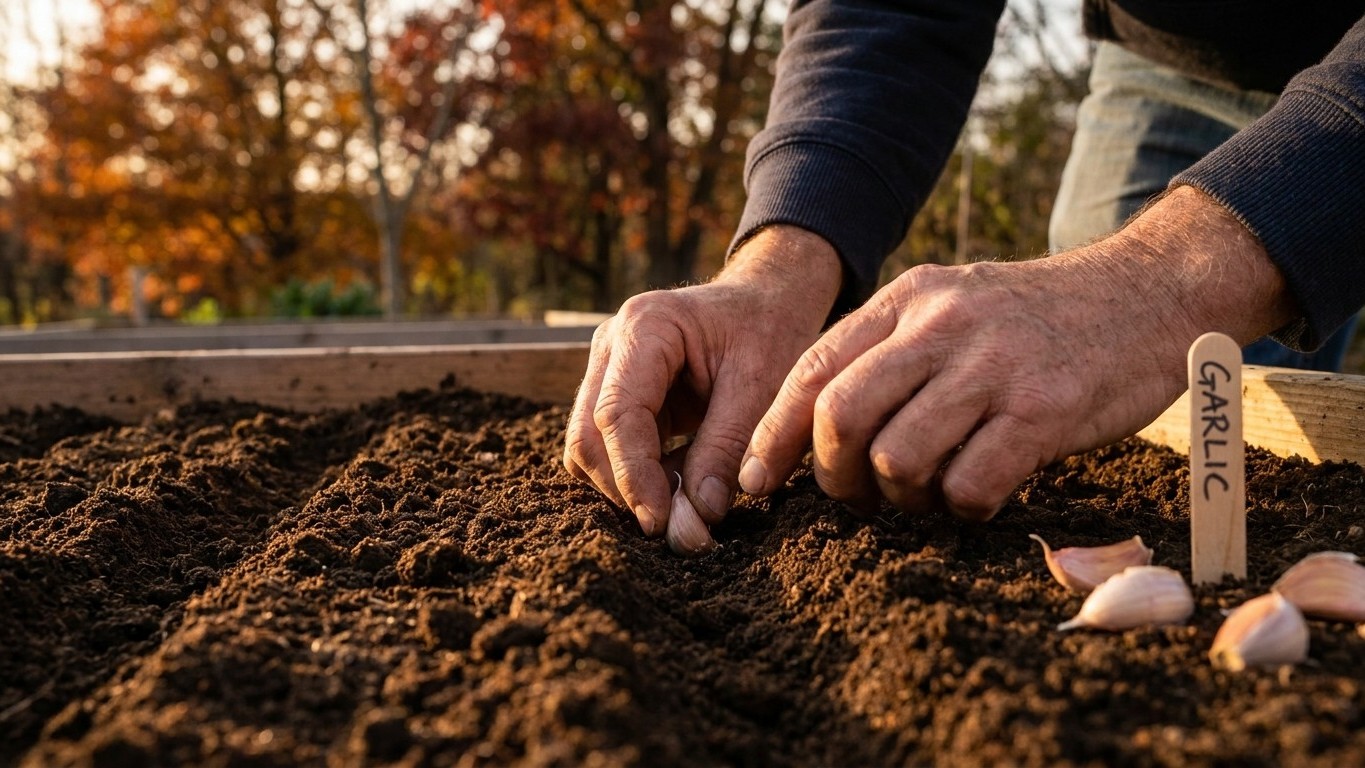

October in Indiana splits into two different gardens. Through the first half of the month, soil is still warm enough to get garlic, shallots and a last round of hardy greens established outdoors. By the back half, the first fall frost arrives (October 21 to October 30 at the Indianapolis reference station), and the job shifts to protecting what’s left, finishing the harvest and putting beds to bed. Garlic cloves and cover crop seed are the safest bets from the first day of the month to the last.
What goes in the ground in October

The decision this month isn’t the calendar, it’s soil temperature and where you fall on the frost window. Indianapolis data puts the first 32°F freeze between October 21 and October 30, which means the first three weeks of the month are still workable ground for anything that tolerates cool nights, while the last week or so is when the odds tip toward a hard stop.
Garlic and shallots are the headline crop. Both go into the ground as individual cloves or divided bulbs, and October timing gives them enough weeks to root before the soil locks up without pushing top growth that would get burned by frost. Plant them 6 to 8 weeks ahead of the ground freezing solid, which in most of Indiana still leaves room clear into November in a mild fall, but October is the safer, less rushed window.
Cover crops earn their keep here too. Cereal rye, winter wheat and crimson clover can all be direct sown through the month; they germinate in cool soil, hold the bed against erosion over winter, and get turned under come spring. Cold-hardy greens like spinach and mâche can still be direct sown or transplanted in the first half of the month for a late fall cutting or an overwintered crop under a cold frame.
What’s a gamble: anything tender. Lettuce transplants set out after mid-month are racing the frost window and need row cover on standby. Peas sown this late in Indiana rarely mature before the ground turns cold, so they’re better saved for a spring sowing. The rule holds across the state: if it can shrug off a light frost, October is fine; if it can’t, it’s either under cover or it waits.
What to start under cover
Starting seeds under cover in October means counting backward from the first fall frost window, not forward from today. Take baby-leaf spinach or mâche, both around 30 to 40 days to a first cutting. Sown under a cold frame or low tunnel in the first days of October, they have just enough runway to reach a usable size before the October 21 to October 30 frost window at Indianapolis slows growth to a crawl. The cold frame doesn’t stop that slowdown, but it buys extra weeks afterward by keeping soil a few degrees warmer than the open air, which is often the difference between one cutting and three.
The arithmetic is worth redoing for whatever’s actually going in the tray. A crop that needs 50 days sown at the start of the month is asking to finish right around the frost window itself, no cushion. Push it a week earlier if the seed packet or your own records say it runs slow in cool soil.
Two ways this goes wrong. Start too early under grow lights indoors and the seedlings stretch and go rootbound before there’s anywhere reasonable to put them, especially with cooling soil outside slowing their transplant shock recovery. Start too late and the plants never build enough root mass to survive under a cold frame once nights drop hard, so they sit stalled rather than growing. The safer habit is sowing in small batches a week apart rather than one big tray, so at least one batch lands in the right window.
What is ready to pick
October is still a real harvest month in Indiana, not a scraping-the-barrel one. Fall brassicas, broccoli, cabbage, kale and brussels sprouts, are often better after a light frost than before it; the cold triggers starches to convert to sugar, which is why kale picked in late October tends to taste sweeter than the same plant in September. Root crops, carrots, beets, turnips, can stay in the ground and be pulled as needed, since cool soil is effectively free refrigeration.
Winter squash and pumpkins should be off the vine before that first hard frost hits, since frozen skin shortens their storage life dramatically even if the flesh looks fine at first. Check the stem: it should be dry, hard and corky, a sign the fruit has finished sizing and hardening.
For anything already in storage from earlier harvests, October is a good month to walk the shelves. Winter squash, potatoes and onions all throw off a soft spot or a sweet smell before they visibly rot, and pulling that one bad specimen now keeps it from taking down its neighbors in the bin. Sprouts and microgreens grown on a windowsill are also worth starting if outdoor harvest is starting to thin, since they’re ready in under two weeks regardless of what the weather’s doing outside.
The jobs that matter this month
October’s real value is in the work that either pays off through winter or costs you the whole next season if it slips. Cleaning up spent plants tops the list: diseased tomato and squash foliage left on the ground overwinters fungal spores and insect eggs right where next year’s crop will go in. Pull it now, not in spring when the damage is already baked into the soil.
Soil testing is worth doing before the ground freezes, since amendments like lime take months to shift pH and fall applications have all winter to work before spring planting. Pair that with a load of compost turned into beds now rather than waiting for a rushed spring window.
Mulching matters differently depending on the crop. Garlic beds get a light straw mulch after planting to buffer freeze-thaw cycles that can heave cloves out of the ground. Perennial beds and strawberry patches benefit from a heavier layer once the first hard frost has knocked back top growth, not before, since mulching too early traps warmth that delays the dormancy the plant actually needs.
Beyond the beds: dormant pruning of stone fruit and berry canes can start once leaves drop, tools deserve a real cleaning and sharpening before they sit unused for months, and seed catalogs for the next growing season start circulating in fall, which makes October a smart time to order popular varieties before they sell out. Fences, raised bed frames and cold frame glazing are also easier to repair now, standing in a mild afternoon, than in January with gloves on.
What not to do in October
The most common misstep is trusting a warm afternoon over the calendar. A run of 70-degree days in early October doesn’t mean the frost window has moved; it means the ground is still catching up to the air, and a clear, calm night can still drop temperatures fast enough to catch uncovered tender plants off guard. Keep row cover or an old sheet within reach all month, not just in the final week.
A related error is uncovering cold frames or tunnels too eagerly after a mild stretch. Plants that have adjusted to a slightly buffered environment can get shocked by a sudden cold snap if the protection comes off a week too soon. Leave it on longer than feels necessary; the greens underneath are rarely bothered by a little extra warmth.
Nitrogen fertilizer is the other classic mistake. Feeding it to perennials, fruit trees or lawns late in the fall pushes soft new growth right when the plant should be hardening off for winter, and that new growth is exactly what frost damages first. If beds need feeding, favor compost or a balanced amendment worked in for spring rather than a nitrogen boost now.
Last, don’t let winter squash, tender herbs or the last tomatoes ride out that first frost warning hoping for one more week. Harvest ahead of the forecast; a squash picked a few days early and cured properly beats one caught by a hard freeze on the vine every time.
Checking this against your own county
Everything above is anchored to Indianapolis, and that’s a starting point, not a set of instructions for every county. Southern Indiana typically runs a couple of weeks behind the northern part of the state when it comes to that first fall frost, and low-lying spots or areas near Lake Michigan’s shoreline can shift the window further still. Elevation and local topography move frost arrival by more than the state-level range suggests.
For a county-level read, Purdue’s extension service (extension.purdue.edu) publishes localized planting guidance and frost data that narrows this range considerably. Treat the dates here as the frame, and the local office as the fine print.
Common questions
Is it too late to plant garlic in October in Indiana?
No. October is close to ideal timing across the state, giving cloves 6 to 8 weeks to root before the ground freezes without pushing vulnerable top growth. Even a planting into early November usually works in a mild fall.
Can grass seed still be planted in October?
Cool-season grass seed does well in fall soil, but timing gets tighter as the month goes on since seedlings need several weeks to establish before hard frost. Early October is safer than late October for this reason.
What vegetables can handle a light frost in Indiana gardens?
Kale, brussels sprouts, cabbage, spinach and mâche all tolerate light frost well, and several, especially kale, actually improve in flavor afterward as the cold triggers sugar production in the leaves.
Should watering stop once the weather turns cold?
Not entirely. Newly planted garlic, cover crops and any fall transplants still need consistent moisture to establish roots before the ground freezes, even as overall watering frequency drops with cooler temperatures and shorter days.
Gardeners who plant by the Moon can check the October 2026 moon planting calendar, a tradition rather than a proven method.
Related guides
- What to Plant in Indiana in February
- When to Plant Cucumbers in Indiana
- When to Plant Melons in Indiana
- the Indiana planting calendar
- What to Plant in Indiana in September
Elsewhere? See what to plant in October in every state and province.