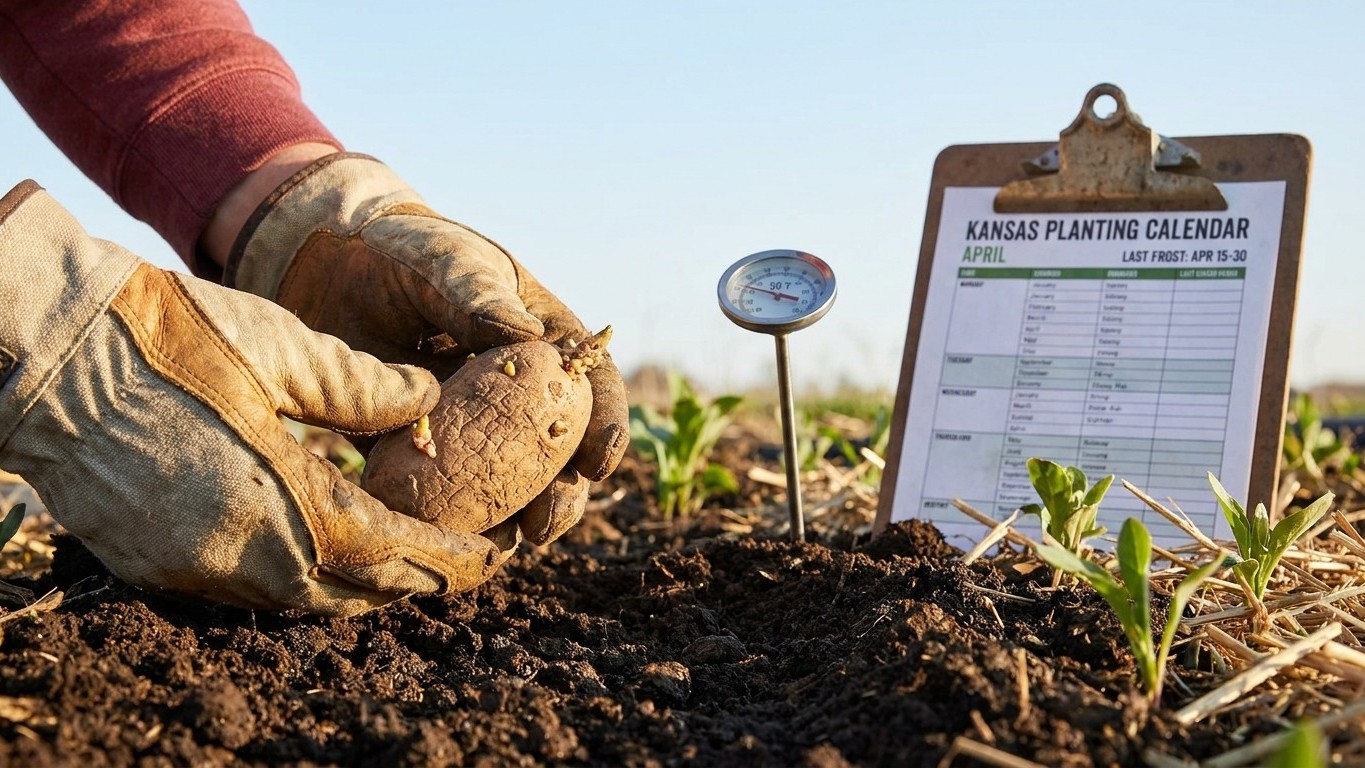

Kansas gardeners plant potatoes 14 to 21 days before their last spring frost, as soon as soil temperature hits 50°F, according to Utah State University Extension and the University of Maine Cooperative Extension. NOAA’s 1991-2020 Climate Normals put the last spring frost for a long-term Kansas reference station somewhere between April 4 and April 18. Count back from your own county’s date, not this one.
The short answer
Work backward from frost, not forward from the calendar. The NOAA NCEI dataset behind that April 4 to April 18 window measures the 30 to 70 percent probability of a 32°F freeze at one long-term airport weather station in Kansas. That’s a wide two-week spread for a single point on the map, and it exists because Kansas itself is wide: a garden in the southeast corner can be running eight to ten degrees warmer in early spring than one near the Nebraska line, and elevation shifts the number further still.
So the real answer isn’t a date. It’s a formula. Take whatever last-frost date applies to your specific county (your local extension office keeps that record), then subtract 14 to 21 days. That’s your planting window, and it lands well before the frost date itself because potatoes don’t wait for warm weather the way tomatoes do. Seed potatoes tolerate a light frost on emerging foliage; the tuber itself, buried several inches under soil, is insulated from the air temperature swings that would kill a pepper transplant overnight.
What actually triggers planting isn’t the frost date at all. It’s soil temperature. Utah State University Extension’s fact sheet on garden potatoes is specific: plant as soon as the soil reaches 50°F. In a Kansas spring, that threshold typically arrives inside that 14-to-21-day pre-frost window, which is why the two figures line up. But soil temperature is what you should actually be checking with a probe thermometer pushed four inches down, not a date circled on a wall calendar.
This matters more in Kansas than in a lot of states because of what happens at the other end of the season. The state racks up a serious number of days above 90°F, and that ceiling temperature isn’t just uncomfortable for the gardener. According to both Utah State and University of Maine Extension, soil temperatures above 90°F inhibit tuber set and fill outright. Watering more doesn’t reverse it. A potato plant caught sizing tubers during a Kansas July heat wave simply stalls, no matter how well it’s irrigated.
That single fact reshapes the whole planting strategy here. The goal isn’t to time potatoes for a long, leisurely summer harvest. It’s to get the crop planted early enough that tuber bulking happens in the cooler weeks of late spring and early summer, ahead of the heat ceiling, rather than trying to push a crop through the hottest stretch of the year and hoping it survives.
What actually decides it
Soil temperature, not air temperature
Air temperature swings by 20 or 30 degrees between a sunny afternoon and a clear night. Soil four inches down does not. That’s precisely why Utah State University Extension anchors its planting guidance to a 50°F soil reading rather than an air-temperature forecast: soil is the stable signal, and it’s the number that actually tells a seed piece whether it will rot in cold, wet ground or sprout. A gardener who plants the moment the air feels like spring, without checking the ground itself, is gambling on a number that hasn’t been measured.
The 90°F ceiling and why it caps the season from the top, not the bottom
Most vegetables in Kansas are limited by how late you can push planting before frost arrives in fall. Potatoes are limited by how much heat arrives in summer. Once soil temperatures climb past 90°F, tuber set and fill stop, according to both Utah State and University of Maine Extension. That’s a hard biological ceiling, not a slowdown that irrigation or shade cloth can talk the plant out of. It’s the reason a county with a high count of 90°F days needs an earlier planting window than one with a milder summer, even if both counties share the same last-frost date. The heat ceiling, not the frost date, is often the real deadline in Kansas.
Why the 14-to-21-day range isn’t one number
Extension sources give a range, not a single count, because soil warms at different rates depending on drainage, color, slope, and how much residue or mulch sits on top of it. A sandy, south-facing bed in a low-humidity stretch of the state can hit 50°F noticeably sooner than a heavier clay bed shaded by a fence line, even in the same town on the same week. That’s the mechanism behind the range: it isn’t extension offices hedging, it’s soil physics varying from one yard to the next.
Why frost data from one station isn’t your garden’s data
The NOAA NCEI freeze-probability record used here comes from a single long-term weather station, sited at an airport under specific, standardized conditions. Suburban yards and rural gardens routinely run one to two weeks later on their last spring frost and one to two weeks earlier on their first fall frost than that station shows, and low-lying or elevated ground shifts things further. Treat the April 4 to April 18 window as a reference point to count back from, then confirm the actual date for your county before you commit seed to the ground.
How to do it
- Find your county’s last spring frost date through your local extension office rather than relying on a single statewide figure.
- Buy certified seed potatoes. Uncertified seed carries viruses that stunt yield and spread to future plantings; certification is the one safeguard against starting the season with infected stock.
- Two to three weeks before that frost date, start checking soil temperature four inches deep with a probe thermometer, ideally in the morning before the sun has warmed the surface.
- Cut larger seed potatoes into pieces with at least one or two eyes each, then let the cut surfaces callus for a day or two before planting to reduce rot risk in cool, damp soil.
- Once the soil reads 50°F, plant seed pieces 3 to 4 inches deep and roughly 12 inches apart in rows spaced about 30 inches apart.
- Mound soil, straw, or mulch over the emerging shoots as they grow, both to protect them from a late light frost and to keep developing tubers covered and shaded.
- Track your local count of 90°F days and plan the harvest of an early-season-class crop before that heat becomes sustained, since tuber fill halts once soil passes that ceiling.
- Water consistently through tuber bulking, but recognize that irrigation cannot compensate once soil temperatures exceed 90°F; the fix is timing, not volume.
What goes wrong
- Planting by the calendar instead of the soil. A gardener who waits for a specific date rather than checking soil temperature can plant into ground still too cold, inviting rot, or too late, losing the cool window before the heat ceiling arrives. Check the ground with a thermometer, not a calendar page.
- Using saved grocery-store potatoes as seed. These are rarely certified and often carry viruses invisible to the eye that reduce yield and can persist in garden soil. Certified seed potatoes from a reputable source are the only way to start clean.
- Assuming a statewide frost date applies locally. The NOAA NCEI range comes from one reference station; a garden in a low-lying valley or at higher elevation can see frost dates shift by a week or two in either direction. Confirm the local figure before counting back.
- Pushing a crop through peak summer heat. Once soil passes 90°F, tuber set and fill stop, and no amount of extra watering restarts it. Where a county logs a high number of 90°F days, plant early enough to finish bulking before that heat arrives, rather than hoping the plant pushes through it.
- Skipping the soil-warming check after a warm spell. A few unusually warm days can trick a gardener into thinking the soil is ready when only the surface has warmed. Probe four inches down, not just at the surface, before planting.
- Leaving cut seed pieces unhealed. Planting freshly cut seed potatoes straight into cool, wet spring soil raises the odds of rot before sprouting. A day or two of callusing time reduces that risk.
Common questions
Can I plant potatoes in Kansas before the last frost date?
Yes, and that’s normal. Utah State University Extension’s guidance calls for planting 14 to 21 days before the last frost date, once soil reaches 50°F, because the seed piece and developing shoots tolerate cool conditions better than the mature foliage of most other vegetables.
What happens if I plant potatoes too late in Kansas?
Tuber set and fill are inhibited once soil temperatures climb above 90°F, according to Utah State and University of Maine Extension. A late-planted crop that’s still bulking tubers when that heat arrives will stall regardless of watering, which is why an early planting window matters more in a hot state than the frost date alone suggests.
Does it matter which season class of potato I choose?
It affects how much of the growing window you’re working with. An early-season-class variety finishes its bulking sooner, giving it a better chance of completing before sustained 90°F soil temperatures set in, compared with a late-season class that needs a longer stretch of cool-to-moderate soil.
Why does my neighbor’s frost date seem different from what I found online?
Statewide or single-station data, like the NOAA NCEI range used here, reflects one long-term weather station. Suburban and rural gardens commonly see their last spring frost arrive later and their first fall frost arrive earlier than that station shows, sometimes by one to two weeks, with elevation pushing the gap even wider. Local extension records are the better check for your specific ground.