
Ohio gardens get about an inch of rain a week during peak summer growth, but that average hides real swings: some weeks deliver almost nothing, others dump it all in one storm that mostly runs off. The right container and watering rhythm depend on knowing exactly where your soil and your summer sit against those numbers.
What changes here

Two numbers set the terms for every Ohio garden: August, the driest summer month, brings only 3.74 inches of rain, and the state averages 15.3 days a year at or above 90F. Read together, that’s a short stretch of genuinely dry weather layered on top of real heat load, which means the soil dries out fast right when plants are working hardest to cool themselves and fill out fruit.
Do the arithmetic and the gap becomes concrete. A vegetable bed or a container garden wants roughly one inch of water a week to keep roots supplied. August’s 3.74 inches, spread over a 31-day month, works out to about 0.84 inch a week from the sky alone. That leaves roughly 0.16 inch a week that has to come from a hose or watering can, assuming the rain falls evenly, which it rarely does. A single August thunderstorm can drop half an inch in twenty minutes and then nothing for ten days, so that theoretical shortfall of under a fifth of an inch can easily balloon into a full inch of hand-watering during a dry stretch.
Soil texture decides how much of that rain actually reaches the roots. A sandy container mix lets water drain through within hours, so the plant only “sees” moisture right after it falls. Heavy clay, common in much of Ohio’s glaciated ground, holds water for days and can still be damp a week after a storm, which changes the whole calculation: the same 3.74 inches that leaves a sandy pot thirsty by Thursday can keep a clay-heavy garden bed adequately moist through the weekend. Neither number, the rainfall or the heat days, tells the whole story on its own. Together they explain why an Ohio gardener can’t rely on “an inch a week” as a fixed rule, only as a target to check against what’s actually happening in their own pots and beds.
How to water when it matters
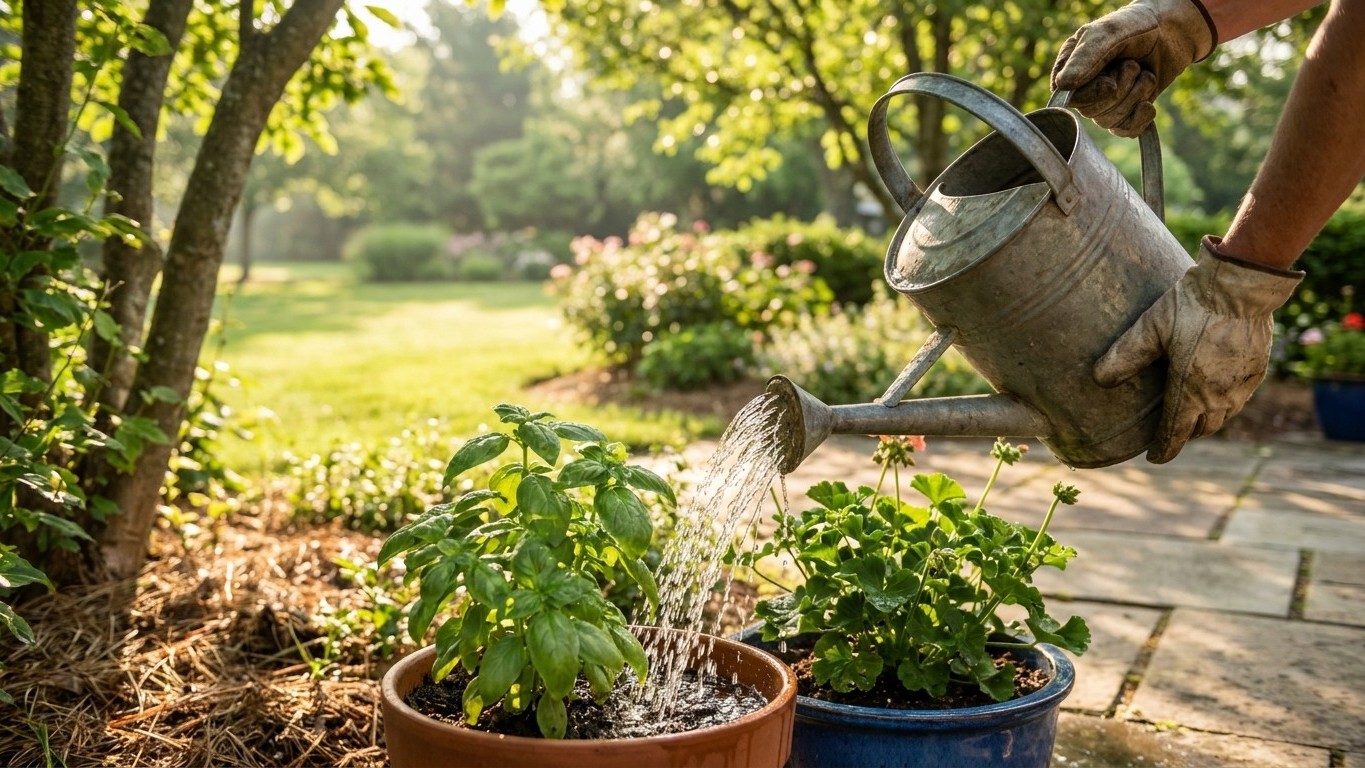
The method that works in Ohio isn’t complicated, but it has to answer to the two numbers above: short bursts of heat that spike demand, and a dry month that doesn’t reliably refill the soil. Deep, infrequent watering at the base of the plant, done in the morning, beats a light daily sprinkle for one simple reason, it trains roots to grow downward into cooler, more stable soil instead of staying shallow where the sun bakes them within a day or two.
Morning watering also matters mechanically, not just as habit. Water applied early gives foliage time to dry before evening, which matters because damp leaves overnight are exactly what fungal diseases like powdery mildew and blight need to take hold. Watering at the base rather than overhead skips that risk entirely and also wastes less to evaporation during Ohio’s hotter afternoons.
Checking the soil beats guessing every time. A finger pushed two inches into the soil, or a trowel pulled up for a quick look, tells you whether the root zone is actually dry. Surface soil can look parched within hours of a heat day even when the ground six inches down is still moist, and the reverse happens too after a quick rain shower.
Texture changes the rhythm more than the total amount. Sandy soil and lightweight container mixes hold little water, so they need shorter, more frequent soakings, sometimes every other day during a 90F stretch. Heavy clay holds a week’s worth of moisture but drowns roots if it’s watered again before it’s had a chance to dry, so the same schedule that works for a sandy bed can kill a clay one through waterlogging.
- Start with about one inch of water applied at the base once or twice a week, adjusting up during the 15.3 days a year that hit 90F or above.
- Water in the early morning so foliage dries before evening and the plant has moisture on hand before peak heat.
- Check soil moisture with a finger or trowel two inches down before every watering, not on a fixed calendar.
- Extend the interval on clay-heavy ground until the top few inches have actually dried; shorten it on sandy or container soil that drains fast.
- Treat any single number as a starting point, then adjust it against what your own soil tells you within the first two weeks.
What goes wrong
Watering a little every day
A light daily splash feels responsible, but it only wets the top inch or two of soil. Roots follow the water, so they stay shallow, and shallow roots are the first to suffer once a 90F day arrives and that thin layer of moisture evaporates by early afternoon. Ohio’s heat days aren’t constant, but when they hit, they punish exactly this habit.
Watering leaves in the evening
Wetting foliage after dinner seems convenient, but the water sits on the leaves all night instead of drying off. That combination of moisture and warm nighttime air is close to ideal for the fungal diseases that show up on Ohio tomatoes and squash by midsummer.
Trusting a rain shower
A ten-minute August storm can look like it solved the watering problem, but it often wets only the top half-inch of soil before running off, especially on compacted or clay ground. The only way to know is to check with a finger or trowel rather than assume the sky did the job.
Skipping mulch
Bare soil loses moisture to evaporation fast, particularly during those 15.3 days a year of 90F heat. A two- to three-inch layer of mulch slows that loss and keeps the root zone from swinging between soaked and bone-dry, which is the more expensive mistake on Ohio’s clay soils: a bed that never fully dries between waterings ends up with roots sitting in water they can’t use, and that leads to rot rather than drought stress.
Local help
Ohio State University Extension offers county-level guidance on soil testing, planting schedules, and watering practices suited to local conditions. Watering restrictions vary by municipality and change with drought conditions, so check with your local water provider before setting a fixed outdoor watering schedule.
Common questions
How often should I water container plants in Ohio during summer?
Check soil moisture two inches down every other day during hot stretches; Containers dry faster than garden beds because they hold less soil volume and drain more freely.
Is August really the driest month in Ohio?
Yes, at the reference station used for state climate normals, August averages 3.74 inches of rain, less than June’s 4.33 inches or July’s 4.67 inches, making it the point in summer when supplemental watering matters most.
Does clay soil mean I can water less often?
It means you should water less often but more deeply. Clay holds moisture for up to a week, and watering again before it dries risks waterlogging and root rot rather than helping the plant.
Do watering needs change on the 90F days?
Yes. Ohio averages 15.3 such days a year, and each one raises evaporation and plant stress sharply, which is why the same soil that needed no water on a mild week may need attention within a day or two once temperatures spike.