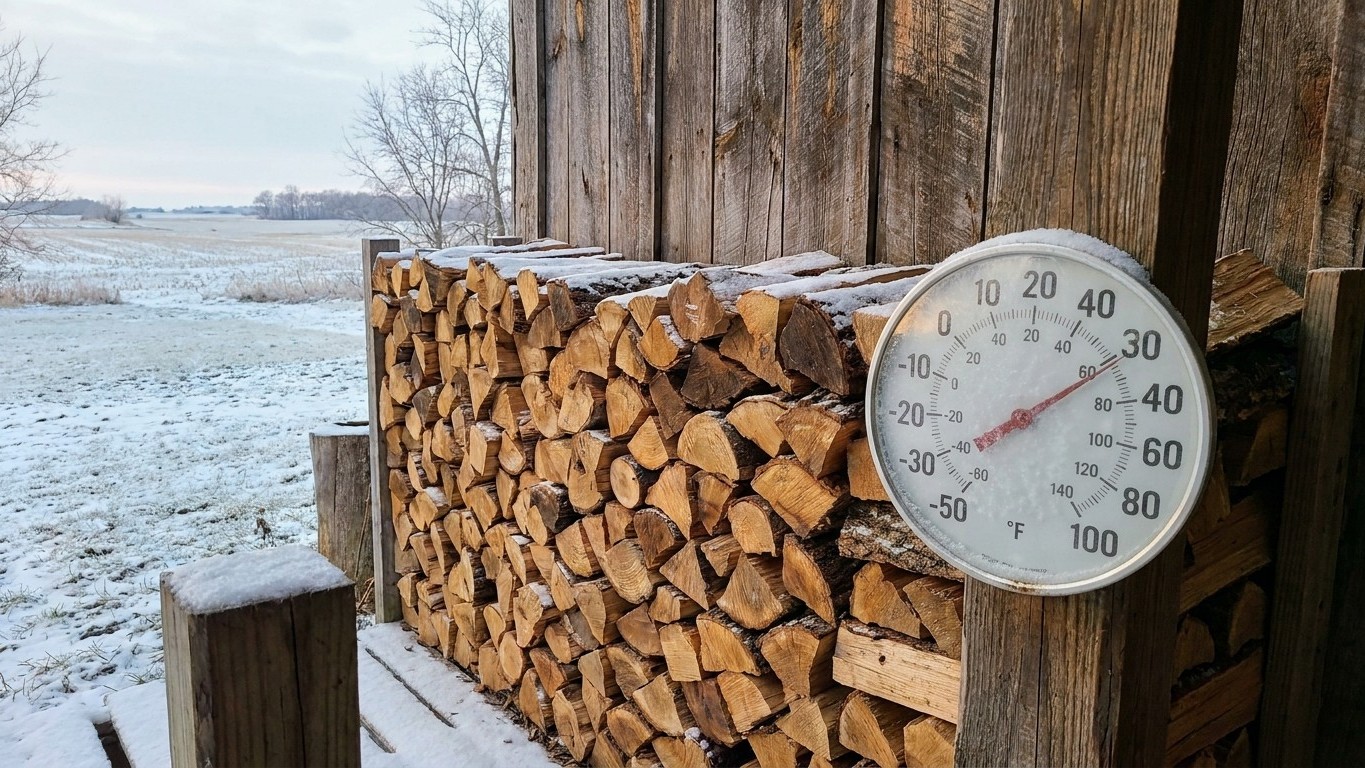

Iowa winters don’t ask a firewood buyer for taste. They ask for pounds. The state’s coldest month bottoms out at an average low of 13.8°F, and that single number decides how much wood you’ll burn, which species are worth chasing, and how far ahead of the cold you need to start stacking.
How cold it actually gets here

Des Moines, the reference point for central Iowa, sees an average daily low of 13.8°F in the coldest month of the year, according to NOAA’s 1991-2020 Climate Normals. That’s not the record low some old-timer will tell you about from a bad January decades back. It’s the average minimum, the temperature the thermometer tends to land on night after night through the worst stretch of winter. And it matters more than any single cold snap, because it tells you what your heating system, wood or otherwise, has to sustain for weeks at a time.
Thirteen degrees above zero is not a mild-climate number. It sits well below freezing, cold enough that a house depending on wood heat needs fuel that holds a fire overnight without constant tending, and cold enough that a poorly insulated home can lose heat faster than a stove can replace it. This is not a climate where firewood is a mood-setter for a few chilly evenings. It’s a climate where, for anyone using wood as a real heat source, the wood itself becomes part of the insulation strategy.
What this means for how you burn
A 13.8°F average low means long burn cycles matter. Nobody wants to wake up at 3 a.m. to a cold stove when the outside air is in the teens. That pushes the whole conversation toward density and moisture content rather than convenience or aroma. It also means the shoulder seasons, October and April in much of Iowa, behave differently than the January-February core of winter. Wood that’s fine for a 40-degree evening in October won’t do the same job in a stretch where the mercury doesn’t climb back above freezing for a week.
None of this means Iowa winters make wood heat impossible or even especially hard. Wood stoves and inserts handle 13.8°F lows across the Upper Midwest every year. But it does mean the margin for error is thinner than in milder states, where a green log or an under-filled woodshed is a comfort problem rather than a real one. Here, the numbers below aren’t decoration. They’re the difference between a stove that carries you through the night and one that doesn’t.
Which woods are worth the effort here
Once the cold figure is on the table, the next question is simple: how much heat does a given volume of wood actually deliver? A cord, the standard unit for firewood, is a stack measuring 4 feet by 4 feet by 8 feet, or 128 cubic feet total. According to Michigan State University Extension, a cord of well-seasoned hardwood carries roughly 20 million BTU, which works out to about the same heat as 145 gallons of #2 fuel oil or 215 gallons of LP gas. That’s the baseline every wood-burning household in Iowa is really buying, whether they think in cords or in gallons.
But that 20 million BTU figure is an average, and averages hide a lot. Species and moisture content move it substantially in either direction. A cord of dense, fully seasoned hardwood packs more usable heat into that same 128 cubic feet than a cord of lighter wood, simply because density and BTU output track each other closely. Since a cord is a fixed volume, not a fixed weight, the density of what’s inside that stack is what separates a wood pile that gets you through a 13.8°F night from one that needs constant feeding.
The one named exception worth knowing
Red oak is the clearest documented example of how species behavior complicates the simple “dense equals better” logic. MSU Extension notes that red oak’s cell structure makes it dry more slowly than other woods, meaning it needs more time stacked and split before it reaches burnable moisture levels. That’s a case where a genuinely dense, high-BTU wood can still let a homeowner down if it wasn’t given the extra season it needs. Density buys you heat only after the water inside the wood has had time to leave.
The practical takeaway for an Iowa household isn’t a ranked list of species to chase. It’s a mindset: prioritize whatever dense hardwood you can reliably get seasoned, and treat availability as seriously as density. A theoretically superior species that only comes to you green, or that you can’t source consistently through a Midwest supplier, is a worse choice than a solid, moderately dense wood you can actually get dry in time. Local firewood dealers and co-ops in Iowa tend to sell what grows regionally and what seasons predictably in the state’s climate, and that local reality often matters more than any chart.
| Category | Typical role | Seasoning consideration |
|---|---|---|
| Dense hardwood (e.g., red oak) | Overnight burns, coldest nights of winter | Needs a full season or more, dries slowly |
| Lighter, faster-drying wood | Starting fires, shoulder-season heat | Reaches 20% moisture faster but burns down quicker |
How much wood a winter takes
There’s no honest single answer to “how many cords for an Iowa winter,” and anyone who gives you one number without asking follow-up questions is guessing. The real estimate depends on three things working together: how cold your specific stretch of the state actually gets, how well your house holds onto the heat you generate, and whether wood is doing all the heavying lifting or just supplementing a furnace.
Start with the cold figure. A home near Des Moines dealing with that 13.8°F average low through January and February needs a different fuel plan than a supplemental fireplace used a few evenings a month. Insulation is the second variable, and it moves the number more than most people expect. A poorly insulated older farmhouse, with drafty windows and minimal wall insulation, can burn through nearly double the wood of a tightly built, well-sealed home experiencing the identical outdoor temperatures. The heat generated by the stove simply leaks out faster, so the fire has to work twice as hard to hold the same indoor temperature.
The third variable, whether wood is primary or supplemental heat, changes the math again. A household running a wood stove as the sole heat source through a full Iowa winter is burning wood essentially around the clock during the cold months. A household using a fireplace insert to take the edge off a furnace’s workload on the coldest nights is burning a fraction of that volume, even in the same house, in the same winter.
That’s why a published “X cords per winter” figure floating around online is close to useless without knowing which house it’s describing. The better approach is to track your own burn rate through one full winter, note how many cords you actually used, and adjust from there based on how that winter’s cold compared to a typical Iowa season. Buying a little extra the first year, and storing well-seasoned surplus for the following season, beats running short in February.
Drying wood in this climate
Seasoning matters more than species selection almost everywhere firewood gets burned, and Iowa is no exception. MSU Extension puts the usable target at 20 percent moisture content or less, while green, freshly cut wood can carry over 60 percent moisture. That extra water has to boil off before the wood releases any of the heat you’re counting on, and boiling it off eats energy that would otherwise be warming your house. Wood that looks fine in the woodshed but hasn’t actually dried down is quietly stealing BTUs from every fire you build with it.
Iowa’s climate shapes how long that drying takes. Humid Midwest summers slow moisture loss compared to drier Western states, and the state’s growing season for drying wood is bounded by winters that arrive early enough to cut the process short if you’re not ahead of schedule. What actually dries wood is airflow and time, not direct sun exposure, which is why split, stacked wood with space between rows outperforms a dense, unsplit pile every time, regardless of where it sits.
Wood that’s split and properly stacked, off the ground and with air moving through the rows, typically reaches that 20 percent target after one full summer of seasoning. Red oak is the documented exception, needing longer because of how its cell structure resists moisture release. That timeline creates the single most common mistake among Iowa wood burners: cutting and splitting wood in spring, then expecting it to be ready for that same winter’s fires. In most cases, it isn’t. Wood seasoned this spring is really being prepared for next winter, not this one, and planning a full season ahead is what keeps a woodpile actually useful when the temperature outside settles into the teens and stays there.