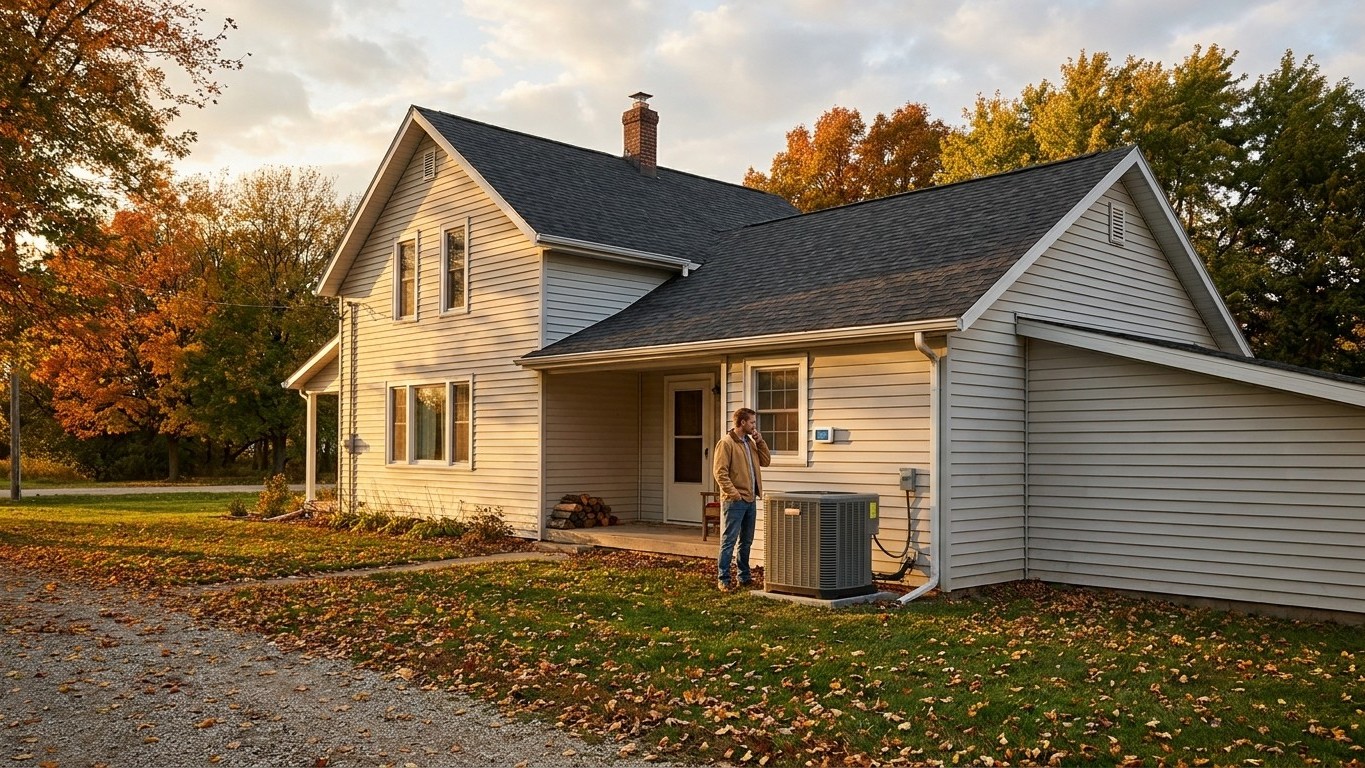

In Iowa, heating season typically begins in October, when the average monthly temperature first dips below 65°F, and it doesn’t let go until June. That’s roughly eight months of possible furnace use, with the coldest stretch landing in January. But the calendar only tells part of the story. What matters for your house is how hard that season pushes your system, and that depends on numbers most homeowners never see.
When the heating season starts in Iowa

At Des Moines International Airport, the National Oceanic and Atmospheric Administration’s 30-year climate normals put the monthly average temperature at 53.2°F in October, the first month that drops below the 65°F baseline used to calculate heating degree days. That baseline isn’t arbitrary. NOAA uses 65°F because it’s roughly the point below which most buildings need supplemental heat to stay comfortable. Once a month’s average temperature falls under that line, the heating clock starts running for that month.
Demand climbs steadily after October, peaks in January at 1,322 heating degree days, and then eases back through spring. By June, the monthly average climbs back above 65°F and the season effectively closes, at least at this reference station. That’s an eight-month run, start to finish. It also means the switch doesn’t happen on a specific day. A monthly normal is an average built from three decades of data, so the first real cold snap of any given year almost always arrives before the calendar says it should. Treat October as a signal to get ready, not a start date to circle.
Here’s what the season looks like month by month, in heating degree days:
| Month | Heating Degree Days |
|---|---|
| January | 1,322 |
| February | 1,068 |
| March | 796 |
| April | 421 |
| May | 153 |
| June | 15 |
| August | 4 |
| September | 86 |
| October | 383 |
| November | 773 |
| December | 1,156 |
Notice July doesn’t appear at all. There’s no heating degree days recorded for that month at this station, meaning the furnace has essentially nothing to do in the dead of summer. Everything else, from the trailing warmth of August through the deep freeze of January and back around to the last chill of June, shows up somewhere on the chart.
How hard the winter works here
Des Moines racks up about 6,178 heating degree days a year on the same 65°F base. That figure is the closest thing to a fuel gauge for the whole season: it adds up, day by day, how far below 65°F the average temperature sat, then totals it for the year. A house with double the heating degree days burns roughly double the fuel to stay at the same indoor temperature, all else equal. It’s a blunt but useful yardstick.
What the annual number doesn’t show is shape, and that’s where the monthly table earlier does the real work. Two places can post the same yearly total in very different ways. One might spread a moderate chill across ten months. Another might cram nearly all of it into a brutal three-month stretch. Iowa’s pattern, based on the monthly breakdown above, leans toward a long season with a sharp, well-defined peak in the dead of winter rather than a flat, evenly distributed chill. That’s worth knowing before you size up your fuel budget or decide how much runway you need before the cold really sets in.
The same station also logs about 1,070 cooling degree days a year, a reminder that Iowa homes work in both directions: real winters and real summers, not a mild climate that leans one way all year.
What most homes in Iowa actually heat with
According to the U.S. Energy Information Administration’s Residential Energy Consumption Survey, here’s how Iowa households heat their homes and what fuels they run on:
| System or Fuel | Share of Homes |
|---|---|
| Furnace | 83% |
| Steam or hot-water boiler | 7% |
| Central heat pump | 4% |
| Natural gas | 71% |
| Electricity | 16% |
| Propane | 13% |
Fuel oil or kerosene use in the state wasn’t reliable enough to publish a figure, which isn’t the same as saying nobody uses it, just that the survey sample was too thin to report with confidence.
The dominant setup here, by a wide margin, is a furnace running on natural gas. That combination shows up in this many homes because it was cheap and widely available when a lot of the state’s housing stock went up, not because it’s automatically the right fit for every house today. A furnace heats fast and recovers quickly after a cold snap, which matters in a state that swings from single digits to sweater weather within days. Its weak point is almost always the ductwork carrying that heat around the house, and the one maintenance task that gets skipped most often, the air filter, is exactly the one that punishes you for ignoring it: a clogged filter chokes airflow, forces the blower to work harder, and can shorten the life of the whole unit.
Run it once before you need it
Every heating system in the state fails on roughly the same schedule: the first genuinely cold night. That’s also the night every HVAC technician within fifty miles is already booked solid. The fix is to test the system weeks ahead, sometime in October before the real cold sets in, not in December when something goes wrong.
- Change or check the filter. This costs a few dollars and takes two minutes, and a clean filter is the single biggest factor in how efficiently the system runs all winter.
- Clear the space around vents, registers, and radiators. Furniture, curtains, and boxes blocking airflow force the system to work harder for less comfort.
- Run a short test cycle and listen. Set the thermostat up a few degrees and let the system kick on. Banging, grinding, or a burning-dust smell on that first firing of the season is normal, that’s just dust burning off the heat exchanger, but a smell that lingers or gets worse is not.
- Test the carbon monoxide alarm. A furnace that’s malfunctioning can produce carbon monoxide, an odorless gas, so a working alarm is a basic safety check, not optional.
- Check registers and returns for dust buildup or damage. Visible gaps or crushed ductwork near accessible sections are worth noting even if you can’t fix them yourself.
- Call a professional if anything above raises a flag. Persistent odd noises, a smell that doesn’t clear, an alarm that fails its test, or a system that won’t hold a cycle all mean it’s time for someone qualified to look before the real cold arrives.
Even a system that passes every one of these checks isn’t the whole story. The U.S. Department of Energy notes that in a typical house, “about 20%-30% of the air that moves through the duct system is lost due to leaks, holes, and poorly connected ducts.” That’s air paid for and heated, then lost before it reaches a single room, which explains a lot about the room that never quite warms up no matter how long the furnace runs.
What turning it down is actually worth
The Department of Energy states it plainly: “You can save as much as 10% a year on heating and cooling by simply turning your thermostat back 7-10 F for 8 hours a day from its normal setting.” That’s a yearly figure tied to a specific setback held for a specific stretch of hours, not a per-degree formula and not a savings that applies to heating alone.
In a state where the heating season stretches across roughly eight months, from October’s first chill through June’s last cool mornings, that setback has a long runway to work. The longer the furnace would otherwise be running to hold a steady temperature, the more hours a modest, consistent setback has to quietly chip away at the total. A programmable or smart thermostat set once in the fall does that work automatically, without anyone remembering to touch the dial every night.