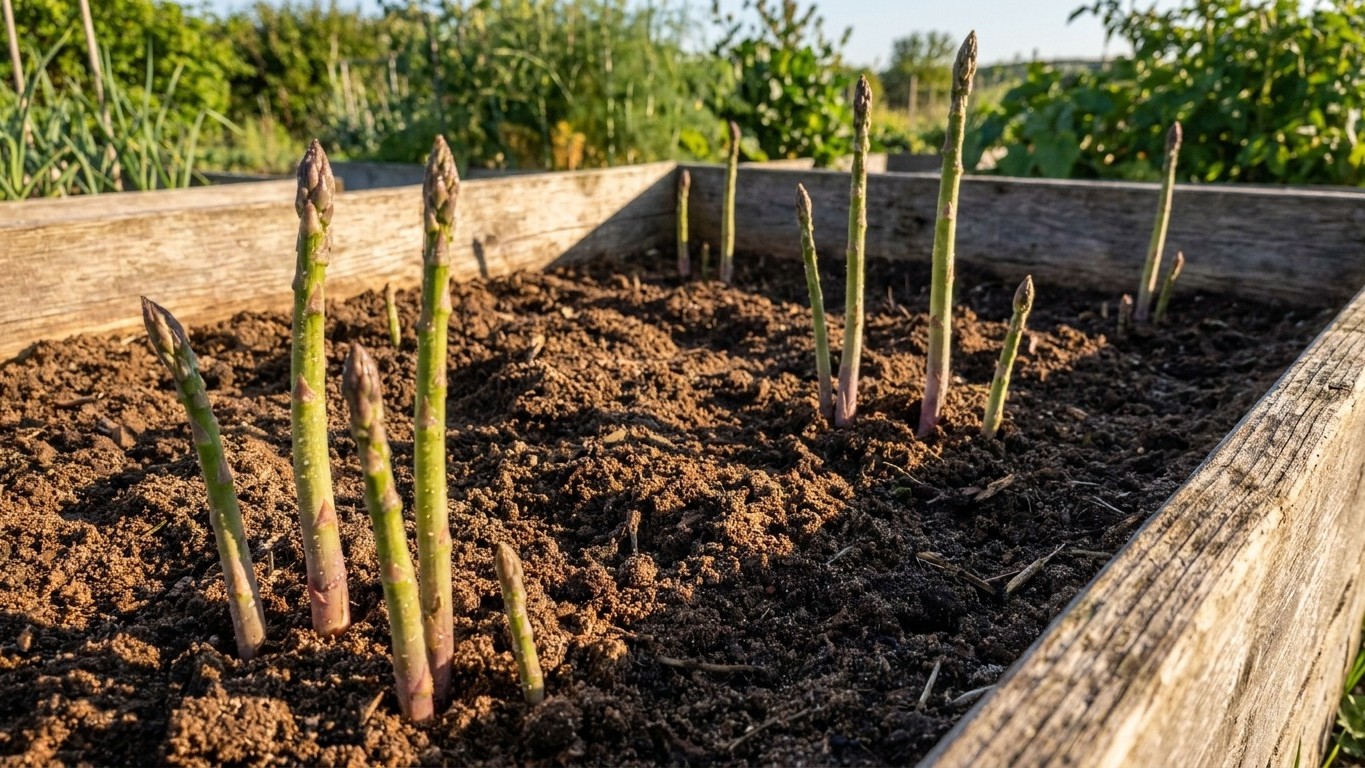

The biggest thing eating an Iowa asparagus bed is time: no harvest until year 3, then a patch that has to stay put for a decade or more. For insects and animals, your county Extension office is the place to ask.
The short answer
A bed planted today is a bed you live with for 10 to 15 years. Utah State University Extension says asparagus goes in as crowns, is not harvested until year 3, and then produces for that long stretch. Its single soil requirement is short: most soils will do, provided they are well drained. Everything else about growing asparagus in Iowa sits on top of that one condition.
What Iowa’s state soil tells you
Iowa’s representative soil is the Tama series, a Mollisol, the deep, dark prairie ground that made the Corn Belt. USDA’s records for the surface layer show 4 percent sand, 26 percent clay and 70 percent silt, with organic matter around 3.5 percent and a surface pH of about 6.5, slightly acid. That makes it a fine-textured soil that holds moisture longer than sand does. USDA also rates it well drained, and that rating is the one that matters here.
So the plain answer is yes. The dominant soil in Iowa drains well enough for a fifteen-year bed. The asparagus source gives no pH target. The 6.5 describes the Tama series as mapped, not your yard.
When your ground is not Tama
A state soil is a starting point, not a diagnosis. Iowa spans hundreds of soil series, and river bottoms, hill country and any lot a builder has scraped or filled can behave nothing like Tama. In most gardens a heavy patch is a yearly nuisance you amend and move on from. With asparagus it is a decision you can’t undo, because the crowns sit in the ground for the life of the bed.
The planting method raises the stakes. Crowns go into furrows 8 inches deep, and a trench is the lowest point in the bed. On ground that sheds water slowly, that trench is where water collects. The test is cheap: after a soaking rain, dig a hole where the bed will go, fill it with water, and see how long it takes to empty. Use your own judgment. If water is still standing the next day, don’t plant there.
If your best spot fails the test, the sensible moves are to pick a different spot or to build a raised bed. A soil test will give you your own numbers, and the Iowa soil and drainage page goes deeper on whether your ground can hold a bed for fifteen years.
Will the summer here water it for you?
The bed asks for 1 to 2 inches of water every other week for the first two years, then every three weeks after that. Iowa’s summer delivers a good share of that on its own. Over June, July and August, the reference station records about 13.2 inches of rain, out of 36.5 inches for the whole year. By month it runs 5.26 inches in June, 3.82 in July (the driest) and 4.17 in August.
On paper, even July works out to a bit under 2 inches per two-week stretch. These are 30-year normals for one station, though, not a forecast and not your plot. Averages hide the weeks when it doesn’t rain, and a single thunderstorm can drop an inch that mostly runs off. Here is how to turn the normals into a watering routine:
- Put a rain gauge on the plot. It settles the question better than any regional figure. A slope, a city heat island or a windbreak can change what your bed receives.
- Add up two weeks of rain. In years 1 and 2, if the gauge shows less than 1 inch since the last good soaking, water to make up the difference, aiming for 1 to 2 inches in total.
- Count a storm as less than it looks. Hard rain on a hot day runs off before it soaks in. After a downpour, check the soil a few inches down before you skip a watering.
- Stretch the schedule after two years. From the third year, the target moves to every three weeks. The same gauge-and-shortfall method applies.
- Watch the heat. Days at or above 90°F drive evaporation. In a hot stretch, the bed loses water faster than the normals suggest.
How much you will actually add
In a normal Iowa summer, probably not much: a handful of top-ups in the dry weeks, mostly in July. A dry year could change that. Tama is well drained, so rain passes through it instead of pooling, which is what the asparagus wants but also means a dry spell shows up in the bed sooner. A fine-textured soil holds water longer than sand, so a clay-heavy or silty bed buffers a gap better than a sandy one would. Sandy ground would need far more help.
When to put the crowns in
Crowns go in during early spring. For Iowa, the anchor is the last spring frost: NOAA’s climate normals put it at around April 12 to April 24 (the 30 to 70 percent probability band for a 32°F freeze) at the reference airport station. A mean frost date is an average, so some years will beat it and some will blow past it.
Treat the airport dates as the optimistic end. Iowa State Extension’s county figures run about 4 days later in spring, so a gardener outside the airport’s neighborhood should lean toward the later end of that window. The month matters more than the exact day: soil workable, frost danger mostly behind you, crowns in the ground early. The planting-time page for Iowa takes the calendar further.
The planting routine, and the seed alternative
Set each crown in a furrow 8 inches deep. Then resist the urge to fill the trench in one go. The furrow is backfilled gradually across the first year, 2 inches every other month, so the growing shoots are never buried under a full load of soil.
Starting from seed is the alternative to crowns, and it is the slower road to the same bed. For varieties, four are named in the source, and only by sex: Jersey Giant and Jersey Knight are all-male, while UC 157 F1 and Purple Passion are male and female. No flavor, no yield and no reason to prefer one is published.
Whichever route you take, the waiting rule is firm. There is no harvest until year 3. In that first harvest season the picking runs 4 weeks, then 6 in the next, then 8 after that. Stop when most spears are thinner than a pencil. That is the signal, not a calendar week.
Common questions
Can I take a few spears before year 3?
No. The source is clear that asparagus is not harvested until year 3. After that, the first season runs 4 weeks, the next 6, then 8. The rule for stopping is an object rather than a date: quit when most spears are thinner than a pencil.
Does Iowa’s soil need fixing before I plant?
Not if you are on something like Tama, which USDA rates as well drained. Most soils will do for asparagus as long as they drain. But the state soil is not your soil. Check your own drainage, and get a soil test for your own numbers before committing to a fifteen-year spot.
Which variety should I pick?
The source names four: Jersey Giant and Jersey Knight (all-male), and UC 157 F1 and Purple Passion (male and female). It gives no flavor, yield or other reason to prefer one.
What pests should I watch for, and when?
Your county Extension office is the right place to ask what is active in your area.
One last detail on the furrow: the 2-inch, every-other-month backfill means a full year passes before the trench is level with the surrounding ground.