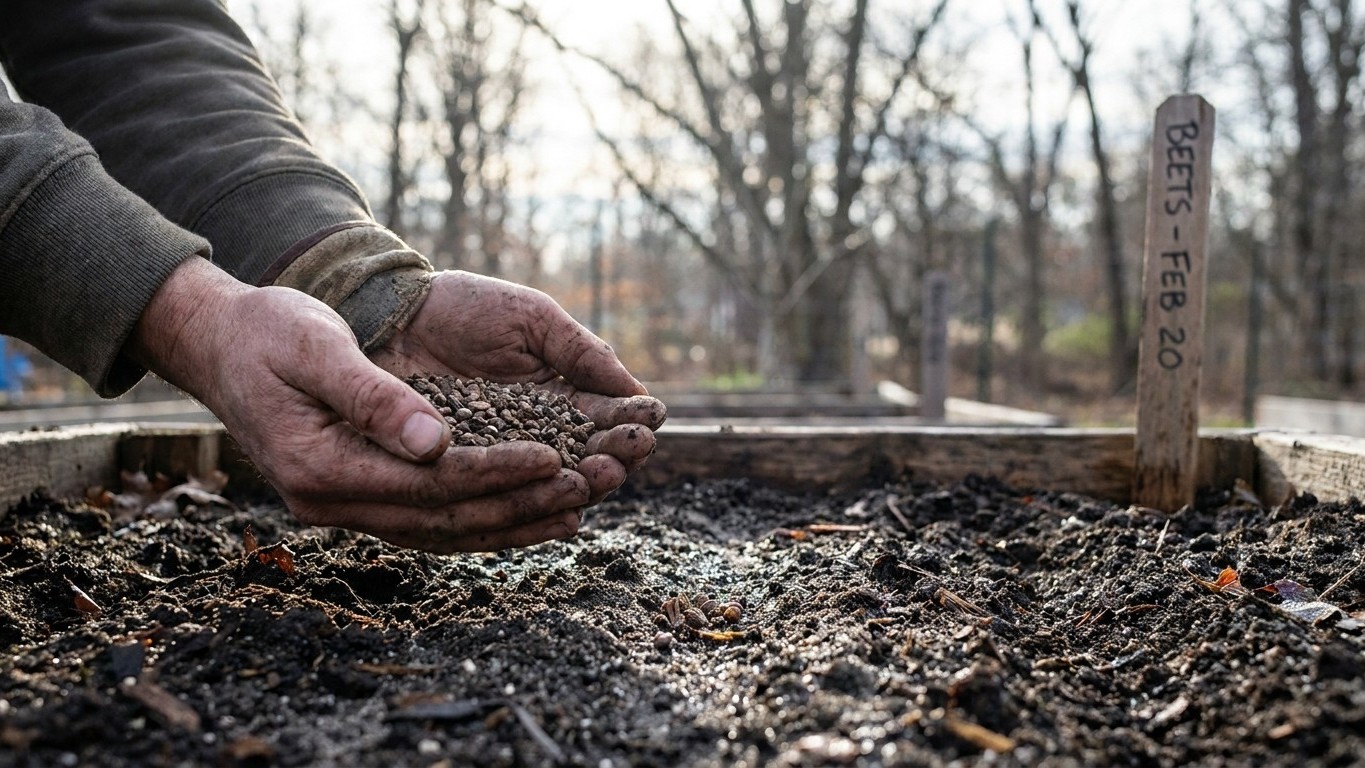

Sow beets in Iowa 2 to 3 weeks before the last spring frost, which for the state falls between April 12 and April 24. That puts seed in the ground roughly March 22 through April 10, though the exact date shifts by county, by soil, and by how the spring behaves that particular year.
The short answer
Iowa’s representative soil is the Tama series, a Mollisol, the deep, dark prairie soil that built the Corn Belt. Its surface runs slightly acid at about pH 6.5, and the texture leans heavy: 4 percent sand, 26 percent clay, 70 percent silt. Organic matter sits around 3.5 percent, and drainage is classed as well drained. That’s a useful starting point, not a verdict on any one yard. Iowa spans hundreds of mapped soil series, and a river-bottom lot, a hillside plot, or ground a builder has scraped and filled can behave nothing like Tama silt loam.
What that texture means for beets is worth sitting with. Beets grow best in deep, sandy, well-drained ground rich in organic matter, according to Utah State University Extension. Tama’s silt and clay content is the opposite of sandy. Silt-heavy soil holds water longer after a rain and can crust hard on top as it dries, which matters a great deal to a seed that needs to push through that crust to germinate. On the plus side, that same water-holding capacity buffers a beet root against short dry spells better than loose sand would, since beets are famously sensitive to water stress in their first six weeks.
The heat side of the equation matters too. Utah State’s guidance is specific: water stress combined with temperatures above 85 F is what turns a beet root woody. This page doesn’t have a published count of how many days a typical Iowa summer spends above 90 F, so that exact number isn’t stated here. What’s worth understanding instead is the mechanism, heat alone doesn’t ruin a beet, but heat layered on top of a thirsty plant does. That’s why timing sowing to avoid the hottest stretch of summer during root development matters more than the raw temperature number.
Put together, the short answer holds: aim for 2 to 3 weeks ahead of that April 12 to April 24 frost window, working with your particular soil rather than assuming it matches Tama silt loam exactly, and watch water more than heat in the early going.
The six weeks that decide it here
Sowing 2 to 3 weeks before the last frost places the first six weeks of a beet’s life inside Iowa’s spring, roughly late March through early May depending on where in the state a garden sits. That stretch of the calendar is where the bolting risk lives, because Utah State’s research ties premature flowering directly to water stress in exactly that window, not to anything that happens later in summer.
Iowa spring is not a steady, predictable season. It’s a transition period known for swinging hard between cold, wet stretches and fast warm-ups, sometimes within the same week. On Tama-type silt loam, that swing plays out in a particular way: a soaking rain leaves the surface saturated and slow to dry because of the high silt and clay content, and then a sudden warm, windy stretch can pull moisture out of that same crusted surface faster than a young beet’s shallow roots can keep up. That’s the setup for water stress, and water stress in those first six weeks is what pushes a beet toward bolting rather than root development.
The caution about frost dates matters here too. The April 12 to April 24 range comes from an airport weather station, and Iowa State University Extension’s county-level figures, built from a longer record, run about 4 days later in spring than that airport data. Treat the airport dates as the optimistic end of the range. A gardener planning a sowing date 2 to 3 weeks ahead of frost should lean toward the later end of that window rather than the earlier one, especially in a spring that’s already trending cold and wet, since a seed sown into saturated Tama silt loam has nowhere to go until the ground firms up.
None of this means watching a calendar and ignoring the ground. It means watching soil moisture through those first six weeks with more attention than most gardeners give a beet bed, because that window, not the heat of July, is where the plant’s fate as a root crop or a flowering stalk gets decided.
What goes wrong here
- Surface crusting blocks germination. Tama’s silt and clay content forms a hard cap after rain, and beet seedlings can’t always push through it. Keep the seedbed loosened at the surface, and work in composted organic matter, no more than 1 inch per 100 square feet per Utah State University Extension’s guidance, so the top inch stays crumbly rather than sealing over.
- Early water stress triggers bolting. A dry stretch in the first six weeks after sowing is the single biggest bolting risk on this soil. Water on a consistent schedule through that window rather than waiting for visible wilting, since beets react to stress before the leaves show it.
- Late-season heat on a thirsty plant produces woody roots. This is a separate failure from bolting, tied to temperatures above 85 F layered on top of water stress later in the root’s development. Mulch to hold soil moisture and water deeply during hot stretches rather than assuming the heat itself is the problem.
- Sowing into saturated, still-cold Tama soil causes seed rot. Because this soil holds water longer than sandy ground, sowing at the earliest edge of the 2 to 3 week pre-frost window can mean planting into mud that hasn’t warmed or drained. Wait until the soil is workable and crumbles rather than clumps before putting seed down, even if that means sowing closer to the later end of the frost window.
Common questions
What’s the actual sowing date range for beets in Iowa?
Working 2 to 3 weeks back from a last frost of April 12 to April 24 puts sowing roughly between March 22 and April 10. Because county-level frost data runs about 4 days later than the airport figures behind that range, many Iowa gardeners will land closer to the first two weeks of April than to late March.
Does Iowa’s Tama-type soil need amending before sowing beets?
Beets want deep, well-drained, sandy soil rich in organic matter, and Tama silt loam is heavier and siltier than that ideal. Working in composted organic matter, capped at 1 inch per 100 square feet, loosens the surface enough to reduce crusting without overdoing the amendment.
How do I tell whether bolting or woodiness is the risk this season?
They come from different causes at different times. Water stress in the first six weeks after sowing risks bolting. Heat above 85 F combined with water stress later in the root’s growth risks woodiness. Track which stage of growth a dry spell hits to know which failure is in play.
Do the 60 to 80 days to harvest start at sowing or transplanting?
Beets are sown directly in place rather than started as transplants, so the 60 to 80 day timeline to harvest runs from the day seed goes into the ground, not from any later transplant date.