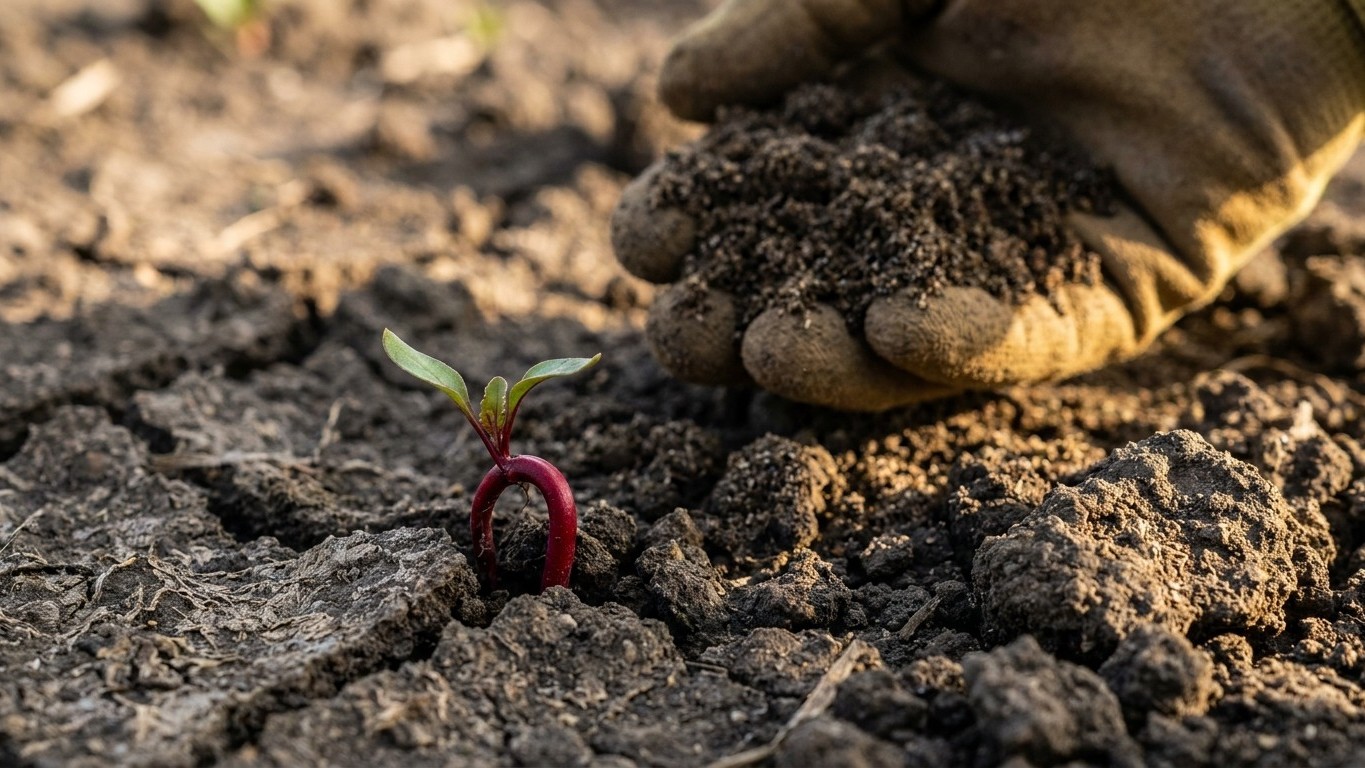

Iowa’s benchmark soil runs 70 percent silt and 26 percent clay, and it holds water the way a sponge does. Beets want the opposite: loose, sandy ground that drains fast and never crusts over a germinating seed. That mismatch is the whole story here. Add a sowing window pinned to a frost date that lands anywhere between April 12 and April 24, and the first six weeks after seeding become the part of the season that decides whether the crop bolts, forks, or just works.
The short answer
The soil that USDA lists as representative of Iowa is the Tama series, a Mollisol, the deep, dark prairie soil that built the Corn Belt. Its surface horizon runs slightly acid at about pH 6.5, and the texture is 4 percent sand, 26 percent clay, and 70 percent silt, with organic matter around 3.5 percent. It’s classed as well drained. Those numbers come from USDA NRCS Soil Data Access, averaged across 246 mapped components of the series.
For a beet, that profile is a mixed bag. Utah State University Extension is blunt about what the crop actually wants: deep, sandy, well-drained soil rich in organic matter, amended with no more than 1 inch of composted organic matter per 100 square feet. Tama-series ground already clears the drainage bar and already carries decent organic matter. What it doesn’t clear is the texture bar, and understanding Beet Soil in Iowa conditions helps explain why. Silt this heavy seals into a crust after a rain, and clay at 26 percent resists the loosening a taproot needs to push straight down. A beet sown into unworked Tama silt loam is far more likely to come up stunted or forked than one sown into an actual sandy loam.
On heat, the picture is harder to pin down with a hard number. No published count of days above 90 F for a reference Iowa city appears in the sourcing behind this page, so that figure isn’t given here. What the research does establish is a threshold: air above 85 F combined with water stress is what turns a beet root woody. Iowa summers reliably clear that 85 F mark for stretches at a time, which means the woodiness risk is real even without an exact day count to quote.
None of this describes any one garden. Iowa spans hundreds of soil series, and a river-bottom plot, a hillside plot, or a lot a builder graded and refilled can behave nothing like the Tama benchmark. Treat the numbers above as what the region’s ground tends to do, not as a reading of your own bed.
The six weeks that decide it here
Beets go into the ground as seed, direct-sown, 2 to 3 weeks ahead of the last spring frost. There’s no transplant step to buffer the timing, so the date you pick determines exactly which stretch of Iowa spring the crop’s first six weeks fall into, a decision covered in detail in When to Sow Beets in Iowa. NOAA’s 1991-2020 climate normals put the 32 F freeze probability window for a reference Iowa station between April 12 and April 24. Iowa State University Extension’s own county-level figures, built from a longer 1950-2021 record, run about 4 days later in spring than that airport-based window. So a gardener sowing off the airport dates alone is working with the optimistic end of the range; county figures push the safe sowing date a few days further out.
That six-week clock matters because of what Utah State’s research links to it directly: water stress during those first six weeks after seeding is what causes beets to bolt, sending the plant to premature flowering instead of a usable root. Iowa spring doesn’t hold one steady character from year to year. Some years it turns dry and windy right after the frost-free date arrives, drying out a seedbed before roots establish. Other years bring saturated ground and cool, slow starts. Either extreme lands inside the same six-week window that decides bolting risk, just from opposite directions.
The Tama-series texture cuts both ways here. Silt and clay at those proportions hold moisture longer than a sandy bed would, which can buffer a short dry spell better than lighter soil. But that same water-holding capacity means a wet spring sits soggy longer, and a compacted or poorly drained pocket within an otherwise well-drained series can stay cold and slow to warm, delaying germination past the point where the six-week clock is still running in your favor. The practical takeaway is that the sowing date and the first six weeks of moisture management deserve more attention here than the seed packet’s generic instructions suggest, because the soil underneath is working against fast, even drainage.
What goes wrong here
- Crusted, uneven germination. Tama-series silt loam seals over after rain, and a crust that hard can stop a beet seed from pushing through at all. Loosen the top several inches before sowing and rake in compost, staying at or under the 1 inch of composted organic matter per 100 square feet that Utah State recommends, so the surface stays workable rather than sealing shut.
- Forked or stubby roots. The 26 percent clay fraction resists a taproot’s downward push, and roots that hit resistance branch sideways instead. Work the bed to a full spade’s depth before sowing, or build a raised bed with looser fill, so the root has clear ground to grow into.
- Bolting from early dryness. If the sowing date lands a dry spring inside that first six-week window, water stress during establishment pushes the plant to flower instead of bulking a root. Keep the seedbed consistently moist from the day of sowing through at least the sixth week, especially if the spring turns windy right after the frost-free date.
- Woody roots from summer heat. Once air runs above 85 F and the plant is also short on water, the root turns fibrous and tough. Time harvest before extended hot, dry stretches hit, and keep watering through any heat spell rather than letting the bed dry out mid-summer.
- Cold, slow starts in a wet pocket. Because Tama soil holds water, a poorly drained low spot within the bed can stay cold and soggy well past the general frost-free date, delaying germination even when the rest of the garden has warmed up. Sow on raised rows or the higher end of the bed if any part of it stays visibly wet longer than the rest.
Checking this against your own county
The Tama series and the April 12-24 frost window describe a benchmark, not your yard. A state this size carries hundreds of mapped soil series, and the ground under a Des Moines subdivision, a Loess Hills farm, and a floodplain garden along the Mississippi can differ completely from each other and from the Tama profile used here. Before committing a sowing date or a soil amendment plan, pull an actual soil test for your bed and check your county’s own frost data, since Iowa State University Extension‘s county figures already run later than the airport-based normals cited above. It is the named source for both county-specific frost dates and local soil testing guidance.
Common questions
What varieties of beet grow in Iowa?
Utah State University Extension names five varieties in its guidance without attaching a season, color, or specific use to any of them individually, so no single one is singled out here as better suited to Iowa conditions. Choosing among named varieties should rest on what a seed source lists for maturity and use, not on a claim tied to any one region.
How many days does it take to grow a beet in Iowa?
The maturity clock runs from the day the seed goes into the ground, not from any transplant step, since beets are always direct-sown. Beyond that seeding-to-harvest structure, no Iowa-specific day count is published in the sourcing behind this page, so a firm number isn’t given here.
Does Iowa’s clay soil mean I need raised beds for beets?
Not necessarily, but the Tama-series benchmark’s 26 percent clay fraction does make deep tillage or a raised bed with looser fill a reasonable precaution against forked roots. A soil test on your own plot will tell you whether your ground actually matches that clay-heavy profile or runs lighter.
Can I sow beets earlier than the frost-free date to avoid summer heat?
Sowing runs 2 to 3 weeks before the last frost, which already sets the earliest practical start. Pushing earlier than that risks cold, wet soil delaying germination, particularly in a Tama-series pocket that holds moisture and stays cool longer than lighter ground would.