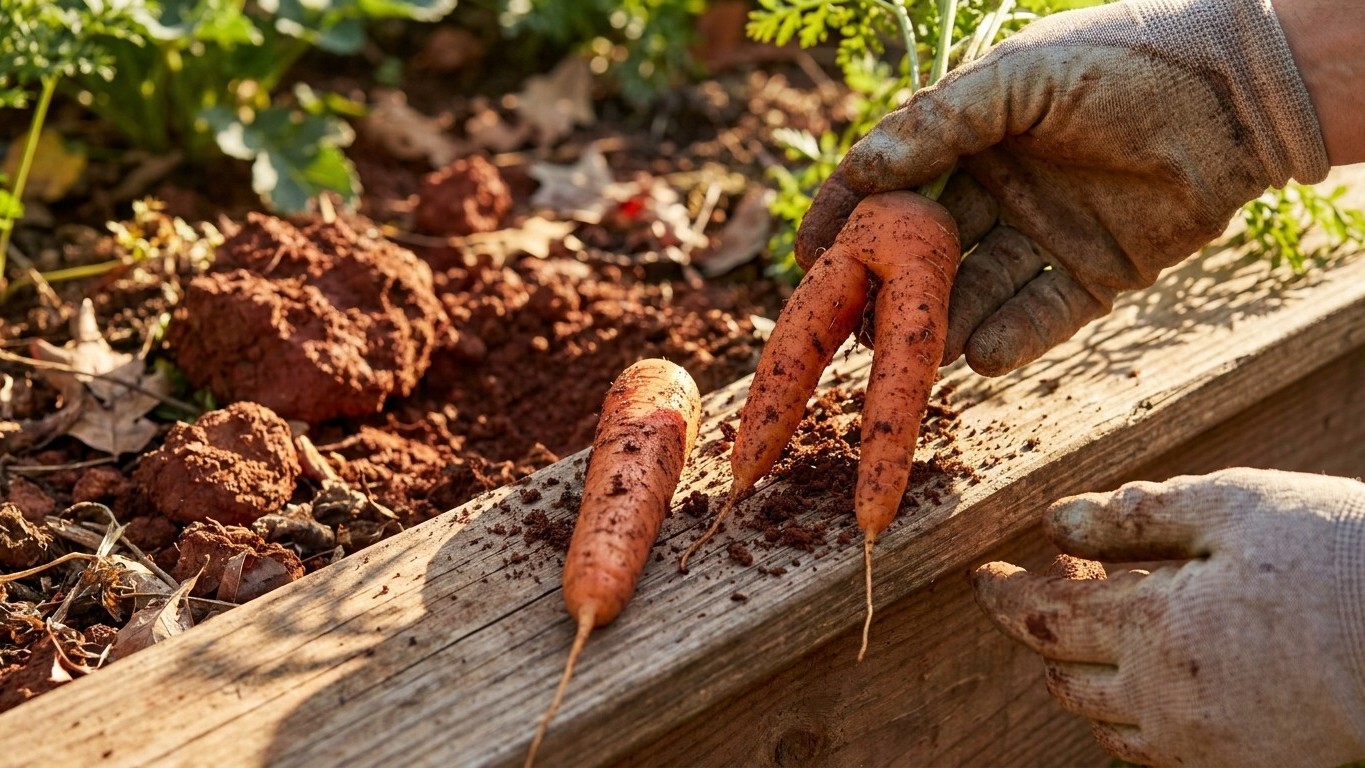

Iowa’s benchmark soil, the Tama series, runs heavy: 26 percent clay and just 4 percent sand, with silt making up the rest. Carrots want the opposite, loose ground that lets a taproot slide straight down without resistance. So in soil built like Tama, a carrot is likely to fork, split, or come up short and gnarled. The ground itself drains well, which helps, but the clay is still the obstacle. The fix isn’t a different variety; it’s compost, double digging, or a raised bed filled with looser mix.
The short answer
The Tama series is what the USDA lists as representative of Iowa. It’s a Mollisol, the deep, dark prairie soil that built the Corn Belt, and its surface horizon runs about 4 percent sand, 26 percent clay, and 70 percent silt, with organic matter around 3.5 percent and a surface pH near 6.5, slightly acid. The drainage class is well drained. That combination sounds almost ideal on paper: fertile, rich in organic matter, no standing water problem. But carrots don’t care how good the soil is for corn or soybeans. What matters for a straight taproot is texture, and a soil that’s 70 percent silt and 26 percent clay is dense and cohesive in a way that resists a growing root tip.
According to Utah State University Extension’s guidance on carrots in the garden, the crop wants deep, sandy, well-drained soil rich in organic matter, and heavy or rocky soil makes the root fork. Iowa’s representative soil checks the “well drained” and “rich in organic matter” boxes, but it fails the sand test badly. A root growing through 26 percent clay meets a wall of tightly packed particles that don’t crumble the way sand does. The tip splits around a clod, a stone, or a compacted layer, and instead of one clean carrot you get two or three skinny legs fused at the top.
The remedy the same source gives for heavy soil is straightforward: work in plenty of compost, and double dig the bed so the loosened layer runs deeper than the roots will grow. If digging that deep isn’t practical, building a raised bed and filling it with a loose, sand-heavy mix sidesteps the clay problem entirely, since the roots never have to push through the native ground at all. Either approach works because it changes the physical structure the root has to travel through, not the fertility or the drainage, which in Iowa’s representative soil are already fine.
None of this means every Iowa garden behaves like the Tama series. A state spans hundreds of mapped soil series, and the ground under a specific driveway, a specific hillside, or a specific river-bottom lot can differ completely from the one the USDA singles out as representative. Treat these numbers as a starting point for what the region’s soil tends to do, not a diagnosis of what’s actually under a particular garden bed.
The test that settles it in your own garden
- Dig a test hole where the carrot bed will go, deep enough to see past the surface layer into what’s underneath it. If the loose, dark topsoil ends abruptly and gives way to a dense, pale, or compacted layer close to the surface, that layer is exactly what will stop a taproot and cause forking.
- Check what’s in that hole besides dirt. Pull out any stones, gravel, or chunks of hardened clay you find, and note how many there were. A bed littered with stones will fork carrots no matter what the state’s representative soil numbers say, because the root simply can’t grow around solid objects.
- Rub a handful of the soil between your fingers. Gritty soil that falls apart easily is sandy and carrot-friendly. Soil that rolls into a smooth ribbon or feels slick and sticky when wet is high in clay, the same texture problem the Tama series numbers describe, and it points toward the same fix: compost and double digging, or a raised bed.
- Fill the test hole with water and watch how long it takes to disappear. Water that vanishes at a steady pace suggests decent drainage. Water that sits for a long stretch points to a compacted or clay-heavy subsoil that will need loosening before carrots go in, regardless of what the surface layer looks like.
- Repeat the dig-and-feel check in more than one spot in the bed. Soil texture can change over a short distance, especially near a foundation, a driveway, or anywhere fill dirt was brought in during construction, so one hole doesn’t tell the whole story.
What goes wrong here
- Forking and stubby, split roots in heavy ground. This is the direct result of the clay-heavy texture the Tama series numbers describe. The remedy is the one Utah State University Extension gives for heavy soil generally: work in plenty of compost and double dig the bed so the loosened zone runs deeper than the roots will reach, or skip the native soil altogether and grow in a raised bed filled with a looser mix.
- Poor germination during a hot, dry spell. Carrot seed is small and slow to sprout, and a soil surface that crusts over and dries out in a heat wave can stop germination before it starts. Keeping the surface consistently moist until seedlings appear, and covering the row lightly to hold moisture in, keeps the seed from stalling out before it ever gets a chance to send down a root.
- Splitting from uneven watering. A root that grows through a stretch of dry soil and then gets hit with a heavy soak can crack from the inside as it swells suddenly. A steady, even watering schedule, rather than long dry spells followed by a drenching, keeps the root growing at a consistent rate and avoids the splits.
Common questions
Does the Tama series mean every Iowa garden has clay-heavy soil?
No. The Tama series is the soil the USDA lists as representative of the state, but a state contains hundreds of mapped soil series. A river-bottom garden, a hillside plot, or a lot with fill dirt brought in during construction can have soil nothing like it. Digging a test hole in the actual bed is the only way to know.
Is the pH of Iowa’s representative soil the same as the pH in my garden?
Not necessarily. The Tama series has a surface pH around 6.5, slightly acid, but that figure describes the surface horizon as mapped across the series, not any single cultivated garden bed. A soil test of the actual bed is the only way to know its real pH.
Can forking be fixed without building a raised bed?
Yes. Utah State University Extension’s advice for heavy soil is to work in plenty of compost and double dig the bed, loosening the ground well below where the roots will grow. A raised bed filled with looser soil is an alternative for gardeners who’d rather not dig that deep, not the only fix.
How long do carrots take from planting to harvest?
Carrots are sown directly in place, never transplanted, and according to Utah State University Extension they generally take 70 to 100 days counted from the seeding date, not from any transplant date, since there isn’t one.