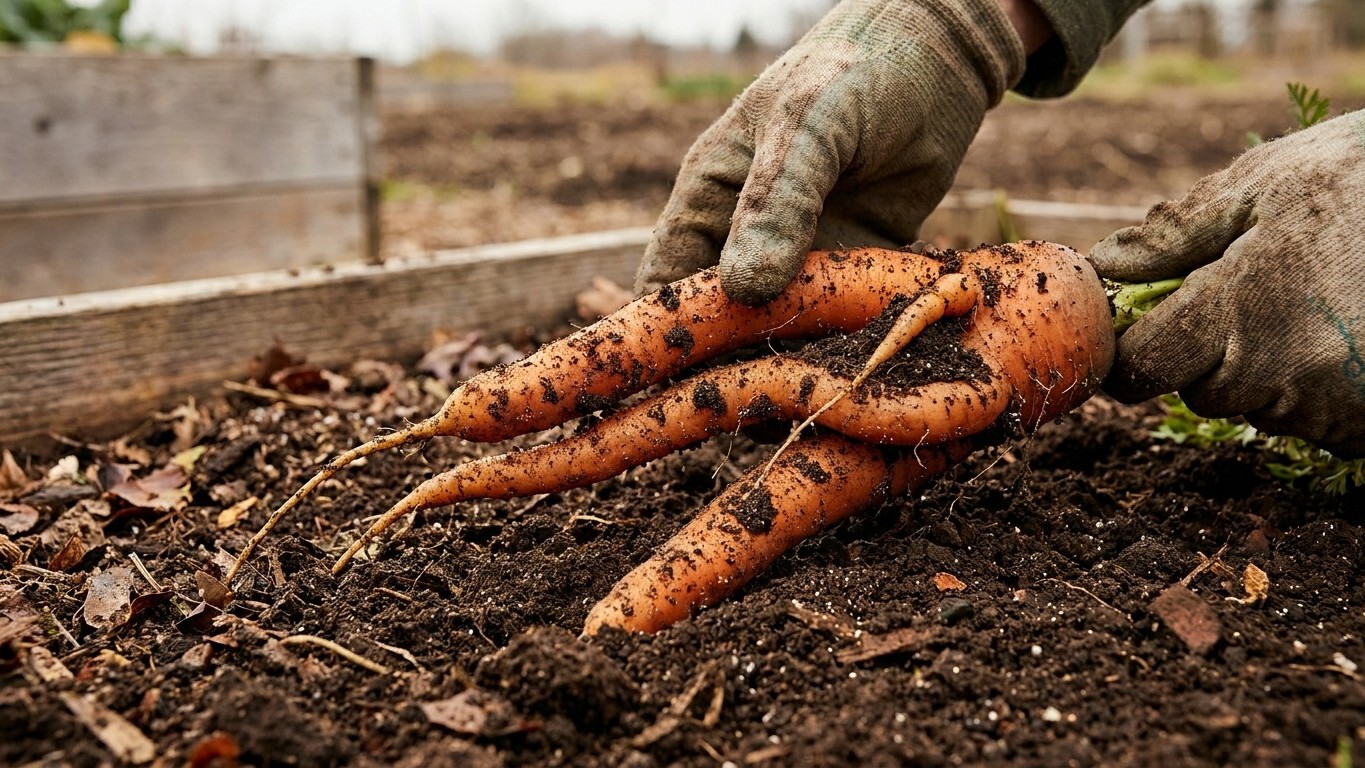

Iowa’s benchmark soil, the Tama series, is a deep prairie Mollisol built from windblown silt: 70 percent silt, 26 percent clay, only 4 percent sand, with a surface pH near 6.5 and organic matter around 3.5 percent. It’s well drained but heavy enough to fork a carrot root if you sow straight into it. The fix is compost worked in deep, or a raised bed, not a different variety.
The short answer
Start with what’s actually in the ground across much of Iowa. The Tama series, the soil USDA names as representative of the state, is a Mollisol: the dark, deep, organic-rich prairie soil that built the Corn Belt. Its surface horizon runs 4 percent sand, 26 percent clay and 70 percent silt, with organic matter around 3.5 percent and a pH near 6.5, just on the acid side of neutral. Drainage class is well drained, which is good news, because standing water rots a carrot root faster than almost anything else.
The texture is the part that matters most for this crop. Utah State University Extension is blunt about it: carrots want deep, sandy, well-drained soil rich in organic matter, and heavy or rocky ground makes the root fork, splitting into two or three legs instead of growing down as one clean taproot. At 26 percent clay, Tama sits well into heavy territory, which raises the question Will Carrots Fork in Iowa Soil? A carrot seedling pushing down through that silt-and-clay matrix will hit resistance, and when a taproot meets resistance it doesn’t push through cleanly, it branches around it. That’s forking, and it’s a texture problem, not a fertility problem or a variety problem.
The remedy Utah State names is direct: work in plenty of compost, and double dig the bed, turning the soil a full spade deep, then loosening the layer beneath that, so the carrot has 12 to 15 inches of loose, amended ground with nothing left to deflect it. Where the clay content runs high or the bed sits low and wet, a raised bed filled with a lighter, blended mix sidesteps the problem instead of fighting it season after season. Either approach works. Neither is optional if you’re gardening in unmodified Tama-type ground, and getting the timing right matters just as much as the soil prep, see When to Sow Carrots in Iowa for the dates that fit this climate.
None of this is a verdict on any one backyard, though. Iowa spans hundreds of mapped soil series, and Tama is simply the one USDA lists as representative of the state as a whole. A garden on a river terrace, a lot built on fill dirt, or ground on a hillside miles from where Tama was sampled can carry a completely different sand-clay-silt balance and a different drainage class. Treat the numbers above as what the region’s soil tends to do, hold water, run slightly acid, resist a taproot, and then check your own dirt before you commit a season to it.
The test that settles it in your own garden
The Tama figures describe a mapped average, not your raised bed or your backyard corner. The only way to know what a carrot will actually meet underground where you garden is to look at that ground yourself, before you sow a single seed.
- Dig a hole where you plan to sow, at least 12 inches deep. This is the depth a carrot root needs to run without hitting an obstruction, so it’s also the depth you need to inspect.
- Check what’s actually in that hole. Note any rocks, gravel, construction debris, or a dense, compacted layer partway down. Any of those will deflect a taproot exactly the way heavy clay does, and no amount of surface compost fixes a hard layer six inches under.
- Rub a handful of moist soil between your fingers. Gritty means sand. Slick and sticky, holding a ribbon shape when you squeeze it, means clay. A silky, floury feel that doesn’t hold a shape well points to silt, the texture the Tama series is dominated by.
- Fill the hole with water and time the drain. Water that vanishes in minutes drains fast; water still standing after several hours signals a heavy, slow-draining spot better suited to a raised bed than to a carrot row sown directly into native soil.
Run this test in more than one spot if your yard has any slope, any area of fill, or any patch that stays soggy after rain. Soil can change completely within the width of a driveway.
When to sow here
Carrots are sown directly into the ground as seed. They’re never transplanted, so every count below runs from the sowing date, not from any seedling stage.
- Start from the last spring frost window. NOAA climate normals put it between April 12 and April 24 for the period the data covers. That’s your anchor date, not a single fixed day, and it shifts field to field.
- Count backward 2 to 3 weeks. Carrot seed goes into the ground before the last frost, not after it, so the sowing window lands somewhere in the last week of March through the first half of April, depending on where in that frost range your ground falls.
- Check soil temperature before trusting the calendar. Carrot seed needs the soil at a minimum of 40 F to germinate at all. A cold, wet April can push that minimum back later than the frost date alone would suggest, so a soil thermometer settles the question faster than the date on a seed packet.
- Aim for the germination sweet spot, not just the minimum. Seeds come up fastest and most evenly between 55 F and 65 F. Sowing at the bare 40 F minimum works, but expect slower, patchier germination than sowing once the soil has warmed closer to that 55-65 F range.
- Remember the county gap. Iowa State University Extension’s own county-level records, covering a longer stretch of years than the airport-based NOAA figures, run about 4 days later in spring than the numbers above. Treat April 12 as an optimistic edge, not a guarantee, especially away from the station the NOAA data was drawn from.
What goes wrong here
- Forking in heavy, silty-clay ground. With Tama-type soil running 26 percent clay, an unamended bed gives a taproot plenty to deflect off. The remedy is the one Utah State names: heavy compost worked in and a full double dig, or a raised bed filled with looser soil if the native ground stays heavy no matter how much organic matter you add.
- Poor germination during a hot spell. Carrot seed germinates best between 55 F and 65 F. A sudden run of hot late-spring days can push surface soil well past that range, and carrot seed sitting in overheated, drying topsoil simply stalls. Shading the row lightly and keeping the seedbed consistently moist through a heat spike keeps germination from stopping cold.
- Splitting from uneven watering. Roots that grow through a dry stretch and then take a heavy soaking swell too fast and crack lengthwise. This has nothing to do with soil texture and everything to do with an inconsistent watering schedule, so a steady, even watering routine through the whole growing period matters as much as the soil prep at planting time.
Checking this against your own county
Everything above starts from a statewide soil average and a single weather station’s frost normals. Neither one is a substitute for local, county-level information. Iowa State University Extension, at extension.iastate.edu, keeps county-specific frost and planting guidance that accounts for the local lag this article already flagged, roughly 4 days later in spring than the airport figures used here. A soil test through your local extension office will also give you an actual pH and texture reading for your own bed, rather than the mapped average for the state’s representative series. That’s the number worth planting by.
Common questions
Does every garden in Iowa have clay-heavy soil like the Tama series?
No. Tama is the series USDA names as representative of the state overall, but Iowa contains hundreds of mapped soil series. River bottoms, hillsides and any lot that’s been built on or filled can differ completely from the Tama figures. A local soil test is the only way to know your own ground.
Can I just pick a different carrot variety instead of amending heavy soil?
The sourced guidance here doesn’t name or compare varieties. What it does say plainly is that heavy or rocky soil forks the root, and the fix is compost and double digging, or a raised bed, not a variety swap.
How early is too early to sow carrot seed?
Before the soil reaches 40 F, seed simply won’t germinate. Check soil temperature directly rather than relying only on the calendar, since a slow, cold spring can push that 40 F mark later than the typical frost-date window suggests.
Why did my carrots come up patchy this spring?
Patchy germination usually traces back to soil temperature outside the 55-65 F range where carrot seed performs best. Sowing at the bare 40 F minimum, or into soil that spiked hot during a warm stretch, both produce slower, uneven emergence.