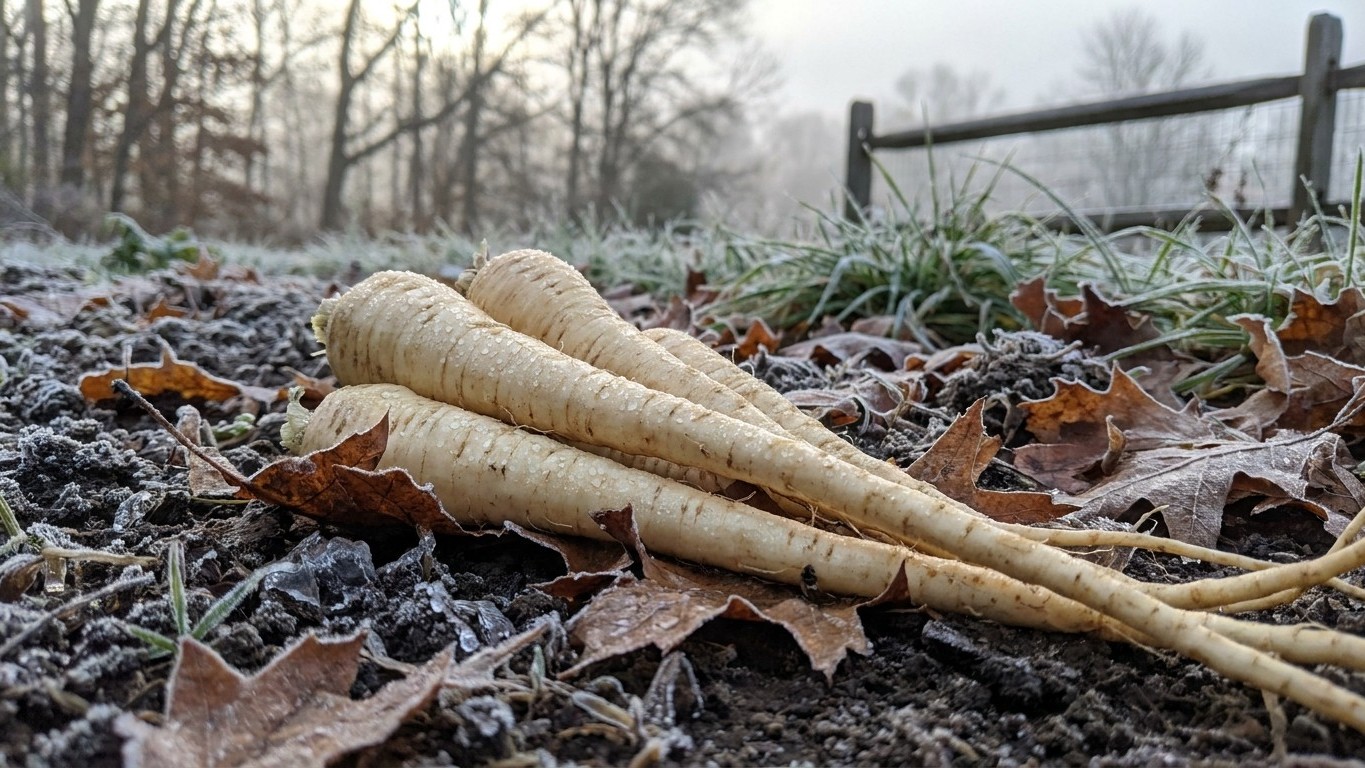

In Iowa, parsnip tops and stems draw generalist feeders more than crop specialists: grasshoppers, common stalk borer, Japanese beetle, and spotted cucumber beetle are the ones documented eating this root crop, and they show up at different points across a season bounded by frost. None of them touch the swelling root underground the way a soil worm might. The damage happens above ground, on leaves and stalks, weeks apart from each other.
Which pests attack parsnip in Iowa

Iowa State University Extension documents nine garden pests that regularly show up in home landscapes and vegetable plots here: Common stalk borer, Grasshoppers, Iris borer (Macronoctua onusta), Japanese beetle (Popillia japonica), Lily leaf beetle, Spotted cucumber beetle, Squash bug, Squash vine borer, and Striped cucumber beetle. That’s the full documented list for this territory, and it isn’t a long one.
Five of those nine have no business on a parsnip bed. Iris borer tunnels exclusively into iris rhizomes and leaf fans; it needs iris to complete its life cycle and won’t touch a root vegetable. Lily leaf beetle is just as narrow, feeding only on true lilies and fritillaries. Squash bug, squash vine borer, and striped cucumber beetle are all cucurbit specialists built around the chemistry of squash, pumpkin, and cucumber vines. A parsnip row offers them nothing they recognize as food, and finding one of these three on a parsnip leaf almost always means it wandered over from a nearby squash mound.
That leaves four generalists that will use a parsnip planting when it’s convenient, even though none of them treat it as a favorite. Common stalk borer bores into the pith of thick-stemmed garden plants, including umbellifers like parsnip, especially where the row sits near grassy weeds where the moths laid their eggs the previous season. Grasshoppers chew ragged notches out of any exposed foliage once weedy margins dry down, and parsnip’s flat, feathery tops are an easy target for a hungry hopper with nothing better nearby. Japanese beetle skeletonizes leaves on hundreds of plant species and will visit parsnip foliage even though roses and grapes rank higher on its preference list. Spotted cucumber beetle, despite the name, carries a host range that extends past cucurbits into other garden vegetables’ foliage and, occasionally, root shoulders.
Parsnip needs 100 to 120 days from seeding to reach harvest size, according to Utah State University Extension. That’s a long stretch for one planting to sit exposed in a garden, and it’s the reason timing ends up mattering more here than the pest list itself.
When each one shows up, and what it does first
Parsnip is sown in place, not transplanted, and germination alone takes 14 to 21 days. A gardener who sees bare soil at day ten and assumes the seed failed is usually just impatient; the row hasn’t had time to show green yet, and that lag matters because early-season pests can already be active on nearby weeds before a single parsnip leaf appears above the surface.
Common stalk borer larvae move into stems early, not long after true leaves form on the young seedling. The first sign isn’t a chewed leaf; it’s a single wilted or discolored stalk while the rest of the plant looks fine, sometimes with a pinhole and a bit of sawdust-like frass near the base. By the time wilting is obvious, the larva is already inside and past the point where anything applied to the leaf surface will reach it.
Grasshoppers build gradually across the frost-free stretch that runs from the last spring frost window of April 12 to April 24 toward the first fall frost window of October 14 to October 25, becoming most noticeable as summer heat dries out weedy field edges and lawns and pushes hoppers toward anything green and tender. The first sign is ragged notching along leaf margins on the parsnip tops, usually worse on the side of the row closest to a fence line, ditch, or unmowed patch.
Japanese beetle adults tend to appear in clusters mid-season and feed as a group. The first sign is lacy, skeletonized patches on leaflets with the veins left standing, and often several beetles visible on one leaf at the same time rather than scattered damage across the row.
Spotted cucumber beetle adults move onto vegetable foliage early in the season and again as populations build through summer. The first sign is small, irregular chewing holes scattered across leaves, and occasionally light scarring on any root shoulder that has pushed up above the soil line.
Telling the damage apart from everything else
Not every rough-looking parsnip plant has a pest problem, and the fastest way to guess wrong is to assume insects before ruling out soil and water. A forked, stunted root has two separate possible causes here, and they don’t get merged: heavy or stony ground that physically blocks the taproot, or overwatering that encourages shallow, branching roots instead of one straight one. Digging a test hole a foot deep before planting settles the soil question; if it comes up as dense clay clods or turns up rocks, that’s the answer, no insect involved.
| Symptom | Likely cause | What settles it |
|---|---|---|
| Forked, stunted root | Heavy/stony soil, or overwatering | Test-dig 12 inches down; check watering frequency separately |
| Ragged notches, chewed leaf edges | Grasshoppers or Japanese beetle | Check the plant at dawn or dusk when these feeders are active; damage alone rarely tells them apart |
| Single wilted stalk, rest of plant healthy | Common stalk borer | Slit the stem lengthwise; frass and a caterpillar inside confirm it, not disease |
| Bitter or bland flesh on a full-size root | Not enough frost exposure yet | Check for chew marks or tunnels first; if none, it’s a timing issue, not a pest |
That last row trips up a lot of gardeners. Parsnip flavor comes from cold converting stored starch to sugar, and that conversion needs several weeks of frosty weather, not just a comfortable planting zone. A root that looks perfect but tastes flat hasn’t been damaged by anything; it simply hasn’t had its frost yet. Pale, uniformly yellowing foliage that starts from the bottom of the plant and works up usually points to a nutrient shortage rather than a chewing insect, since insect feeding tends to leave visible holes or tunnels rather than even discoloration. When the cause still isn’t obvious, a local extension office can look at a sample or a photo and settle it faster than guesswork.
What actually works here, and what is a waste of time
A physical barrier set up before trouble starts beats almost anything applied after the fact, and on a crop that needs 100 to 120 days in the ground, timing the barrier matters as much as using one. A lightweight floating cover placed over the row at seeding, before that 14-to-21-day germination window even finishes, keeps stalk borer moths from laying eggs near young stems and blocks early grasshopper and beetle feeding without touching a single leaf.
Clearing grassy weeds and mowed margins near the parsnip bed removes the egg-laying sites common stalk borer relies on, since the moths favor weedy grass stands over bare cultivated soil. Rotating where root crops go from one year to the next reduces the odds of spotted cucumber beetle building up in the same spot season after season. Hand-removing Japanese beetles in the cooler part of the morning, when they’re sluggish, thins a cluster faster than most people expect, since the beetles that fall off a shaken leaf rarely fly back up right away.
Counting on winter cold to solve the problem doesn’t hold up. The coldest month here averages a daily minimum of only 13.8°F, and these pests overwinter as eggs or pupae tucked into plant debris, soil, or grassy cover well below that exposure. Spraying broad-spectrum treatments after stalk borer damage is already visible is also a poor use of time, since the larva is inside the stem by then and nothing applied to the leaf surface reaches it. For anything beyond covers, rotation, and hand-removal, a county extension office can confirm what’s actually labeled for use on parsnip in this state, since this isn’t the place to guess at a treatment.
Where to check this for your own county
Everything above comes from Iowa State University Extension, and it’s documented at the state level, not the county level. Pest pressure inside Iowa isn’t uniform: a county extension office nearer the Missouri or Mississippi River may see earlier grasshopper buildup than a spot farther north, and frost timing itself shifts across the state. The airport-station frost windows used above (April 12 to April 24 for last spring frost, October 14 to October 25 for first fall frost) run roughly 4 days earlier in spring and 10 days later in fall than the longer county-level figures Iowa State Extension has compiled, so treat the airport dates as the optimistic end of the range for any given county.
A county extension office can also confirm what’s actually present on the ground in a given garden, since a statewide list says what’s documented across Iowa, not what’s chewing on one particular row. Bringing in a sample, a clear photo of the damage, or a description of the timing gets a faster answer than trying to match symptoms against a general list alone. That’s the next step worth taking before assuming which of the four generalist feeders above is the one responsible.
Common questions
Do parsnips need any pest control most seasons?
Not always. Many home rows get through the season with only light grasshopper or beetle notching that doesn’t affect the root underground. A cover placed at seeding handles most of what shows up without any further action.
Can I still eat a parsnip root with beetle damage on the leaves?
Leaf feeding from grasshoppers, Japanese beetle, or spotted cucumber beetle rarely reaches the root itself. The root is usually fine to harvest and eat once it has had its stretch of frosty weather.
Why does my parsnip taste bland even though the root looks full-size?
It likely hasn’t been exposed to enough frosty weather yet. The sugar conversion that gives parsnip its flavor depends on cold exposure, not on the root simply reaching size.
Should I plant parsnip somewhere new every year because of these pests?
Rotating root crops away from last year’s spot helps limit spotted cucumber beetle buildup in particular, since it reduces the odds of the same soil hosting the same population two seasons running.