
Iowa peppers ripen reliably when growers start seed indoors 8 to 10 weeks before a late-April transplant date and manage a summer that averages 18.4 days above 90°F. That heat load pushes some pepper varieties into blossom drop during the hottest stretches of July and August, so the real skill in this state is less about picking a “fast” variety and more about timing the whole season around frost, soil temperature, and heat spikes.
The short answer

Des Moines, the reference station for Iowa’s climate normals, logs an average of 18.4 days a year at or above 90°F, based on the 1991-2020 NOAA NCEI Climate Normals. That’s not a rare event scattered across a hot week in July. It’s closer to two and a half weeks of accumulated heat stress spread across the growing season, often clustered in mid-to-late summer when pepper plants are trying to set their heaviest flush of fruit.
Heat above 90°F matters because pepper flowers abort when daytime temperatures run too hot for too long, a mechanism confirmed by Utah State University Extension’s guidance on pepper fruit set. The plant keeps growing, keeps flowering, but the blossoms drop before they turn into fruit. In a state where nearly three weeks of the year cross that threshold, a grower who plants a single early-season pepper crop and expects steady fruit set right through August is going to see gaps, especially if those hot days bunch together during a dry spell.
Heat isn’t the only failure point. Fruit set also fails on the cool end, when nighttime temperatures drop below 55°F. That threshold matters most in spring, right after transplant, and again in early fall as nights start cooling down ahead of the first frost. This site tracks days above 90°F for Iowa, but it does not carry summer night minimum data for this state. That’s a real gap, and it means a gardener can’t rely on a published number here to know when nights are running too cool for fruit set.
The practical move is to watch your own thermometer, not to guess based on where Iowa sits on a map or what the coldest month of the year looks like. Latitude doesn’t tell you what a specific July or September night will do in your yard, and the coldest-month average is a different measurement entirely, one that has nothing to do with the isolated cool nights that can knock blossoms off a pepper plant in what’s otherwise a warm season. If you’re growing in a low-lying area, near a creek bottom, or in a spot that tends to collect cold air, your nights may run several degrees cooler than a nearby weather station, even in mid-summer.
So the short answer has two halves. On the hot end, Iowa’s 18.4 days above 90°F is a documented, fixed number you can plan around, staggering plantings or providing afternoon shade during the worst stretches. On the cool end, the number that matters isn’t published for this state, and the responsibility falls on the grower to track nighttime lows in their own garden, especially during the shoulder weeks of the season when a single cold night can undo a week of good fruit set.
When to start seed here
Working backward from transplant to seed-starting date isn’t guesswork. It’s arithmetic, and once you know the pieces, you can redo the math for your exact county rather than relying on a statewide average.
- Start with the frost window. NOAA NCEI’s 1991-2020 Climate Normals put the 32°F freeze probability for Iowa’s reference station between April 12 and April 24, using the 30 to 70 percent probability band. That’s the range where frost risk drops enough that most gardeners feel comfortable transplanting, though it’s still a probability window, not a guarantee.
- Adjust for your county. Iowa State University Extension’s county-level frost data, drawn from 1950-2021 records, runs about 4 days later in spring than the airport station figures above, and about 10 days earlier in fall. That means the airport-based window is the optimistic end of the range. If you’re outside the immediate Des Moines area, especially in a county with more rolling terrain or a history of later frosts, plan on nudging your transplant date a few days later than the airport numbers suggest.
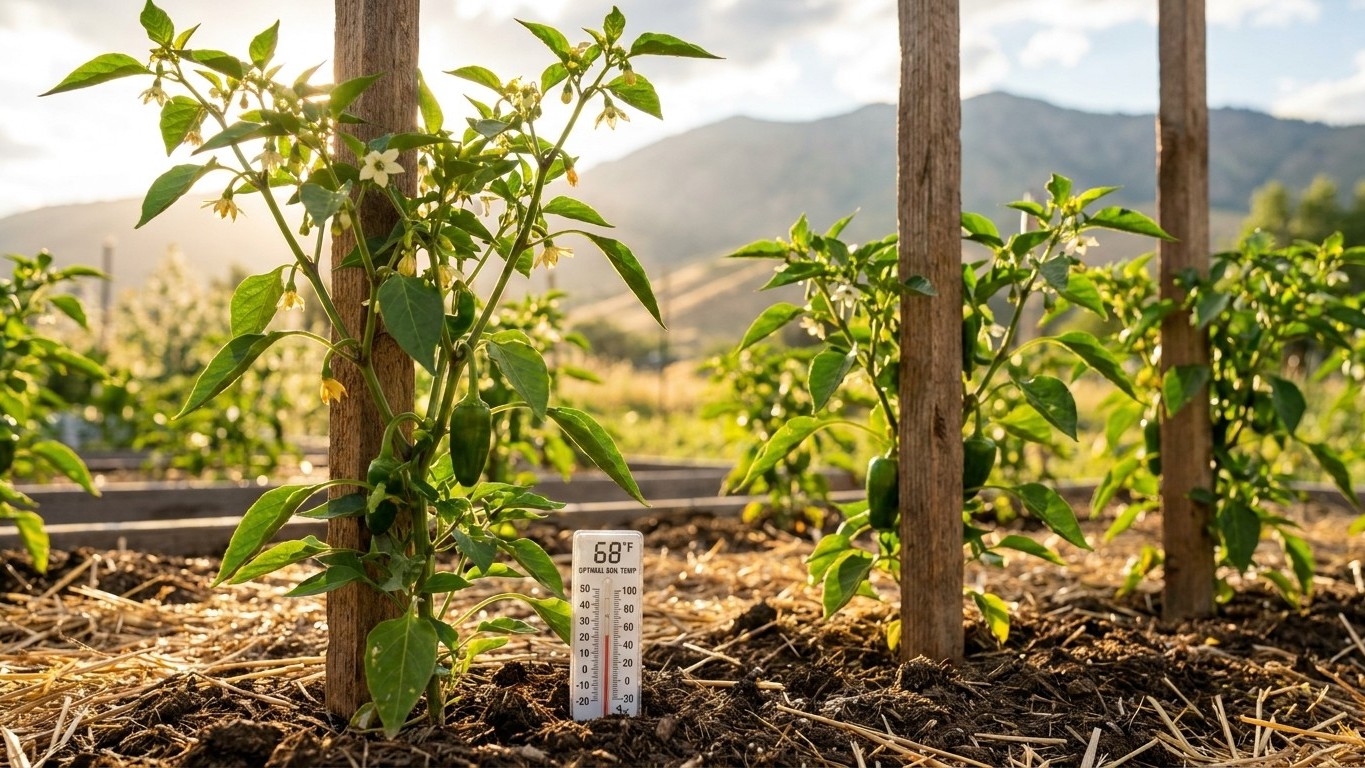
- Check soil temperature, not just the calendar. Frost date alone isn’t enough. Peppers need soil at 60°F before transplant, according to Utah State University Extension. A cold, wet spring can push soil temperature well behind the frost-free date, so a soil thermometer pushed 4 inches down is worth more than any calendar guess.
- Count back 8 to 10 weeks for seed starting. Once you’ve settled on a realistic transplant date, whether that’s the optimistic April 12 or the more cautious late-April window adjusted for your county, count back 8 to 10 weeks. That’s the indoor seed-starting window Utah State University Extension recommends for peppers, giving the plants enough time to build a root system and a few sets of true leaves before they head outside.
- Build in slack for a late spring. Because frost windows and soil warm-up don’t always cooperate with the calendar, many Iowa growers start seed at the early edge of that 8 to 10 week range, giving themselves a buffer if a cool, wet stretch delays transplant by a week or two.
The math is simple once it’s laid out, but it only works if you’re honest about which frost date applies to your actual location, not just the nearest airport.
What goes wrong here
Iowa’s combination of hot summer stretches, strong midsummer sun, and unpredictable rainfall creates a specific set of pepper problems that show up year after year. Here’s what tends to go wrong, and what to do about each one.
- Blossom drop during a heat spell. When daytime temperatures push into the 90s for several days running, pepper flowers abort before they set fruit, a pattern documented by Utah State University Extension. The remedy is timing and shade: stagger plantings so not every plant is flowering during the same hot week, and consider light afternoon shade cloth over plants during the worst stretches to bring leaf temperature down without blocking all the light the plant needs.
- Blossom drop from a cool night. The same failure happens on the opposite end, when nights drop below 55°F, particularly in spring right after transplant or in early fall as temperatures start sliding. Since this site doesn’t track summer night minimums for Iowa, the fix is vigilance: keep a min-max thermometer in the garden and be ready to cover plants with row cover on nights that look like they’ll dip into that range.
- Sunscald on exposed fruit. Iowa’s strong midsummer sun can scald pepper fruit that’s left exposed after pruning or defoliation from disease, showing up as pale, papery patches on the sun-facing side. Leaving more of the plant’s natural leaf canopy intact, rather than aggressively pruning for airflow, gives fruit the shade it needs to avoid this kind of damage.
- Blossom-end rot on developing fruit. Uneven watering, common during Iowa’s swings between dry spells and heavy summer rain, disrupts calcium uptake and produces the sunken, leathery patch known as blossom-end rot. Consistent soil moisture, maintained with mulch and a regular watering schedule rather than sporadic deep soaks, is the most reliable way to keep this from spreading through a planting.
Common questions
Which pepper varieties handle Iowa’s heat best?
Utah State University Extension names several pepper varieties suited to home gardens but does not publish heat ratings, days-to-maturity figures, or fruit size for any of them. Rather than picking a variety based on an assumed heat tolerance, focus on the timing strategies in this article, staggered planting, soil temperature checks, and shade during heat spikes, since those factors apply regardless of which variety you grow.
How many days after flowering does a pepper need to ripen?
Utah State University Extension notes that pepper fruit generally needs roughly 35 to 45 days from flowering to reach maturity, not from the date of sowing or transplanting. That distinction matters when you’re counting backward from your area’s first fall frost to figure out how late you can let plants keep flowering.
Does Iowa’s summer night temperature threaten pepper fruit set?
It can, since fruit set fails when nights drop below 55°F, but this site does not carry summer night minimum data for Iowa. Don’t estimate that figure from the state’s latitude or from its coldest winter month, since neither reflects an individual summer night in your yard. Track your own garden’s overnight lows with a thermometer instead.
What’s the safest window to transplant peppers in Iowa?
Based on NOAA NCEI’s 1991-2020 Climate Normals, the 32°F freeze probability at Iowa’s reference station falls between April 12 and April 24. Iowa State University Extension’s county-level data suggests adding roughly 4 days to that window for many counties, and you’ll also want soil at 60°F before you transplant, regardless of what the calendar says.