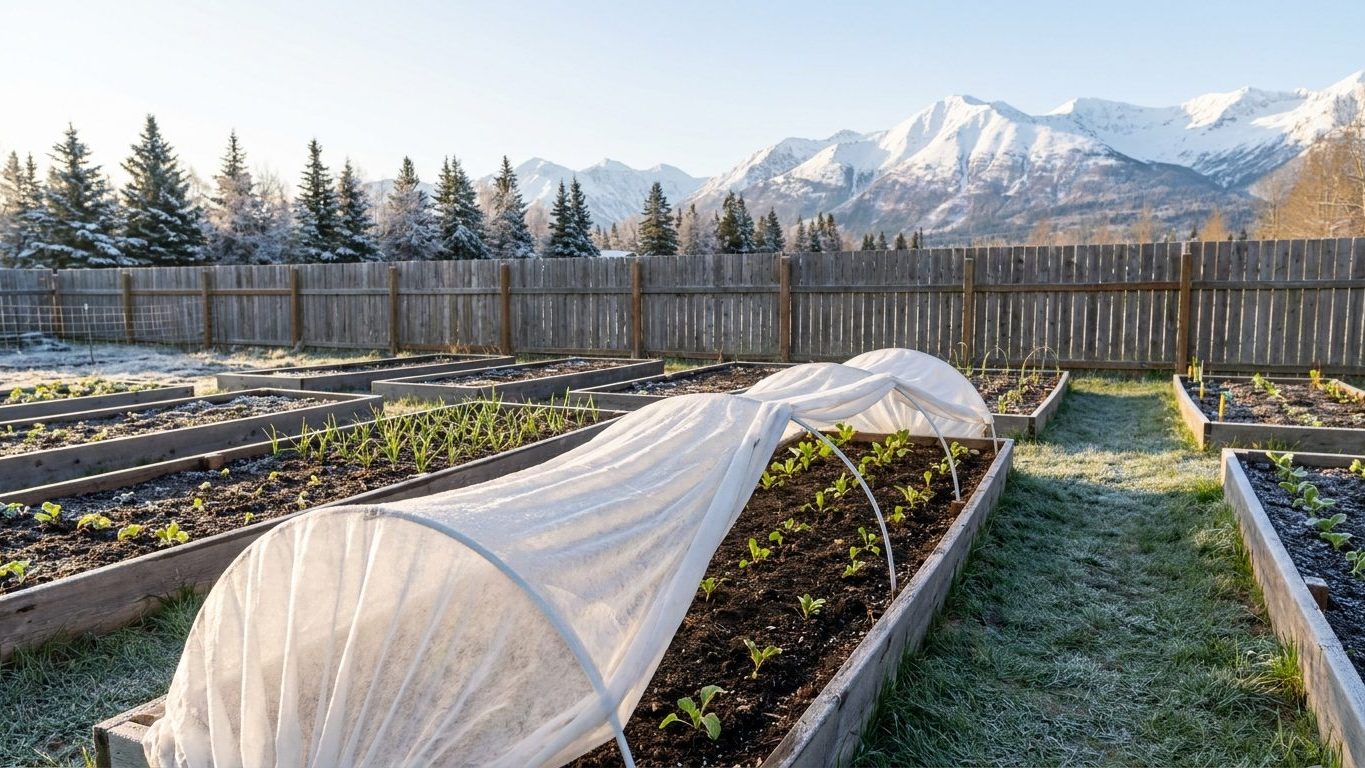

Cover your garden on any night the forecast calls for a 32°F freeze, not on a fixed date. In Louisville, the reference city for this page, the last spring freeze typically falls between March 24 and April 4, and the first fall freeze between November 2 and November 12. Those dates tell you when to start checking the forecast every evening. They don’t tell you when a given night is dangerous.
The short answer for Kentucky
Start watching nightly lows in late March, keep covers within reach through the first days of April, and begin again in early November. Those dates come from NOAA’s 1991-2020 Climate Normals for the Louisville station, and they are probabilities, not deadlines. Each one marks where the chance of a 32°F freeze sits in the 30 to 70 percent band. In spring, that is the stretch where another freeze is still roughly a toss-up. In fall, it is the stretch where the first freeze is roughly a toss-up.
| Season | Date window (Louisville) | What it is a probability of |
|---|---|---|
| Last spring freeze | March 24 to April 4 | A 32°F freeze, 30-70% band |
| First fall freeze | November 2 to November 12 | A 32°F freeze, 30-70% band |
One caution comes straight from the National Weather Service in Louisville. The station sits in an urban area, and the NWS warns that it behaves differently from the rural countryside around it in Jefferson County. A garden out past the city limits should expect a tighter window than the one in the table. Plan for covers a little earlier than the city dates suggest in fall and a little later in spring.
What this means in practice is three covering moments. The first comes in spring, after you transplant. Anything set out between late March and early April can meet a freeze, and a cloth or cover thrown over the bed that evening is cheap insurance. The second comes in fall. Tomatoes, peppers, and beans can still be producing when the first freeze arrives, and one covered night can buy you extra weeks of harvest. The third is winter, for hardy greens that you want to keep alive and growing under protection.
Which material suits which job is a separate question, covered in Which Season Extenders Work in Kentucky. For the bigger picture of how covers stretch the season at both ends, see Extending the Growing Season in Kentucky.
What will not work here
Covering by the calendar fails first. Both windows are under two weeks wide, and they describe odds, not guarantees. A gardener who waits until April 5 to stop worrying is trusting a number that is not a promise. Freezes after the band are less likely, but they still happen. The reverse mistake is just as common: a gardener who covers every bed every night from March 24 to April 4 will spend a lot of evenings hauling cloth for no reason, and quit by the second week.
Trusting the Louisville numbers if you garden in the countryside is the second failure. The NWS warning about this station is plain, and a rural plot should expect a tighter window. If your garden sits in a low spot, cold air pools there on still, clear nights, and the window gets tighter again.
Third, a cover will not rescue tender crops through winter. The mean daily minimum of the coldest month here is 27.8°F, below freezing on the average night, which means many nights run colder than that. A single layer of fabric over tomato plants in January is a funeral shroud. Covers in Kentucky extend the season by weeks at either end, and they protect hardy crops through winter. They don’t turn a Kentucky January into a growing season for warm-weather crops.
Fourth, covers do nothing for crops that run on day length. Louisville sits at 38.18 degrees north, and at that latitude the shortening and lengthening days, not the warmth, tell an onion when to quit growing leaves and start forming a bulb. A tunnel that warms the soil in February can get onion sets growing sooner, but it cannot make the bulb arrive earlier than the day length allows. If you garden far from Louisville’s latitude, look up your own, because the trigger shifts with it.
Last, leaving covers on through a warm spring afternoon causes damage of its own. Fabric and plastic that protect at 2 a.m. can overheat seedlings by midday and, over squash and cucumbers once they flower, keep pollinators out. The cover belongs on at dusk and off again in the morning once the freeze danger has passed. A cover left sealed all week is a liability, not protection.
What changes across Kentucky
Kentucky is not one garden. The USDA Plant Hardiness Zone Map (2023 edition, built on 1991-2020 normals) runs the state from zone 6a to 7a. That spread is based on one variable only, the average annual extreme minimum temperature. It says nothing about when the last spring freeze arrives or how long a hot summer runs. And it means there is no single answer to the title question, only a spread of answers that depend on where in the state you stand.
The dates on this page belong to Louisville. A reader in the north of the state, or on higher ground, should shift toward a later last freeze in spring and an earlier first freeze in fall. In practical terms, that means starting the evening forecast check a bit later in spring and starting it earlier in autumn than the Louisville dates suggest. Someone in a milder pocket of the state can lean the other way. How far to shift is exactly what this page cannot tell you, because the facts here describe one station, not every county.
Latitude adds a second layer. Louisville’s 38.18 degrees north is a single reference point. A garden near the northern or southern edge of the state has a slightly different day length, which matters for onions and for anything else that responds to light more than to warmth. If you garden near an edge of Kentucky, check your own latitude before leaning on this page’s numbers.
As for your own zone, this page won’t assign you one. Look up your address on the USDA Plant Hardiness Zone Map and read the zone for your location. Then treat that zone as a clue about winter cold, not a frost date.
Where to check this for your own county
The best source for your county is the University of Kentucky Cooperative Extension service, the state’s land-grant extension system. Every county has an extension office staffed by agents who know local soil, local frost pockets, and what actually grows well in that county. This page has no county-level planting calendar, so it can’t hand you one. The extension service can.
When you reach the extension site or your county office, look for two things. First, the local planting calendar, which will give sowing and transplanting dates for your area rather than for Louisville. Second, the vegetable varieties that have been trialled in your county, because a variety that thrives in one corner of the state may sulk in another. Ask also whether they have a local frost-date table, and whether it comes from a station near you or one far away.
A county recommendation beats a state one, every time, and this page is the state one. The extension agent has seen how your neighbors’ gardens behaved in the last bad spring. Whatever they tell you about timing for your county should replace the Louisville windows above, not sit alongside them.
Checking this against your own garden
Your own observation outranks every date on this page. Three things are worth watching, and none needs more than your hands and eyes.
- Soil warmth by feel. Push your hand a couple of inches into the bed in the morning. Cold, clammy soil means seeds will sit and sulk. Soil that feels neutral or faintly warm means roots can work. Compare a sunny, south-facing bed with a shaded or low one. The difference tells you where your warm microclimate is and which bed deserves the earliest planting.
- The first flush of male flowers. Squash and cucumbers open male flowers before female ones. When they appear in your garden, and how early in one bed versus another, shows how quickly that spot warms. Early male flowers in one corner mean it is your fast bed.
- The first true leaves. The first pair of leaves on a seedling are seed leaves. The second set, the true leaves, show the plant is established and growing on its own. Seedlings that reach this stage quickly are in a kind spot. Seedlings that stall there are telling you the bed is cold, shaded, or too wet.
Over a season or two, these observations add up to a map of your own yard that no state table can match. Write the dates down, even on the back of a seed packet, and next year you will have your own frost calendar.
Common questions
Is April 4 a safe date to stop covering in Kentucky?
No. April 4 is the end of the window where the chance of a 32°F freeze sits in the 30 to 70 percent band at the Louisville station. It marks where the odds fall off, not where they hit zero. Keep checking the forecast after that date, especially if you garden outside the city.
Do I need to cover when the forecast says 34°F?
The freeze figure used here is 32°F. Forecasts are for a general area, though, and clear, still nights can run colder in low spots in a yard than the number on your phone. If you have tender transplants in the ground and the forecast is close to freezing, cover them.
Can covers carry tomatoes through a Kentucky winter?
No. With the mean daily minimum of the coldest month at 27.8°F, tomatoes are not going to overwinter under a cover. Covers are for stretching harvests past the first fall freeze and for protecting hardy greens. Plan on replanting tomatoes each spring.
Which date should I use if I live nowhere near Louisville?
Use the Louisville dates only as a rough starting point, and shift later in spring and earlier in fall if you are in the north of the state or at altitude. Then ask your county office at the University of Kentucky Cooperative Extension for the local figures. The state’s hardiness zones span 6a to 7a, so the spread across Kentucky is real.