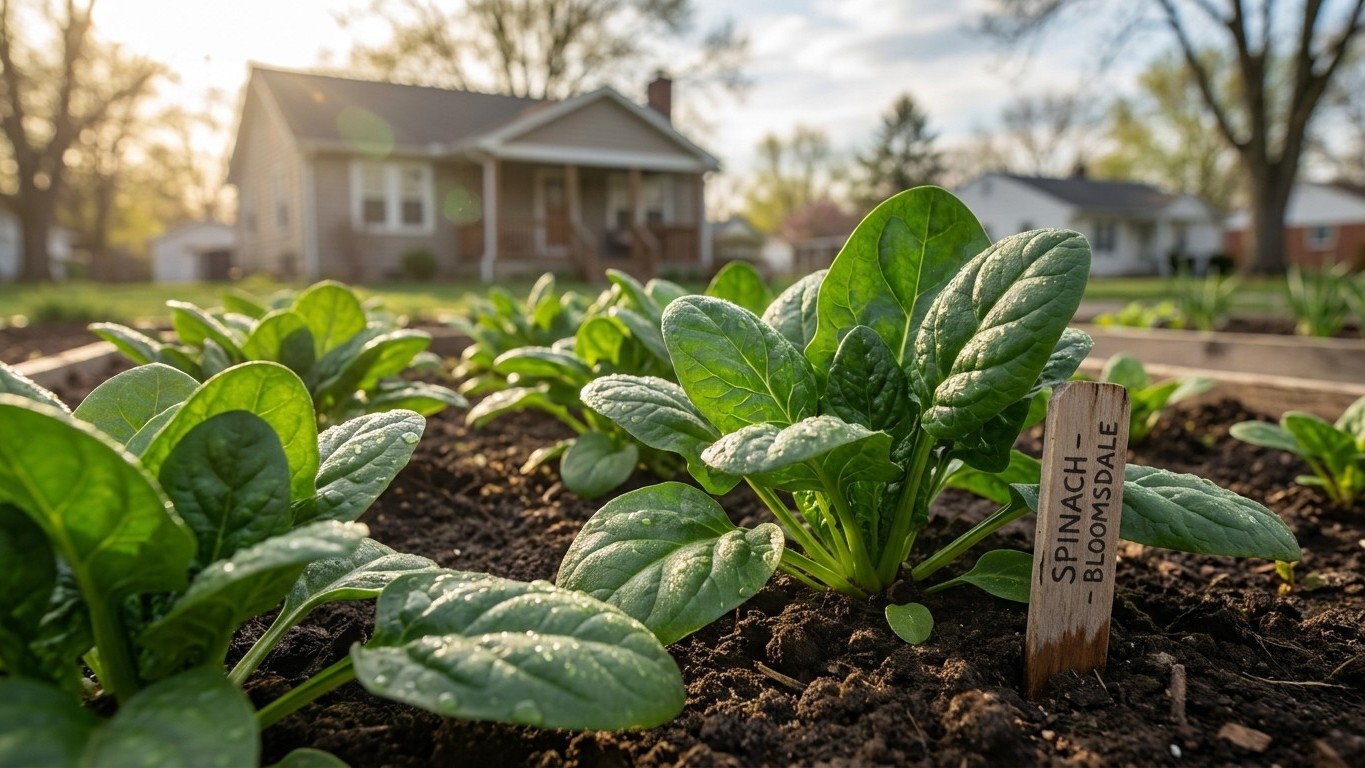

Spinach in Iowa gets squeezed from two directions at once. The long daylight hours of an Iowa summer push the plant toward flowering no matter how mild the temperatures stay, and the heat that follows makes the leaves bitter before bolting even finishes the job. That leaves two short, separate growing windows, one in spring and one in fall, rather than one long summer harvest.
The short answer
On the longest day of the year, this part of Iowa sees 15 hours and 1 minute of daylight. That number matters more than most gardeners expect, because spinach reads day length as a signal to stop making leaves and start making seed. Long days push the plant toward bolting, and 15 hours and 1 minute is a long day by any standard. A cool, mild summer does not change that signal. The plant does not care whether the air feels comfortable. It counts daylight, and once the days stretch out this far, flowering starts. Will Spinach Bolt Early in Iowa?
So the limit in Iowa is not one thing, it is two things stacked on top of each other. Day length starts the bolting process as spring turns to early summer, and heat finishes it. Iowa averages 18.4 days a year at 90 F or hotter at the Des Moines reference station, and spinach starts struggling well below that mark. Growth quality falls apart once temperatures climb past 75 F, and that ceiling is doing double duty: it is both the point where growth slows and the point where leaves turn bitter. So even a spinach plant that has not fully bolted yet can already taste like it should have been picked two weeks earlier.
This is why spinach behaves so differently from a crop like onions on the other side of this same daylight equation. Long summer days build the bulb in an onion. In spinach, the same long days trigger the opposite response, pushing the plant toward a flower stalk instead of more leaf. Same variable, opposite outcome, and that is the single most important thing to understand before planning either a spring or a fall spinach crop in Iowa.
The practical result is that Iowa gardeners are not really fighting a long summer slump the way tomato or pepper growers might. They are working with two narrow shoulder seasons, spring and fall, when day length is shorter and temperatures sit under that 75 F ceiling. Everything else in this guide is about sizing those two windows accurately, because guessing at them by a week or two in either direction is usually the difference between a full harvest basket and a patch of spinach that has already gone to seed. For details on timing that second window correctly, see When to Sow Autumn Spinach in Iowa.
How long the spring window really is
- Sowing time: spinach seed goes in the ground 2 to 3 weeks before the last spring frost. With last frost running April 12 to April 24 at the reference station, that puts sowing somewhere between roughly late March and early April, cold soil and all.
- Early growth: spinach germinates and grows slowly in cool soil, so the first couple of weeks after sowing add length to the season without adding much to the basket yet.
- The ceiling arrives fast: growth stops being good once temperatures push past 75 F, and Iowa’s day length is already climbing quickly through April and May, adding to the bolting pressure well before the hottest days of summer show up.
- Usable harvest: putting sowing in late March to early April against a bolting point that typically lands in mid-to-late May leaves somewhere around six to nine weeks of usable spring growth, shorter in a warm, early spring and longer in a cool, late one.
Four spinach varieties come up again and again in general growing guidance: Bloomsdale, Melody, Teton, and Olympia. Utah State University Extension, the source behind the growth figures in this guide, names all four but does not publish days-to-maturity, bolt-resistance ratings, or any other performance data for any of them. Worth knowing before choosing seed, but not something to guess a number onto.
The spring window in Iowa is short by design, not by accident. It exists in the gap between soil finally warming enough to germinate seed reliably and day length climbing high enough to trigger bolting. Push sowing a week later than the frost guidance suggests, and that gap can close before a full harvest comes in.
The autumn crop, and when the soil lets you sow
Fall spinach in Iowa is not blocked by cold. It is blocked by heat, in the form of soil that is still too warm to germinate seed reliably, and then bounded on the far end by the first hard frost of the season.
Soil too warm to germinate
Utah State University Extension notes that spinach seed germination drops once soil temperature climbs above 80 F. Late summer soil in Iowa, still holding heat from a season that averages 18.4 days above 90 F air temperature, commonly sits in that range well into August. Sowing too early in that stretch means poor, patchy germination even if the calendar says there is plenty of time left before frost.
Racing the first frost
The other boundary is the first fall frost, which runs October 14 to October 25 at the reference station. Utah State University Extension’s guidance for a fall crop is to sow 50 to 75 days before the date a gardener wants to harvest. Counting back 75 days from October 14 lands around the end of July. Counting back just 50 days from October 25 lands around the first days of September. That gives a sowing range of roughly late July through early September, but the earliest part of that range runs straight into the soil-temperature problem above. The realistic sowing window, once both obstacles are respected, sits closer to mid-August through the first week of September, after soil has started cooling but with enough days left before frost to reach harvest size.
One more thing worth flagging: Iowa State Extension’s county-level figures, drawn from a 1950 to 2021 dataset, run about 4 days later in spring and about 10 days earlier in fall than the airport-station numbers used above. That means the airport figures are the optimistic end of the range, and a fall sowing window planned around them may need to shift earlier by a week or so depending on the county.
Checking this against your own county
Every number above comes from a single reference station, and Iowa is a big state with real variation in frost timing from the Missouri River bluffs to the Mississippi River valley. Before locking in a sowing date, it is worth checking local figures against Iowa State University Extension, the state’s land-grant extension service. County offices there track frost dates and soil conditions specific to local terrain, and can confirm whether a given county runs closer to the airport-station numbers used here or further into the later-spring, earlier-fall pattern that Iowa State’s own long-term county data tends to show.
That check matters most for the fall crop, where the sowing window is already tight. A county running even a week earlier toward frost than the reference station changes whether mid-August or early September is the safer sowing date.
Common questions
Can spinach handle a light frost in Iowa?
The data available here covers the 32 F freeze date used by NOAA NCEI, not a separate light-frost threshold. Spinach is generally considered cold-tolerant compared to warm-season crops, but no specific frost-hardiness figure for spinach is published in the sources behind this guide.
Why does spinach bolt even in a cool Iowa summer?
Because bolting is triggered by long daylight hours as well as heat. Iowa’s summer day length, 15 hours and 1 minute at its longest, is long enough on its own to push spinach toward flowering, regardless of how mild the temperatures stay.
Is fall spinach or spring spinach more reliable in Iowa?
Neither is guaranteed, but the fall window has an advantage: day length is shortening rather than lengthening during that growth period, removing one of the two bolting triggers. The main obstacle in fall is soil still too warm to germinate well, not bolting pressure.
Does variety choice change the timing in this guide?
Bloomsdale, Melody, Teton, and Olympia are the four varieties named in the Utah State University Extension guidance this article draws from, but no maturity dates or bolt-resistance data are published for any of them there, so variety choice cannot be used to adjust the windows above with any precision.