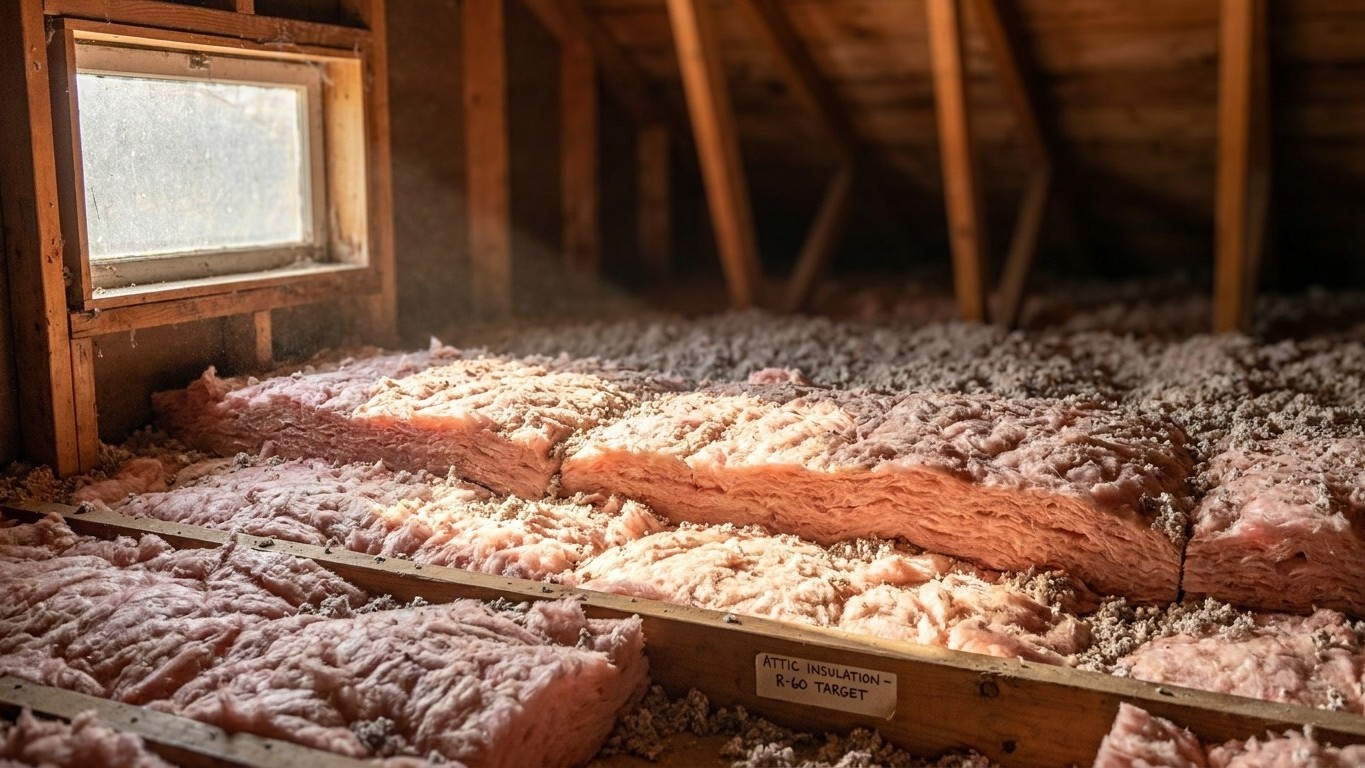

Kansas homes fall into two different insulation requirements, not one. The state’s 105 counties split between IECC climate zone 4A (88 counties) and zone 5A (17 counties), and the recommended attic and floor R-values shift depending on which zone a house sits in. Add in the state’s roughly 4,414 heating degree days a year, and insulation here isn’t a minor upgrade, it’s tied directly to how much fuel a furnace burns every winter.
Which climate zone Kansas is in

There’s no single climate zone for Kansas, and that matters because the zone is what decides which row of the insulation table applies to a given house. Under the 2021 International Energy Conservation Code, Table R301.1 assigns each U.S. county to a climate zone based on temperature and moisture patterns. Kansas splits between two of them.
| Climate zone | Number of counties |
|---|---|
| Zone 4A | 88 counties |
| Zone 5A | 17 counties |
That’s 88 counties of 105 in zone 4A, and 17 of 105 in zone 5A. Notice what that count does and doesn’t tell you: it’s a tally of counties, not a share of the state’s population. A handful of counties can hold a disproportionate number of residents, so don’t read “88 of 105” as “88 percent of Kansans.” It simply means zone 4A covers more territory on the map.
A climate zone number, in the IECC system, reflects how cold or hot a region runs on average, with lower numbers meaning milder climates and higher numbers meaning harsher ones. The letter that follows the number describes moisture: A stands for moist, B for dry, and C for marine. Zones 7 and 8, reserved for the coldest parts of the country, carry no letter at all. That letter isn’t decorative. It changes which row of the ENERGY STAR insulation table a home falls under, because the table groups certain zone-and-letter combinations together and separates others.
If you’re trying to figure out which of the two zones your own county falls into, this page won’t tell you and neither should any other general guide, that’s a county-by-county lookup best done against the official 2021 IECC table or the ENERGY STAR climate zone map, not a guess based on where you live relative to Wichita or Topeka. What this page can tell you is the shape of the state: two zones, a majority-county zone (4A) and a smaller cluster of counties (5A) that likely run colder on average, since higher zone numbers generally track colder winters. Once you know which zone applies to your county, the next section gives you the actual numbers to work from.
The insulation levels that apply here
ENERGY STAR publishes recommended insulation levels for retrofitting existing wood-framed homes, based on the 2021 IECC residential provisions. These are the guidelines to use when adding insulation to a house that’s already standing, not the requirements for new construction. The table below reproduces those levels exactly as ENERGY STAR presents them.
| Zone | Attic if UNINSULATED | Attic if you ALREADY HAVE 3-4 inches | Floor |
|---|---|---|---|
| Zone 1 | R30 | R25 | R13 |
| Zone 2 | R49 | R38 | R13 |
| Zone 3 | R49 | R38 | R19 |
| Zones 4A and 4B | R60 | R49 | R19 |
| Zones 6, 5 and 4C | R60 | R49 | R30 |
| Zones 7 and 8 | R60 | R49 | R38 |
Read that table carefully, because the header is easy to misread. Each zone has three figures, but they aren’t three attic values. The first two columns are both about the attic: one for a home with no insulation up there at all, and one for a home that already has 3 to 4 inches sitting in the joists. The third column is a completely different part of the house, the floor over an unconditioned space like a crawlspace or garage.
For Kansas, two rows matter, and they aren’t the same. The 88 counties in zone 4A fall under “Zones 4A and 4B,” which calls for R60 in an uninsulated attic, R49 if 3-4 inches are already there, and R19 at the floor. The 17 counties in zone 5A fall under “Zones 6, 5 and 4C,” which keeps the same attic numbers, R60 and R49, but raises the floor recommendation to R30. A homeowner in one of the state’s zone 5A counties and one in a zone 4A county are buying the same attic material but a noticeably different amount of floor insulation. Neither figure should be blended into some statewide average. Doing that would mean under-insulating a floor in the colder counties or over-buying material in the warmer ones, and R-values aren’t a place to split the difference.
Sealing comes before insulating
ENERGY STAR treats air sealing and insulation as two steps of the same project, and its own guidance is specific about the order: seal the attic first, insulate it second. That sequence isn’t arbitrary. Insulation slows heat as it moves through a material, but it does nothing to stop air moving around or through gaps, wire penetrations, plumbing chases, and can lights. Lay batts or blow-in insulation over those unsealed openings and you haven’t fixed the problem, you’ve just hidden it under a layer of material that makes it harder to find later.
The practical order of work, following that logic, looks like this:
- Seal air leaks in the attic first, targeting the top plates, chimney chases, and any penetrations where ductwork or plumbing passes through the ceiling
- Add or top up attic insulation to the level called for by the applicable zone row above
- Seal and insulate the rim joist, the band around the foundation where the house framing sits on the basement or crawlspace wall
- Address the floor over crawlspaces or unconditioned basements
- Move to wall insulation last, since walls typically leak less air than attics and rim joists and involve more invasive work to access
Notice that the published energy savings figure, covered in the last section of this page, applies to sealing and insulating together as a combined project. There’s no separate number for what sealing alone saves a Kansas household, and treating the two as interchangeable steps rather than a single project is part of what leads homeowners to skip the sealing step entirely. For the specifics of how to seal a given area or how much a particular type of insulation performs, the national insulation guides on this site walk through each step in more depth than a state-level page can.
What the winter here actually asks for
Wichita, Kansas averages about 4,414 heating degree days a year, alongside roughly 1,774 cooling degree days, according to NOAA’s 1991-2020 climate normals. Degree days aren’t a temperature reading, they’re a measure of demand: the figure adds up, for every day of the year, how far the average temperature fell below 65°F. A year with twice the heating degree days of another location generally means roughly twice the fuel burned to keep a similarly built house warm, all else equal. At 4,414, Kansas carries a heating season that’s substantial, not extreme, but real enough that attic and floor insulation levels have a direct line to a household’s winter fuel use.
What Kansas homes actually heat with backs that up. Data from the U.S. Energy Information Administration’s 2020 Residential Energy Consumption Survey shows 86% of Kansas homes rely on a furnace as their main heating equipment, with 6% using a central heat pump. The survey didn’t publish a reliable figure for steam or hot-water boilers in the state, listing that category as “not reported” because the estimate was suppressed as unreliable, which is not the same as saying no Kansas homes use boilers. On fuel, natural gas leads at 71%, electricity accounts for 21%, and propane covers 6%; fuel oil or kerosene came back with no figure reported at all in the survey, meaning too few households were surveyed using that fuel to publish a number, not that the count is zero.
A state running mostly on furnaces and forced air, rather than boilers and radiators, has a specific vulnerability that ceiling insulation alone doesn’t fix: ductwork. When furnace ductwork runs through an unconditioned attic, which is common in Kansas homes, the ducts themselves leak conditioned air before it ever reaches a room, and no amount of attic insulation stops that loss if the ducts aren’t sealed and insulated separately.
That gives Kansas homeowners a fairly clear set of priorities:
- Seal attic air leaks before adding insulation, since the furnace-and-ductwork setup common here means attic penetrations are doing double duty as heat loss points
- Bring attic insulation up to the level for your county’s zone, R60 for an uninsulated attic in both zones present in Kansas
- Check and seal ductwork running through the attic, a step separate from insulation but directly tied to how much of that furnace-heated air actually reaches the living space
- Address the floor over crawlspaces or basements, using R19 in zone 4A counties or R30 in zone 5A counties
The duct guides on this site cover how to identify and seal leaky attic ductwork in more detail, which matters here given how many Kansas households depend on a furnace pushing air through exactly that kind of duct run.
What the work is worth
ENERGY STAR’s own methodology page puts a number on this combined work: “EPA estimates that homeowners can save an average of 15% on heating and cooling costs (or an average of 11% on total energy costs) by air sealing their homes and adding insulation in attics, floors over crawl spaces, and accessible basement rim joists.” Both figures matter, and they aren’t interchangeable. The 15% applies specifically to heating and cooling costs; the 11% applies to total energy costs, a broader category that includes water heating, appliances, and lighting alongside the heating and cooling bill.
These are averages drawn from energy modeling of a “typical” existing U.S. home, not a guarantee for any specific Kansas house. A home that’s already well-sealed and insulated to current levels won’t see anywhere close to those figures, while a home with an original, uninsulated attic and unsealed ductwork could plausibly see more. The estimate also names its scope precisely: attics, floors over crawl spaces, and accessible basement rim joists. It does not cover walls, windows, or doors, and stretching the 15%/11% figure to include those areas overstates what the underlying study actually measured.
It’s worth keeping this figure separate from two others that sound similar but aren’t the same claim. ENERGY STAR’s own program landing page cites “up to a 10% savings on your annual energy bills” for sealing and insulating, a different number built on a different denominator. Separately, the U.S. Department of Energy’s commonly cited 10% figure refers to setting a thermostat back 7 to 10 degrees for eight hours a day, a scheduling habit that has nothing to do with insulation at all. Three real numbers, three different claims, and for a Kansas homeowner weighing whether attic work in a zone 4A or zone 5A county is worth doing, the 15%/11% figure from ENERGY STAR’s methodology is the one that actually describes sealing and insulating the attic, floor, and rim joist.