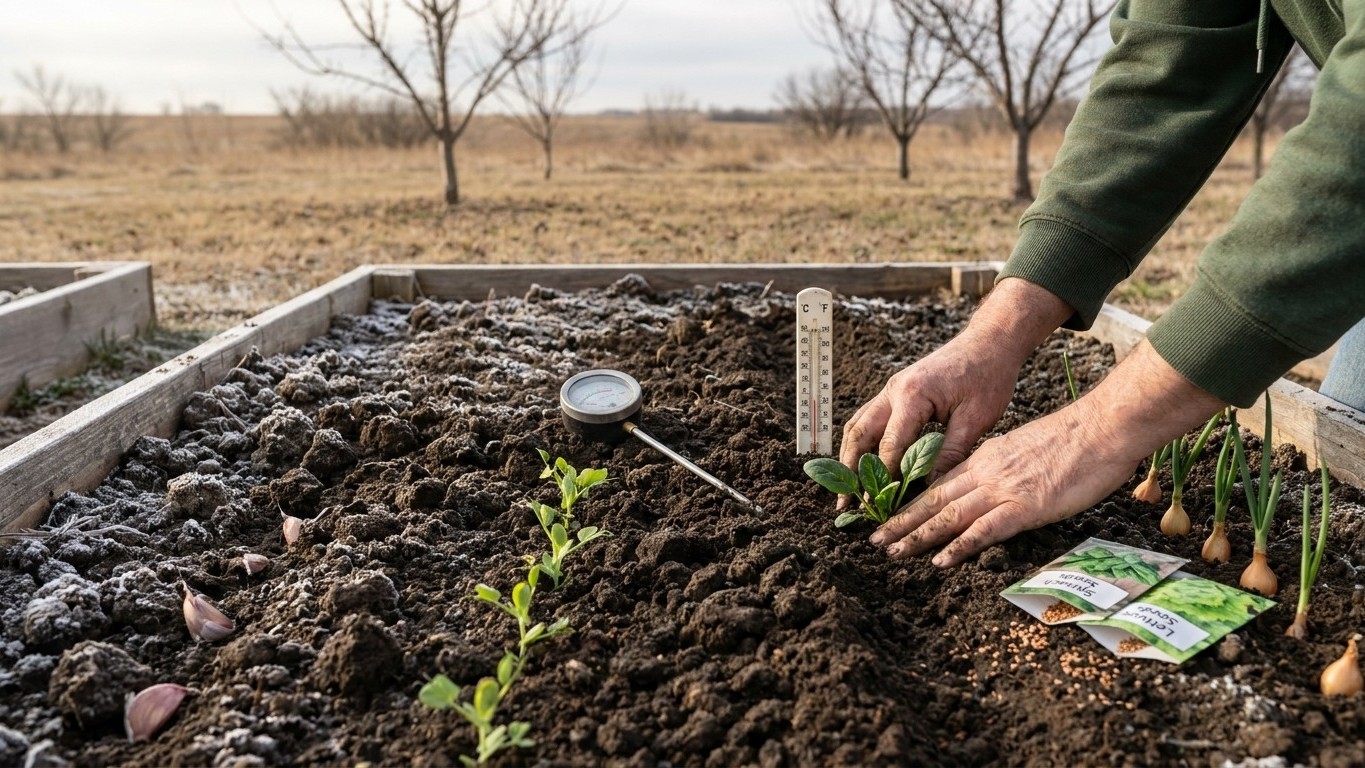

March in Kansas sits well ahead of the average last spring frost, which the National Weather Service data puts between April 4 and April 18 for the reference station. That three-to-six week gap is what decides this month’s garden work: hardy crops that tolerate a hard freeze go into the ground now, while anything tender waits indoors under lights. Peas, spinach, lettuce, onion sets, garlic and bare-root fruit stock are the safe bets outdoors, provided the soil has thawed enough to work without turning to mud.
What goes in the ground in March

The calendar says spring is close. The soil says otherwise. Kansas gardens across the 5b-7a hardiness range still have three to six weeks before the average last freeze clears out, and soil temperature, not air temperature, is what actually governs whether a seed sprouts or rots in place. A 60-degree afternoon does not mean the ground four inches down has caught up, and that gap is where most March planting mistakes happen.
What survives this month is the short list of genuinely cold-hardy crops. Peas can go in as soon as the soil crumbles rather than clumps, since they germinate in soil as cool as the low 40s. Spinach, lettuce and radish seed handle a light freeze once they’ve sprouted, and all three can be direct-sown as soon as beds are workable. Onion sets and seed potatoes tolerate frosty nights if planted with a few inches of soil over the top. Garlic and shallots planted the previous fall are already pushing green shoots by now, and any cloves missed in the fall window can still go in if the ground isn’t frozen solid, though yields will lag behind fall-planted garlic.
Bare-root stock is the other big category this month: fruit trees, berry canes, asparagus crowns and rhubarb divisions all go in while they’re still dormant, ideally before buds swell. Planting dormant stock in March, rather than waiting for leaves to appear, gives roots weeks to establish before the plant has to support top growth. Cold frames and low tunnels stretch the list further, letting kale, spinach and even carrot seed go in two to three weeks earlier than open ground would allow. What doesn’t belong outside yet: tomatoes, peppers, beans, squash, cucumbers and anything else that came from a warm climate. Cold soil either rots the seed outright or stalls the seedling so badly it never catches up to a plant started properly indoors.
What to start under cover
Indoor seed-starting in March runs on subtraction, not a fixed date. Take the local last-frost window, April 4 to April 18 for the reference station, and count backward by the number of weeks each crop needs before it’s ready for the garden. Tomatoes need six to eight weeks of indoor growth before transplant, which puts their seeding window in mid-February to early March for most of the state. Peppers run slower, needing eight to ten weeks, so peppers started this month are already behind for gardeners aiming at an early April transplant date and are better aimed at planting out in May once soil has properly warmed.
Cabbage, broccoli and other brassica transplants need only four to six weeks indoors, which makes March the ideal window for a crop that can go outside under row cover before the last frost even clears, since these plants shrug off a freeze that would kill a tomato seedling outright. Onions started from seed rather than sets need ten to twelve weeks and should already be well underway by March; if they aren’t, sets are the faster path to a similar harvest.
Two failure modes show up every season. Starting too early leaves plants rootbound and leggy on a windowsill for weeks past when they should have gone outside, producing stunted transplants that never fully recover. Starting too late means running out of growing season entirely, especially for long-season crops like peppers and eggplant that need every one of those warm weeks between the last frost and the first fall freeze on October 23 to November 2 to produce a real harvest.
What is ready to pick
Not much comes out of an open Kansas garden in March, and there’s no point pretending otherwise. What kept producing through winter, though, still has something to offer. Kale and leeks left in the ground under mulch or snow cover often taste sweeter after repeated freezes, since cold stress converts starches to sugar in both crops. Spinach and mâche that overwintered under a cold frame or low tunnel can be cut now, and cutting the outer leaves rather than pulling the whole plant keeps it producing for weeks longer.
Indoors, sprouts and microgreens fill the gap on a much shorter cycle, ready in seven to fourteen days from seed with nothing more than a tray, some growing medium and a windowsill. They’re the fastest route to fresh greens while outdoor beds are still too cold to plant.
Stored crops need a check this month regardless of what’s happening outside. Squash that’s been sitting since fall storage should feel firm and heavy for its size; any softness near the stem end signals rot starting from the inside out. Potatoes with green patches or long pale sprouts should be used first or composted, since sprouting drains the tuber’s stored starch fast. Onions that have gone soft at the neck or started growing a green shoot are past their storage life and worth pulling from the bin before they spread mold to the rest.
The jobs that matter this month
March carries more real deadlines than any other month on the Kansas garden calendar, and most of them have nothing to do with planting. Dormant pruning of fruit trees and berry canes needs to happen before buds swell and sap starts moving, since pruning cuts made after growth begins waste the plant’s stored energy and open wounds that heal more slowly. Apple, pear and stone fruit trees are all still workable candidates for this if it hasn’t happened yet.
Seed ordering has a real deadline too, quieter but just as costly to miss: popular varieties of tomatoes, peppers and specialty greens sell out from seed suppliers by late winter most seasons, and a gardener who waits until planting week to order is choosing from whatever’s left rather than what they wanted.
Soil deserves attention before anything goes into it. A basic soil test now, run through a local extension lab, gives results in time to correct pH or nutrient gaps before the main planting rush, something that’s impossible to fix retroactively once seedlings are already struggling in the ground. Turning finished compost into beds while the soil is still workable and not yet planted avoids disturbing roots later. Tools benefit from the same attention: a sharp, clean pruner or hoe blade makes cleaner cuts that heal faster and spreads less disease between plants than a dull, rusty one.
Beds and fencing need a walk-through before the season’s growth hides problems. A rotted raised-bed corner or a sagging fence panel is a five-minute fix in March and a half-day project once vines and canes have grown through it. Rotation planning, deciding which family of crops goes where this season versus last, is easiest done now on paper, before beds fill up and the plan gets improvised on the fly.
What not to do in March
The most common mistake this month is trusting the air instead of the soil. A run of 65-degree afternoons feels like permission to set out tomato or pepper transplants, but soil four to six inches down often lags a full week or more behind air temperature, and a tender seedling planted into cold, wet ground either stalls for weeks or rots outright. The safer read is the one below the surface, not the one on the porch thermometer.
A related trap: pulling row covers or mulch off cold-hardy crops after a mild stretch, only to lose them to a hard freeze that arrives within the normal April 4 to April 18 window. That window is a range, not a deadline, and freezes inside it are expected, not exceptional. Covers are cheap insurance against a mistake that costs an entire planting.
Nitrogen fertilizer applied too early is another classic misstep. Feeding young plants a heavy dose of nitrogen before they’ve built real root mass pushes soft, sappy top growth that’s more vulnerable to frost damage, not less. The better sequence is root-first: let seedlings establish, then feed once they’re actively growing and the frost risk has genuinely passed. Working wet soil rounds out the list of avoidable damage, since tilling or digging beds that are still saturated compacts the structure and can set drainage problems that last the whole growing season.
Checking this against your own county
Everything above is a state-wide starting point, not a set of instructions for a specific backyard. Kansas stretches from the humid, lower-elevation east to the higher, drier High Plains in the west, and that difference alone can shift frost dates by two weeks or more in either direction. Elevation, local terrain and even a nearby lake or river can push a rural garden’s last frost later, or its first fall frost earlier, than the reference-station figures cited here.
The most reliable next step is a county-level check through the Kansas State University Research and Extension service, which publishes localized planting guidance and frost data closer to a specific address than any state-wide figure can offer.
Common questions
Is it too early to plant tomatoes in Kansas in March?
Yes, for outdoor planting. The average last frost for the reference station falls between April 4 and April 18, and tomatoes have zero frost tolerance. March is the month to start tomato seed indoors, six to eight weeks ahead of that outdoor transplant date, not to set plants in open soil.
Can I plant potatoes in Kansas in March?
Seed potatoes tolerate cool soil and light frost once sprouted, which makes March a reasonable window as soon as garden soil is workable rather than waterlogged. Planting a few inches deep gives the developing tubers protection if a late freeze follows.
What vegetables can survive a Kansas frost in March?
Peas, spinach, lettuce, kale, radish and onion sets all tolerate freezing temperatures once established, which is why they’re the reliable direct-sow choices this month across the state’s 5b-7a hardiness range.
When should I start seeds indoors for a Kansas garden?
Count backward from the local last frost date rather than from March 1. Peppers need eight to ten weeks indoors, tomatoes six to eight, and brassica transplants like broccoli and cabbage only four to six, so each crop has its own starting week even within the same month.