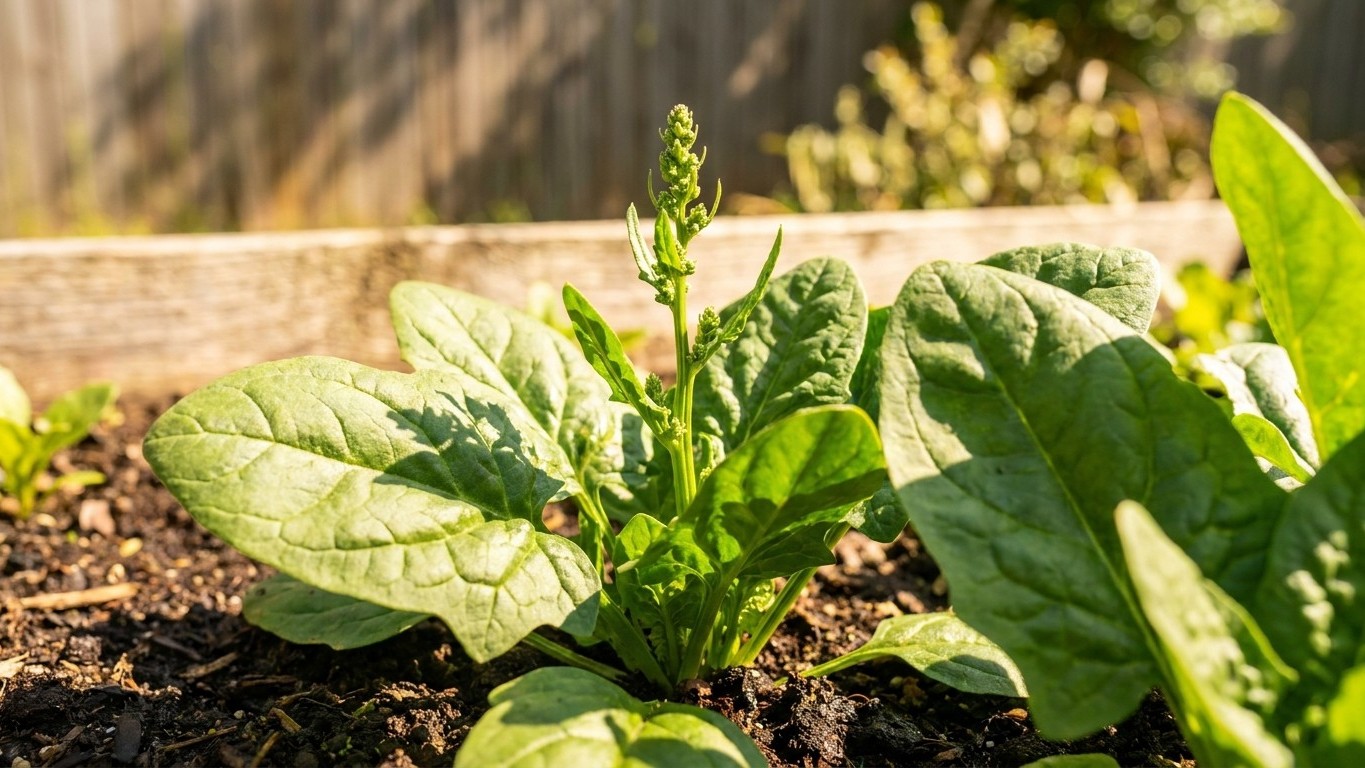

Spinach in Kansas bolts early because of two forces working together, not one. The state’s long summer days trigger flowering on their own, and Wichita’s climate piles on extreme heat that pushes the plant past its growth ceiling even faster. The real question for Kansas gardeners isn’t whether spinach will bolt, it’s how many usable weeks you get before it does, in both spring and fall.
The short answer
On the longest day of the year, Wichita sees 14 hours and 36 minutes of daylight. That number matters more than most gardeners realize, because spinach flowers in response to long days, independent of temperature. A cooler-than-normal June wouldn’t buy extra growing time here even if Kansas had one, because the day length itself is the trigger. Once daylight stretches past a certain point, the plant shifts into reproductive mode and sends up a flower stalk, and no amount of shade cloth or mulch reverses that clock.
That would be a real limitation on its own. But Kansas doesn’t offer a cool summer to soften the blow. The reference station in Wichita averages 57.6 days a year at 90 F or hotter, a heat load that ranks among the more intense in the country for a cool-season crop like spinach. Spinach grows best where temperatures stay under 75 F, and that ceiling is not a soft guideline. Above it, growth slows, leaves turn bitter, and the plant is primed to bolt at the first long-day signal. Kansas crosses that 75 F mark early and often, well before the days reach their longest point in late June.
So the honest answer is that both mechanisms work against spinach in this state at the same time. Day length pushes the plant toward flowering regardless of heat, and Kansas heat arrives on a schedule that reinforces the same outcome from a different direction. A gardener in a milder-summer state might get a few extra weeks of quality leaf growth before day length alone takes over. In Kansas, the heat gets there first in most years, and the long days finish the job shortly after.
This isn’t a reason to skip spinach, though. It’s a reason to treat it as a bookend crop, something grown hard against the cool edges of the year rather than through the middle of it. Spring sowing has to happen early and finish fast. Fall sowing has to wait for the ground to cool, then race the first frost. Understanding which force, day length or heat, is doing the damage at any given point in the calendar is what lets a Kansas gardener plan around it instead of being surprised by it.
How long the spring window really is
Spinach seed goes in the ground 2 to 3 weeks before the last expected frost, while soil is still cold and the crop can get a head start before heat and day length turn against it. Here’s how that plays out using the Wichita reference dates:
- Last spring frost at the reference station: April 4 to April 18. Suburban and rural gardens away from the airport station typically see frost linger later than this, sometimes by one to two weeks, so a garden outside the immediate Wichita area should treat this as an earliest-case estimate, not a guarantee.
- Sowing date: working back 2 to 3 weeks from even the earlier end of that frost range puts seed in the ground in mid-March for many Kansas gardens, and possibly the first days of April for those in cooler pockets or at higher elevation.
- Growth period before the 75 F ceiling becomes a daily problem: Kansas heat builds quickly once spring turns to early summer. With 57.6 days a year averaging 90 F or above at the reference station, the climb past a 75 F growing ceiling for spinach tends to happen well before the calendar reaches the longest days of the year.
- Effective harvest window: that leaves a usable spring stretch of roughly six to eight weeks from sowing to the point where heat and lengthening days start working against leaf quality, shorter in a warm spring, a little longer if the season starts cool and stays that way into May.
That window is tight compared to states with milder early summers, and it rewards gardeners who sow at the first workable date rather than waiting for settled warm weather. Waiting for what feels like safe spring planting weather in Kansas often means sowing spinach directly into a season that’s already closing.
The autumn crop, and when the soil lets you sow
Fall spinach in Kansas has to clear two separate hurdles, one at the start of the season and one at the end, and they don’t operate on the same clock.
Soil too warm to germinate
Spinach seed germination drops off once soil temperature climbs above 80 F, a threshold that matters a great deal in a state where summer heat lingers into what other regions would already call fall. With Wichita averaging nearly 58 days a year at 90 F or hotter, soil at seed depth commonly stays above that 80 F germination ceiling well past the point when the air itself starts to feel cooler in the evenings. Practically, this means an early September sowing attempt in a hot Kansas summer can still land on soil that’s simply too warm for the seed to sprout reliably, even if the daytime high has started to ease. The fall window doesn’t open on the calendar, it opens when the ground itself cools down, and that can lag the first cooler days by a couple of weeks.
The frost that ends the season
At the other end, the first fall frost at the reference station arrives between October 23 and November 2, and rural or suburban gardens away from the airport station often see that first frost arrive earlier than the station date, sometimes by one to two weeks. For a fall harvest, sowing should happen 50 to 75 days before the date you want to bring the crop in, a range that comes directly from Utah State University Extension guidance for spinach and isn’t tied to any specific days-to-maturity figure for a particular variety. Counting back from a realistic harvest target in mid-to-late October, that 50-to-75-day window points to a sowing date somewhere in the second half of August through mid-September for many Kansas gardens.
That puts the two obstacles on a collision course in a hot year: soil that’s still too warm to germinate well into early September, and a frost that can show up by the third week of October in gardens outside the reference station. The gap between those two dates is where fall spinach succeeds or fails in Kansas, and it can be narrow. Watching soil temperature directly, rather than trusting a date on the calendar, is the more reliable way to time the sowing.
Four spinach varieties come up often in seed catalogs and extension materials, Bloomsdale, Melody, Teton, and Olympia, but no data on days to maturity, heat tolerance, or bolt resistance for any of these specific varieties is published in the sources behind this article. Gardeners choosing between them should look to the seed packet or a local extension office for that detail rather than assuming one variety buys meaningfully more time against Kansas heat and day length.
Common questions
Does planting spinach in shade slow down bolting in Kansas?
Shade can lower leaf temperature somewhat and may help keep the plant under that 75 F growth ceiling a little longer, but it does nothing about day length, which is the other trigger for bolting. Since Wichita’s long summer days push toward flowering regardless of temperature, shade alone won’t prevent bolting, it can only slow the heat side of the equation.
Is there a spinach variety that resists bolting better in a hot state like Kansas?
Bloomsdale, Melody, Teton, and Olympia are commonly available varieties, but no comparative data on bolt resistance for these specific varieties appears in the sources used for this article. Any claim about one variety outperforming another in Kansas heat should be checked against the seed supplier’s own information or a local extension office rather than assumed.
Why does warm soil stop fall spinach from germinating in Kansas?
Spinach seed germination is reduced once soil temperature rises above 80 F, and Kansas summers regularly push soil past that mark well into what feels like early fall. Until soil cools below that threshold, seed sown for a fall crop may simply fail to sprout, regardless of how promising the air temperature looks.
Should I trust the Wichita frost dates for my own Kansas garden?
Treat them as a starting reference point, not a guarantee. The last spring frost (April 4 to April 18) and first fall frost (October 23 to November 2) come from the airport weather station, and gardens in suburban or rural areas typically see frost arrive later in spring and earlier in fall than the station records, sometimes by one to two weeks or more at higher elevation. Checking local conditions and your own garden’s frost history will give a more accurate picture than the station data alone.