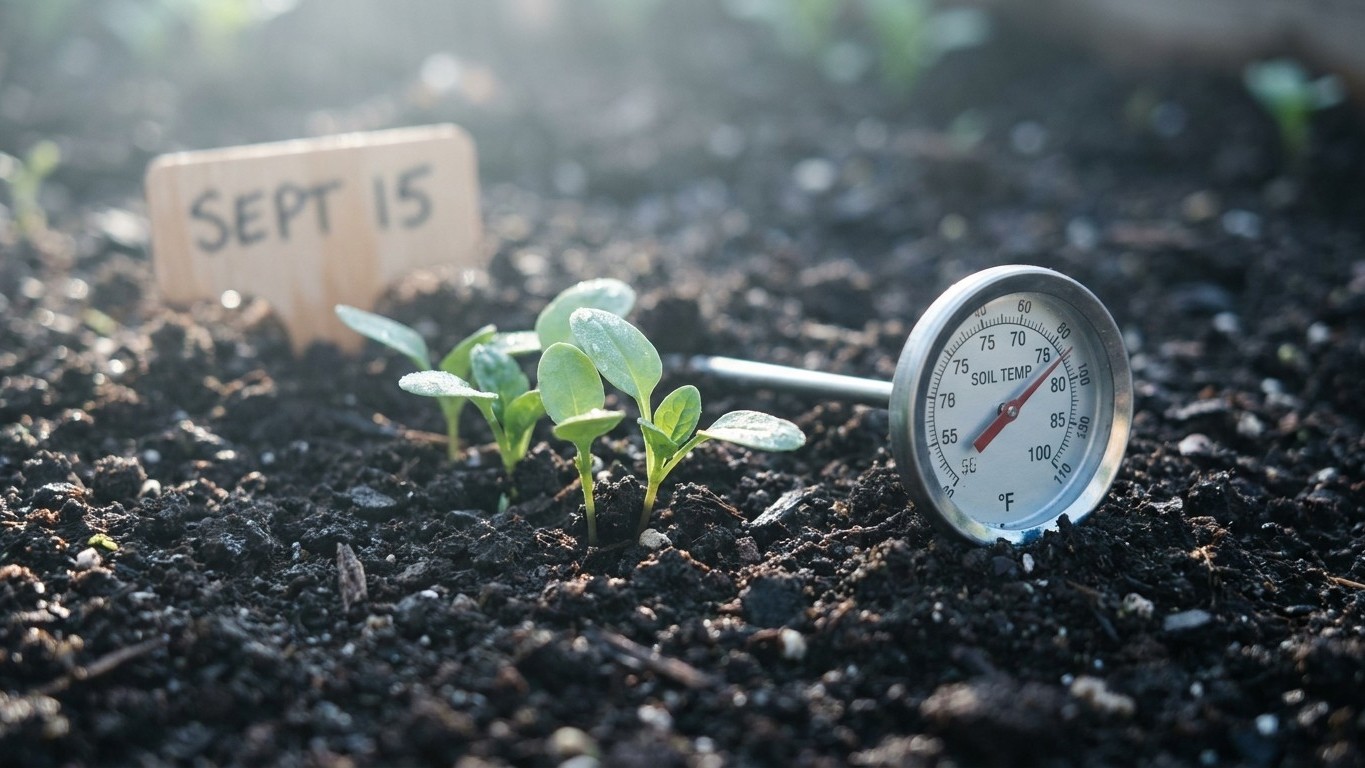

Kansas gardeners get one real shot at fall spinach: seed goes in the ground once soil temperatures drop out of summer’s danger zone, roughly early August through mid-September, so the crop matures and gets harvested before the season’s first hard freeze in late October. The exact week shifts with soil temperature and your target harvest date, not with the calendar.
The short answer
Wichita, the reference station for this region, logs 14 hours and 36 minutes of daylight on the longest day of the year. That number matters more than most gardeners assume, because spinach bolts, meaning it stops making leaves and shifts into flowering, when days run long and temperatures climb. A cool summer does not cancel this out. Even if a July happened to run mild, the plant would still read the long daylight hours as a signal to flower. The clock that triggers bolting is set by the sun, not the thermometer alone.
Heat piles on top of that signal. Utah State University Extension notes that spinach grows best where temperatures stay under 75 F, and that same 75 F line marks where the leaves start turning bitter even if the plant hasn’t bolted yet. Wichita averages 57.6 days a year at 90 F or hotter, a heat load concentrated squarely in the months when day length is also at its peak. That combination, long days stacked on top of high heat, is why spinach struggles here from late spring through summer.
So the limiting factor in Kansas is both day length and heat, working together rather than one canceling the other. Long days alone would eventually push the plant to flower even in a cooler climate. Add Kansas-level summer heat, and the plant has almost no room to produce the mild, tender leaves gardeners actually want. That’s the reason fall sowing works better here than trying to stretch a spring crop deep into summer: by the time September arrives, day length is shortening again and the worst of the 90-degree days are behind you, even though the soil itself takes a while longer to catch up.
This also explains why fall spinach in Kansas has a narrower window than you might expect from frost dates alone. The crop isn’t waiting on cold to arrive. It’s waiting on the soil to cool enough to germinate, and on the calendar to deliver enough non-bolting days before frost ends the season outright. Both conditions have to line up, and neither is negotiable.
How long the spring window really is
Spring spinach in Kansas is possible, but it’s a short-lived crop squeezed between frost and heat. Here’s how the timing actually works out:
- The reference city’s last spring frost falls between April 4 and April 18, based on NOAA NCEI 1991-2020 climate normals. Suburban and rural gardens away from the airport station often see frost linger one to two weeks later, so check your own county before committing to a date.
- Spinach seed goes in 2 to 3 weeks before that last frost date, since the crop tolerates cold soil far better than heat. That puts sowing somewhere in the second half of March for most of the region, edging into early April if your local frost date runs later than Wichita’s.
- From there, the plant grows well as long as temperatures stay under that 75 F ceiling. Once daytime highs push consistently past it, growth quality drops and bolting risk climbs fast, especially as day length keeps stretching toward the June solstice.
- Given how quickly Kansas heats up, that 75 F ceiling typically arrives well before summer officially starts. Combined with lengthening daylight through May, the realistic stretch of good spring growth runs somewhere around 8 weeks, from a mid-to-late March sowing to a harvest finished before the heat and day length combine to force bolting.
- That’s a workable but tight window. Miss the early sowing date, and there often isn’t enough cool, short-enough-day stretch left to grow a full crop before conditions turn against it.
The spring window exists, but it rewards gardeners who sow early and harvest promptly rather than letting plants linger in the ground once May heat sets in.
The autumn crop, and when the soil lets you sow
Fall spinach flips the spring problem around. Instead of racing lengthening days and rising heat, you’re waiting for both to ease off, and timing your sowing against two separate obstacles: soil that’s still too warm, and a frost that eventually shuts the whole thing down.
Soil still too warm to germinate
Utah State University Extension notes that spinach seed germination drops off once soil temperature climbs above 80 F. In Kansas, where 57.6 days a year reach 90 F in the air, soil in a garden bed can stay above that 80 F germination threshold well into late summer, even after the hottest air temperatures start to ease. That’s the real gate on fall sowing here, not frost. Sowing too early, while soil is still baked from a Kansas summer, often means poor or spotty germination regardless of how carefully you water. Waiting until soil has genuinely cooled, which usually means holding off until deep summer heat has broken, matters more than watching the calendar.
The frost that ends the season
The first fall frost at the reference station arrives between October 23 and November 2, again based on NOAA NCEI 1991-2020 climate normals. Rural and elevated gardens tend to see that first freeze show up earlier, sometimes by a week or two, so treat this as a Wichita-area reference point rather than a guarantee for your own yard.
Utah State University Extension’s guidance for a fall crop is to sow 50 to 75 days before the date you want to harvest, no more specific maturity figure is published for spinach, so don’t lean on a fixed days-to-harvest number from another crop. Counting back from a realistic harvest target in the last third of October, that 50-to-75-day window lands seed in the ground somewhere between early August and mid-September, later if you’re comfortable harvesting closer to first frost, earlier if you want a buffer before the freeze arrives. Whichever variety you plant, and the names that come up most often are Bloomsdale, Melody, Teton, and Olympia, no published performance data distinguishes one from another for this purpose, so the sowing math stays the same regardless of which seed packet you pick.
Common questions
Can I sow spinach in the heat of a Kansas August?
Only once soil temperature has actually dropped, not simply because the calendar says August. With soil regularly running above the 80 F germination threshold through peak summer, an early-August sowing into still-hot ground often fails to sprout evenly. Check soil temperature directly rather than sowing on a fixed date.
Does a mild Kansas summer mean I can push spring spinach later?
No. Bolting is triggered by long daylight hours as much as by heat, and day length keeps lengthening toward the June solstice regardless of how warm or cool the air happens to be that particular year. A cooler-than-usual summer doesn’t buy extra weeks.
Is 75 F a hard cutoff date for spinach?
No, it’s a temperature ceiling, not a date. It marks both where growth quality declines and where leaves start tasting bitter. Some years that threshold arrives earlier or later depending on the spring, which is another reason to watch conditions rather than lock in a fixed date.
Which frost date should I trust for planning, spring or fall?
Both matter, but for opposite reasons. The spring frost date sets how early you can sow without cold damage; the fall frost date sets the outer limit for how long your autumn crop can keep growing. Both figures come from the same NOAA NCEI climate normals for the reference station, and both tend to arrive later in spring and earlier in fall for gardens away from that station, so build in a margin on either end.