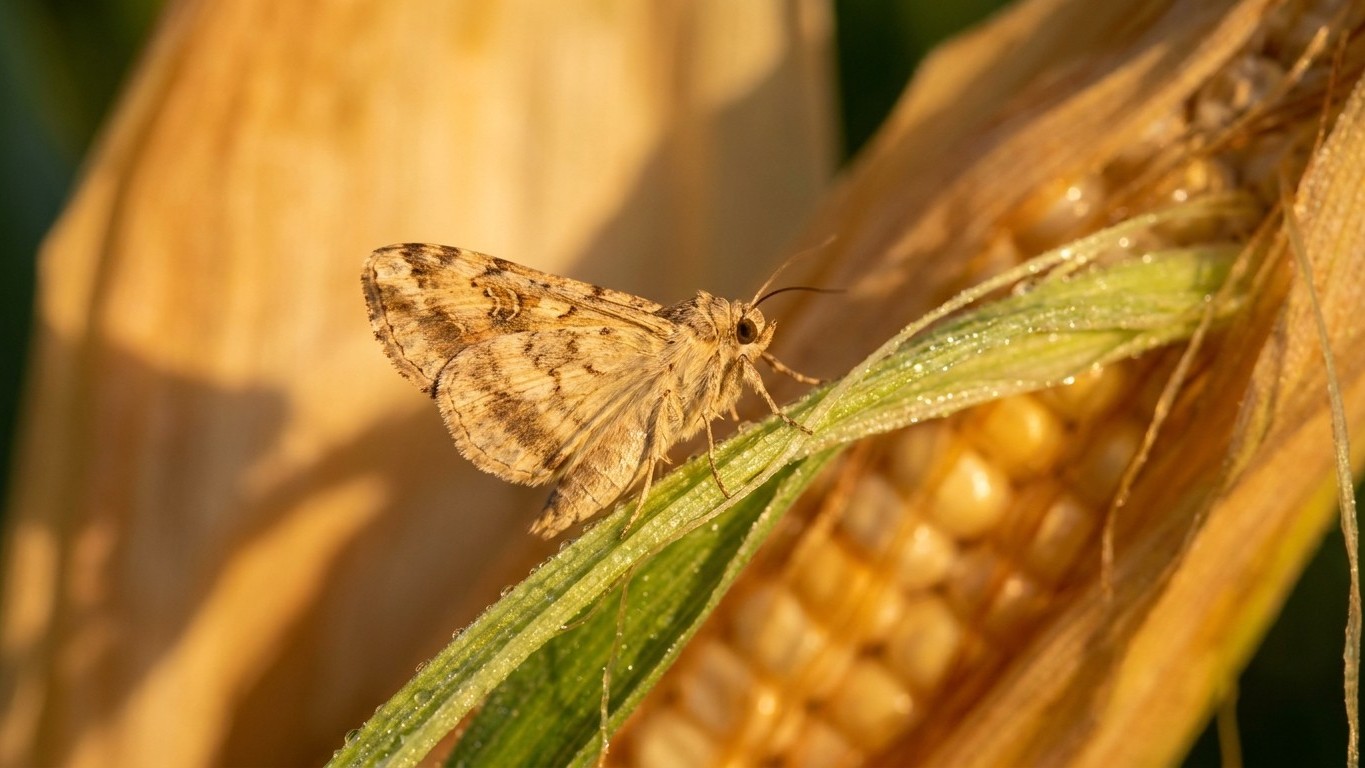

Corn in Kansas takes real damage from just three insects K-State Research and Extension documents for the state: grasshoppers, blister beetles, and the spotted cucumber beetle, whose larvae are the southern corn rootworm. Grasshoppers chew leaves all summer, blister beetles show up in swarms during tasseling, and rootworm larvae work the roots soon after the seedlings come up. The other seven pests on the state’s list belong to other crops entirely.
Which pests attack corn in Kansas
K-State Research and Extension documents ten insects for Kansas gardens and landscapes: bagworm (Thyridopteryx ephemeraeformis), blister beetle (Epicauta spp.), Colorado potato beetle, grasshopper, harlequin bug, pine sawyer beetle, spotted cucumber beetle, squash bug (Anasa tristis), squash vine borer, and striped cucumber beetle. That is the full list this service tracks for the territory, and it is not a corn-specific roster. Only three of the ten actually have a reason to be in a stand of corn. The rest are specialists that skip it entirely, and knowing why matters more than knowing the names.
- Bagworm feeds on juniper, arborvitae, and other evergreen foliage. It builds a bag of plant material and never touches a row crop.
- Colorado potato beetle is a nightshade specialist. It wants potato, eggplant, and tomato foliage, not corn leaves.
- Harlequin bug targets cabbage-family plants. Corn has none of the chemistry that draws it.
- Pine sawyer beetle is a wood-boring pest of pine trees, not a garden insect at all.
- Squash bug and squash vine borer both work squash and pumpkin vines, feeding on stems and leaves that don’t exist on a corn plant.
- Striped cucumber beetle is a cucurbit specialist. It will visit a garden with cucumbers or melons nearby but has little interest in corn foliage or roots.
That leaves grasshoppers, blister beetles, and the spotted cucumber beetle. Grasshoppers are generalist chewers that will eat almost any green leaf once populations build, and corn is no exception. Blister beetles feed on foliage and flowers of a wide range of garden plants, including corn silks during pollination, which matters because damaged silks mean fewer kernels fill out. The spotted cucumber beetle is the one that surprises people: its larval stage is known separately as the southern corn rootworm, and those larvae tunnel into corn roots while the adult beetle feeds above ground on pollen and silks. One insect, two names, two kinds of damage.
When each one shows up, and what it does first
Kansas corn plantings follow the frost calendar before anything else. The reference station shows a last spring frost between April 4 and April 18, and sweet corn needs soil warmer than 60 F before seed goes in the ground, which comes well after that frost date, not on it. From there, the crop needs 60 to 90 days to mature, and that window has to close before the first fall frost, which the same station places between October 23 and November 2. Pest pressure tracks that same stretch of the calendar.
Early on, right after the seedlings emerge, the first sign of trouble is usually below ground. Southern corn rootworm larvae, the immature stage of the spotted cucumber beetle, feed on young roots while plants are still small. What you notice first is a plant that wobbles more than its neighbors, or one that leans and doesn’t stand back up after wind. That’s a root problem before it’s ever a leaf problem.
As the season moves into its hottest stretch, grasshoppers build in number. The reference station averages 57.6 days a year at or above 90 F, and that heat load is exactly what favors grasshopper population growth. The first sign is ragged, notched leaf margins, chewed from the outside edge inward rather than punched through the middle of the blade. In a bad year, damage can move fast because grasshoppers keep feeding as long as green tissue is available.
Blister beetles tend to arrive later, often in loose swarms rather than as scattered individuals, and their timing lines up with tasseling and silking. That’s the same stretch the sweet corn clock is measuring toward maturity, somewhere inside that 60-to-90-day window from planting. What you see first is clipped or shortened silks, sometimes with the beetles still visible on the ear when you check in daylight, since they tend to feed in groups rather than singly.
Telling the damage apart from everything else
Not every ragged leaf or leaning stalk is an insect. Kansas summers stress corn on their own, and a few look-alikes cause more confused diagnoses than the actual pests do. The decisive habit is to inspect before you name a cause: pull back a leaf, dig near the base of a stalk, or split a husk before deciding what you’re looking at.
| What you see | Likely insect cause | What points elsewhere |
|---|---|---|
| Leaning or lodged stalks, weak root mass | Southern corn rootworm larvae (spotted cucumber beetle) | Compacted or waterlogged soil produces the same shallow, poor root system without any tunneling or larvae present when you dig |
| Ragged, notched leaf edges | Grasshopper feeding | Hail or wind-whipped leaves tear irregularly across the blade rather than from the margin inward, and there’s no frass or insects nearby |
| Clipped or shortened silks | Blister beetle feeding | Silks that simply dry and brown as pollination finishes look uniform along their length, not frayed or bitten at the tip |
| Yellow striping between leaf veins | Not an insect | Nutrient deficiency, usually nitrogen, shows as color change following the vein pattern with no chew marks or holes anywhere on the leaf |
Drought stress deserves its own mention. Kansas summers routinely hit that 90-degree mark dozens of times a year, and corn under water stress will roll its leaves inward and look pale before any insect gets involved. Water stress alone never produces chew marks, tunneling, or beetles on the plant. If you find all three, an insect is involved; if you find none, check the soil moisture first.
What actually works here, and what is a waste of time
Timing beats treatment on a growing season this short. The single biggest mistake is leaving row covers on past the start of tasseling, because corn is wind-pollinated and a cover blocks the pollen from reaching the silks. Covers make sense early, right after planting, to keep grasshoppers and beetles off young seedlings, but they need to come off before tassels appear.
Handpicking works on both grasshoppers and blister beetles, and it works best in the cool of early morning when both are sluggish and easy to knock into a container of soapy water. It’s slow, but on a home garden scale it’s often enough to keep silk damage below the point of hurting pollination. Crop rotation matters for the rootworm side of the problem: planting corn in a different spot than the previous year breaks the cycle for larvae that overwinter in the soil where corn grew before.
What doesn’t help much is spraying after the damage is already visible. By the time clipped silks or notched leaves show up, the feeding that mattered most, during pollination, has usually already happened. Broad treatments applied during tasseling also risk killing the pollinators and beneficial insects working the same silks, which can cost more in reduced kernel fill than the pest damage itself. This site doesn’t recommend specific products or active ingredients; what’s registered for use in Kansas changes, and the county extension office is the source that knows what’s currently approved and how to time it correctly.
Where to check this for your own county
K-State Research and Extension is the service that documents these insects for Kansas, and it operates through local county offices that track what’s actually showing up in a given area during a given season. State-level documentation doesn’t mean even distribution: a county along a river bottom with heavy alfalfa acreage nearby will see blister beetle swarms far more often than one without, since beetles often move into gardens right after a nearby alfalfa cutting.
The same goes for grasshopper pressure, which tracks local rainfall and vegetation as much as it tracks the statewide heat averages. A dry pocket in one part of the state can carry a grasshopper outbreak while a wetter county twenty miles away sees almost none. None of that shows up in a statewide pest list; it shows up in what the local extension office is fielding calls about that particular week.
The next useful step is a call or a sample drop-off at the county extension office rather than a guess based on this list alone. Bring the actual insect if you can catch one, or a clear photo of the damage pattern, since larvae and adult beetles both need a look under conditions this article can’t replicate. County agents also know which pests have been reported nearby that season, information that changes year to year and that no state-level page can keep current.
Common questions
Does corn earworm show up in Kansas gardens?
It isn’t part of the documented list from K-State Research and Extension used for this article. That doesn’t rule it out statewide, it just means this source doesn’t carry it for this territory. A county extension office can confirm what’s been reported locally.
When is the right time to plant sweet corn in Kansas?
Soil needs to warm above 60 F, which comes after the last spring frost window of April 4 to April 18 at the reference station, not on that date itself. From planting, the crop needs 60 to 90 days to mature, and that stretch has to fit before the first fall frost, expected between October 23 and November 2 at the same station.
Can different sweet corn varieties be planted near each other?
Sweetness suffers when su, se, and sh2 types tassel at the same time, according to Utah State University Extension. The fix is timing plantings so the types don’t pollinate together, not a fixed planting distance, which isn’t published in that source.
Are grasshoppers worse in hot, dry years?
The reference station averages 57.6 days a year at or above 90 F, and that heat load favors grasshopper population buildup. A summer running above that average tends to bring heavier grasshopper pressure on garden corn than a cooler, wetter one.