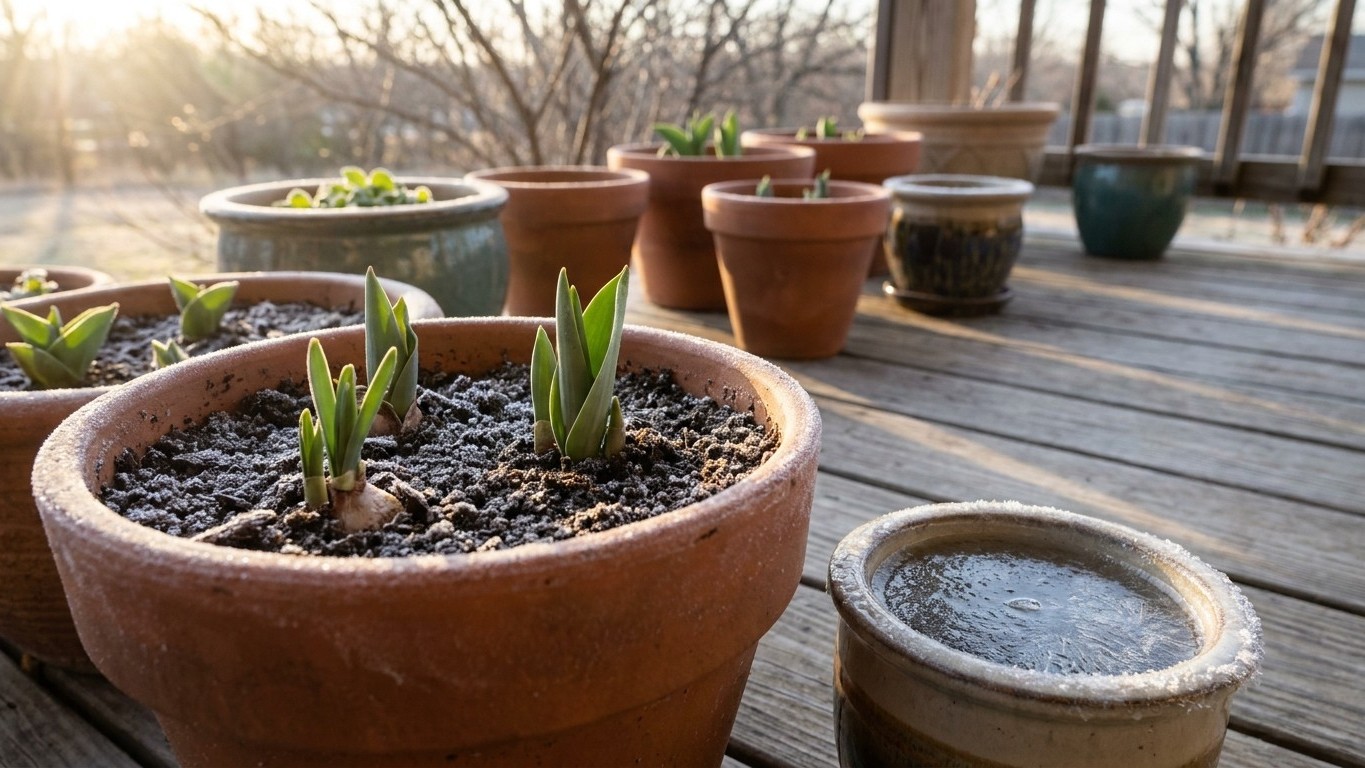

The short answer: Kansas winters already deliver enough cold for spring bulbs planted in the ground, but a container is a different animal. A pot freezes solid, roots included, while garden soil only crusts at the surface. That single difference decides whether your tulips need a refrigerator, a garage, or nothing at all.
Why this matters in Kansas

Start with the number that actually settles this: 22.5°F. That’s the mean daily minimum for the coldest month at the Wichita reference station, per NOAA NCEI Climate Normals for 1991-2020. Spring bulbs like tulips and daffodils need roughly twelve to fourteen weeks of temperatures below 45°F to break dormancy and bloom properly. A coldest-month average minimum of 22.5°F is nowhere near a borderline case. Kansas ground gets plenty cold enough, for plenty long enough, without any help from you.
That matters because it rules out one whole category of worry. Forcing, in the technical sense, meaning artificially supplying the chill period because winter won’t do it, is a strategy built for places where the ground barely dips below 50°F all season. That’s not this territory. If you’re planting bulbs straight into garden soil here, the chill requirement takes care of itself.
Containers flip the equation. The USDA Plant Hardiness Zone Map (2023 edition, based on 1991-2020 normals) puts Kansas across a 5b-7a range, which is already a wide spread depending on where in the state you garden. But that zone rating describes soil in the ground, where surrounding earth acts as a buffer and slows how far cold penetrates. A container has no such buffer. Air can reach the pot from every side, so the root ball inside can drop to whatever the outside air temperature is, roughly two USDA zones colder than what the same bulb would experience in a garden bed at that same address.
So the real risk in this territory isn’t insufficient cold. It’s the opposite: a container left on a porch or patio through a Kansas winter can expose bulb roots to conditions closer to a zone 3b-5a plant would need to tolerate, even in the milder 7a pockets of the state. A tulip that would sail through winter in a garden bed at Wichita’s hardiness rating can freeze to death in an unprotected pot a few feet away. That’s the problem worth solving here, and it’s a container problem, not a chilling-hours problem.
How to do it here
Whether you’re forcing bulbs indoors for an early bloom or wintering a container outdoors, the method comes down to a short, checkable sequence. Follow it in order.
- Pick the bulb before you pick the pot. Bulbs with a short cold requirement force faster and tolerate container life better than bulbs that need the full twelve to fourteen weeks and then some.
- Decide indoor forcing or outdoor container overwintering. If you want blooms weeks ahead of the garden, you’ll supply cold artificially. If you’re leaving the pot outside all winter, skip to step 5.
- Pot the bulbs with drainage as the priority. Use a container with holes, a loose potting mix, and don’t bury the bulb deeper than roughly its own height. Standing water in a pot rots bulbs faster than cold ever will.
- Supply the twelve to fourteen weeks below 45°F. An unheated garage that stays above freezing but below that threshold works. So does a refrigerator crisper drawer, as long as it’s kept away from apples, pears, or any ripening fruit, since the ethylene gas they release will kill the flower bud forming inside the bulb before you ever see a petal.
- If the pot stays outdoors instead, treat it as two zones colder than the ground. Given the 5b-7a range across Kansas, that means only choosing bulbs rated hardy to roughly zone 3 or 4, or taking action: sink the whole pot into a garden bed up to its rim, group several pots together and pack the gaps with mulch or leaves, or move the container into an unheated garage for the coldest stretch.
- Bring the pot into warmth gradually once the cold period is met. A sudden jump from a 40°F garage to a heated living room shocks the bulb and shortens the stem before the flower has a chance to rise above the foliage.
- Water sparingly during the cold period, then increase once new growth appears. Dormant bulbs need barely any moisture; actively growing ones need consistent, not soggy, soil.
Which bulbs are worth it
Not every spring bulb rewards the extra work of a container. The ones with a shorter cold requirement come along faster and finish before a tall stem becomes a problem. Bulbs that need a long chill and then throw up a tall flower stalk tend to topple in a pot with limited soil mass to anchor roots.
Worth noting too: several of the best container performers, paperwhites in particular, aren’t winter-hardy in Kansas anyway and were never going to survive outdoors or return next year. Forcing one of those costs nothing in the long run since the bulb was a one-season purchase from the start.
- Crocus, small and quick to bloom with a modest cold requirement
- Daffodils and narcissus, sturdy stems that hold up well in pots
- Hyacinths, reliable forcers with a strong scent payoff
- Muscari (grape hyacinth), compact and rarely topples
- Paperwhites, no cold period needed at all, and disposable by design
- Dwarf or species tulips, shorter stems than standard tulips
Bulbs that sulk in containers, or ask for more than a pot can reasonably give:
- Standard tall tulips, which need a long chill and then lean or topple once the stem elongates
- Fritillaria, finicky about moisture and prone to rot in a container’s tighter root zone
- Large ornamental alliums, whose flower heads are top-heavy relative to a pot’s stability
What goes wrong, and when you can still fix it
All leaves, no flower
This means the cold period ran short. The bulb produced foliage because it has enough stored energy for that, but never got the signal to set a flower bud. Nothing fixes this in the current pot this season. Note the timing and add more weeks of cold below 45°F for the same bulb next winter.
Flower buried low, barely above the leaves
This usually means the pot was warmed too fast after the cold period. The stem didn’t get the chance to elongate before the flower opened. It’s not reversible for this bloom, but it tells you to warm the next batch gradually, over several days rather than moving it straight from a cold garage into a heated room.
Bulb rot inside the pot
Soft, mushy bulbs or a sour smell in the soil point to drainage failure, either no holes in the container or a potting mix that held too much water through the cold months. A rotted bulb can’t be saved this season. The fix applies to the next planting: drainage holes, a looser mix, and less water while the bulb sits dormant.