
Kentucky gardeners plant cover crops twice: warm-season species like buckwheat or cowpea once the danger of frost has passed in spring, and cool-season grasses or legumes such as cereal rye, oats, crimson clover, or hairy vetch in late summer as soon as a bed empties out. The right date depends on soil temperature, the state’s frost windows, and what job the crop needs to do.
When the soil is warm enough in Kentucky
The date gardeners want isn’t the date the soil gives
Every gardener wants a single circled date on the calendar. NOAA’s 1991-2020 Climate Normals put Kentucky’s last spring 32°F freeze in the 30-70% probability band between March 24 and April 4, based on the Louisville reference station. The National Weather Service office in Louisville is upfront about a wrinkle here: that station sits in an urban heat pocket and runs later in spring than the rural county around it. A garden outside the city should treat that window as tighter, not looser, and lean toward the earlier end for planning purposes. And that’s still only a probability, not a promise. Some years land outside it entirely.
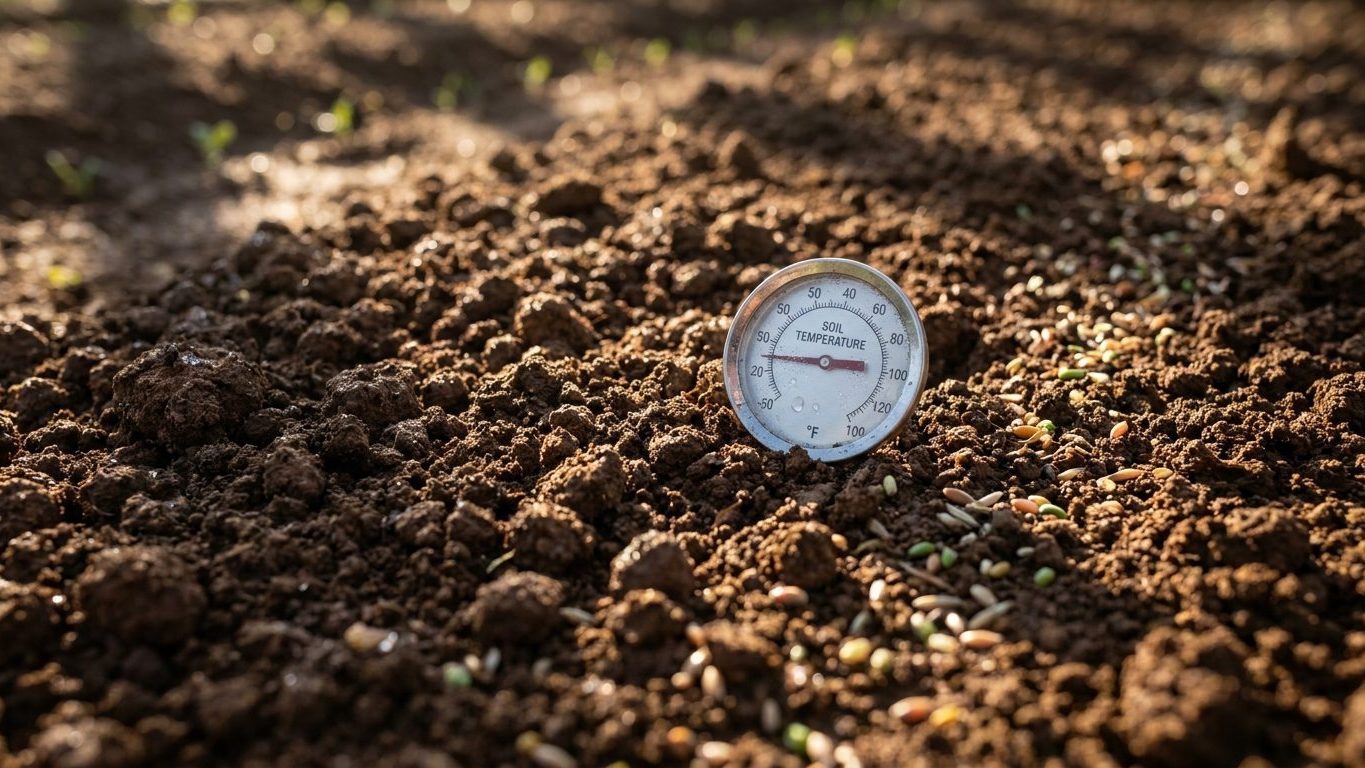
Frost is a useful marker because it’s the number every weather service tracks, but it measures air temperature at screen height, five feet above the ground. Soil, especially the clay-heavy ground common across the Bluegrass region, warms on its own schedule. It holds winter cold longer than the air does, then lags behind rising spring air temperatures by weeks. A warm-season cover crop planted the day after the last frost date passes is often going into ground that’s still too cold to germinate evenly.
What actually decides the sowing rate and the method
Buckwheat and cowpea, the two warm-season workhorses for Kentucky vegetable gardens, germinate reliably only once soil several inches down has warmed well past the freezing mark, typically a couple of weeks after the average last-frost date has come and gone rather than the day it arrives. Waiting that extra stretch costs little and avoids a patchy, gap-toothed stand that never fully closes.
How much seed to put down isn’t a fixed number. It shifts with the species, whether you’re broadcasting by hand or drilling in rows, and whether the goal is fast ground cover or maximum biomass. That’s a question for the University of Kentucky’s Cooperative Extension Service, whose county offices are reachable through the UK Cooperative Extension directory, and it’s the right first call before buying seed. When it’s time to end the crop, this approach sticks to mechanical methods, mowing, crimping, or cutting, plus letting a hard frost do the work on tender species, rather than reaching for a chemical termination.
How long the season lasts here
A window of roughly seven to seven and a half months
Pair the last spring frost (March 24 to April 4) with the first fall frost, which NOAA’s same 1991-2020 Normals place between November 2 and November 12 at that Louisville station. Stack the earliest and latest possibilities against each other and the frost-free window runs somewhere between roughly 212 days in a tight year and 233 days in a generous one. That’s a season long enough to matter for planning, not just for tomatoes and peppers but for cover crops themselves.
A window that size does real work. It’s long enough to run a cash crop, follow it with a cool-season cover crop that goes in during late summer or early fall, let that crop grow through winter, terminate it in spring, and still get a full second planting of vegetables in before the next frost arrives. In a shorter growing region, growers often only get one useful cover-crop sowing per year and have to choose it carefully. Here, there’s usually room for a fall-seeded stand and, in some years, a fast warm-season cover crop squeezed into a gap between spring and fall plantings.
Where that extra time matters for transplants
That length also changes the transplant math. With roughly seven months of frost-free ground, a gardener can afford to start seedlings indoors, harden them off properly, and still get a full harvest before fall frost shuts things down, rather than rushing direct-seeded crops to beat a short window. It’s worth checking root development before setting transplants out, since a plant pushed into the ground too early to save time on a long season gains little and risks transplant shock for no reason. For gardeners stacking multiple plantings into that window, the site’s succession sowing guide covers how to time those overlapping crops without leaving gaps in the bed.
Heat and water in Kentucky
For cover crops, the real question is winter, not summer
Kentucky’s summers run warm and humid, but for cover crops the deciding factor isn’t the peak heat of July, it’s what happens after the first fall frost and how cold the coldest month actually gets. That first fall frost, November 2 to 12 at the Louisville reference point, sets the last practical date to get a fall cover crop established before growth stalls for the season. Sow too late and the seed either doesn’t germinate before cold shuts it down or comes up too thin to do its job over winter.
The number that matters most after that is the average daily minimum in the coldest month: 27.8°F, per NOAA’s Climate Normals for the Louisville station. That figure, not the record low and not a monthly average, is what separates cover crops that reliably winterkill from those that shrug off frost and keep growing. Oats are the clearest example. In a Kentucky winter, oats typically die back on their own once sustained cold sets in, leaving a frost-killed mulch on the surface by spring with no mowing required. Push oats into a genuinely mild winter climate further south, though, and they can limp through and turn into a weed the following season instead of quietly composting in place. Cereal rye behaves the opposite way: it keeps growing through a Kentucky winter and needs to be mowed, crimped, or cut back by hand once spring arrives.
USDA places Kentucky in hardiness zones 6a to 7a, a range built entirely around average annual extreme minimum temperature, and that spread across the state is exactly why the Louisville figures above should be treated as a reference point, not a statewide constant. A garden in the far western part of the state or up against the Ohio River sits in different territory than one in the eastern mountains, and the coldest-month minimum shifts accordingly.
Which cover crops suit Kentucky
Kentucky’s season length and winter pattern point toward a handful of species types rather than any single answer. The frost-free window is generous enough to support both a fall-planted cool-season crop and, in many years, a fast warm-season crop squeezed in elsewhere, so the choice comes down to timing and moisture tolerance more than season length alone.
| Type | Typical role | Behavior through a Kentucky winter |
|---|---|---|
| Cool-season grass (oats, cereal rye) | Fast biomass, erosion control over winter | Oats winterkill into a surface mulch; rye keeps growing and needs mechanical termination in spring |
| Cool-season legume (crimson clover, hairy vetch, winter pea) | Feeds nitrogen to the following spring planting | Survives the winter in zones 6a-7a, terminated by mowing or crimping before seed set |
| Warm-season legume (cowpea) | Summer nitrogen and weed suppression between plantings | Killed outright by the first fall frost |
| Warm-season broadleaf (buckwheat) | Quick smother crop, pollinator forage | Dies with the first light frost, breaks down fast |
Kentucky’s summer humidity makes disease resistance the practical first filter within any of those categories, since fungal pressure builds fast in warm, damp air and a susceptible stand can thin out before it’s done its job. The hot stretch of summer also rewards spacing that gives a crop airflow and some shade at the root line rather than a dense, sun-baked mat. None of that points to a specific variety, and this page won’t pretend to hand one over. Which cultivar of clover, rye, or vetch actually performs well against local disease pressure and winter survival is a question the University of Kentucky Cooperative Extension Service tracks through its own regional variety trials, and that county-level, currently tested information is worth more than any name printed on a page that doesn’t grow in your soil. Reach them through the UK Cooperative Extension directory before buying seed, and let their local trial data, not a national list, make the final call.