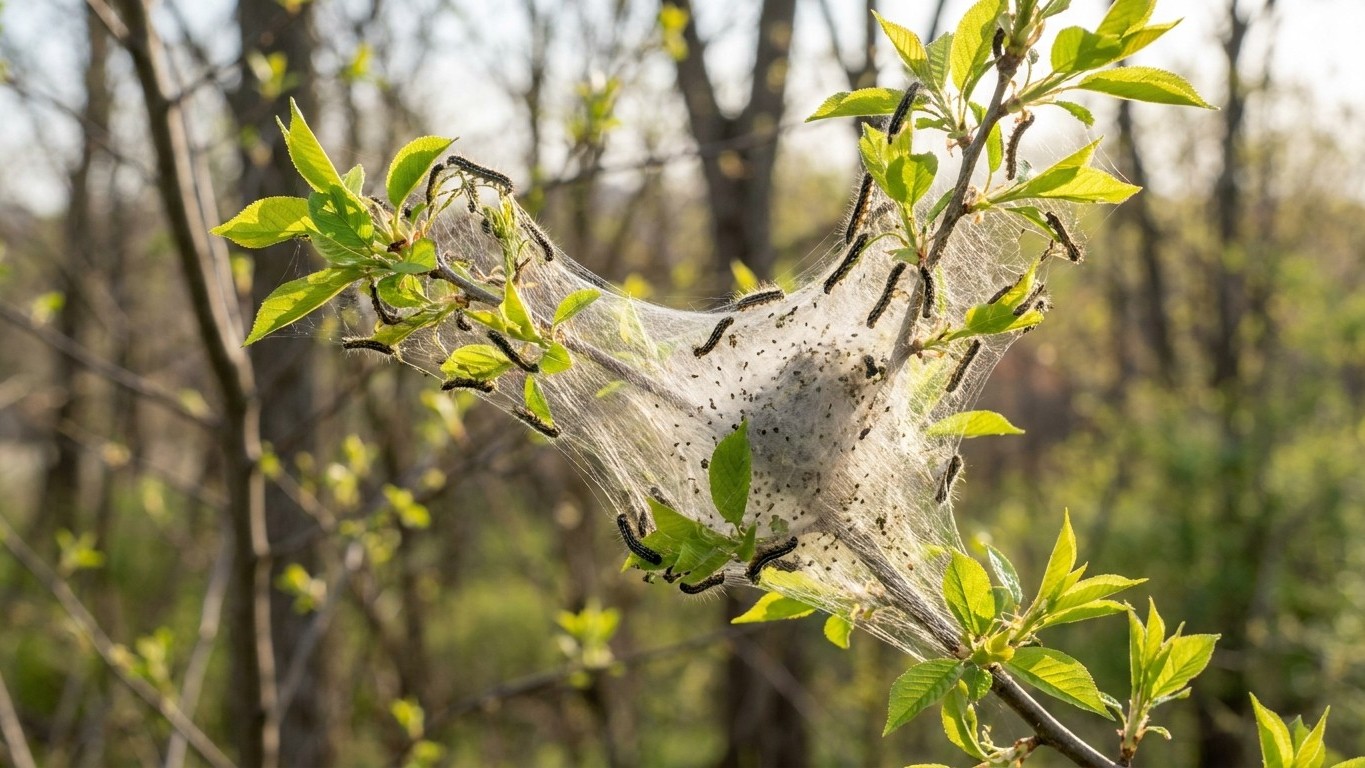

Eastern tent caterpillar shows up in Kentucky early April to mid-May, with larvae spinning silk tents in the branch crotches of wild cherry and apple trees right as those trees leaf out. University of Kentucky Extension Entomology tracks this window every spring. The caterpillars rarely threaten a mature tree’s health, but the webbing is impossible to miss, and its timing tracks closely with the state’s last frost.
The weeks to watch

Eastern tent caterpillar is active in Kentucky from early April to mid-May, according to University of Kentucky Extension Entomology’s ENTfact EF447 calendar. That’s the full window for this species in the state. Unlike some of the pests tracked alongside it, such as bagworm (mid-May through mid-June) or fall webworm (which shows up twice, late May to June and again mid to late July), eastern tent caterpillar completes its damaging feeding in a single stretch each year.
From egg hatch to first tents
The window opens with egg hatch, timed to bud break on host trees. Newly hatched larvae move fast: within a day or two of hatching, they’ve already picked a branch fork and started spinning the first threads of a tent. Early April is when Kentucky gardeners typically spot the first small, silky pockets tucked into the crotches of wild cherry limbs.
Peak feeding before cocooning
Feeding intensifies through late April and into May as the tent grows and the colony inside grows with it. By mid-May, most larvae have finished feeding, left the tent, and wandered off to spin cocoons elsewhere, often on fences, siding, or nearby tree trunks. That dispersal marks the practical end of the window. Once larvae have moved out to pupate, there’s nothing left in the tent to treat.
Reading the calendar from your last frost

Eastern tent caterpillar doesn’t answer to a date on the wall. It answers to bud break, which itself answers to soil and air warming, which is why the pest’s timing tracks so closely with the region’s last spring frost. In Kentucky, that frost date falls between March 24 and April 4, based on NOAA’s 1991-2020 climate normals for the state’s Louisville reporting station. NWS Louisville notes that this urban station tends to run later in spring than the surrounding rural county, so gardeners outside the city should expect a tighter window than the one listed here.
The arithmetic is simple, and it’s worth doing with your own local frost date rather than borrowing Louisville’s exactly:
- Start from your area’s typical last frost, roughly late March to early April in most of Kentucky.
- Add one to two weeks for host trees to leaf out and eggs to hatch; that puts first tent sightings in early to mid-April in most years.
An early, mild spring pulls the whole window forward. A cold, late one pushes it back. That’s also why a single calculated date is never as reliable as the range itself. If you’re watching for tents to prune out before larvae fully disperse, checking wild cherry and crabapple branches starting the week after your last frost is a reasonable rule of thumb.
What it attacks, and what the damage looks like

The first sign is usually visual, not biological: a dense, silvery-white webbing wedged into a branch fork, often before anyone notices the caterpillars themselves. As the colony grows, the tent expands and nearby leaves start disappearing in patches, leaving bare, chewed branch tips that stand out against otherwise full foliage. The caterpillars, dark with a white stripe down the back and blue side markings, retreat into the tent during the heat of the day and rain, then come out to feed morning and evening.
Only the larval stage causes feeding damage. Eggs, laid in dark, varnished bands wrapped around twigs the previous summer, don’t feed at all, and adult moths don’t return to the leaves once they emerge. That matters for treatment: anything aimed at the moth stage or the egg mass has to happen outside the April-to-May feeding window, while anything aimed at stopping current feeding only works while larvae are still inside or near the tent.
Host trees affected in Kentucky include:
- Wild black cherry (the primary and most commonly infested host)
- Apple and crabapple
- Hawthorn
- Other trees in the Prunus family, including ornamental cherry and plum
A single season of defoliation rarely kills an established tree. Repeated years of heavy feeding on the same tree, especially one already stressed by drought or poor soil, is a different story.
How Kentucky sits in this pest’s range
Eastern tent caterpillar is documented in just one state on this site: Kentucky. That’s a statement about this site’s current coverage, not about how far the insect actually spreads. Its range covers most of the eastern half of the United States, wherever wild cherry, apple, and hawthorn grow in enough density to support tent colonies, so the species itself is far from rare or localized.
What that single-state listing does mean is that there’s no neighboring-state comparison to lean on here. University of Kentucky Extension Entomology’s own calendar, EF447, is the timing reference for this page, drawn from observations within the state rather than borrowed from a bordering state’s data. Kentucky’s timing (early April through mid-May) reflects the state’s own frost and bud-break pattern rather than a regional average, so gardeners just across the border in Tennessee, Ohio, Indiana, or Virginia should expect the window to shift slightly earlier or later depending on their own local frost dates, not assume Kentucky’s exact dates apply.
What actually works against it

Cheapest and most effective first, here’s the order that makes sense for a home gardener dealing with eastern tent caterpillar:
- Scout for egg masses in winter. The dark, shiny bands wrapped around pencil-thick twigs are visible on bare branches from late fall through late winter. Pruning out and destroying those twigs before bud break removes next year’s colony before it ever hatches. This only works before eggs hatch; once April arrives, the eggs are gone and the larvae are already out.
- Prune out tents by hand while larvae are inside. Early morning or evening, when the colony is clustered in the tent rather than out feeding, is the easiest time to cut the branch and destroy the tent. This works through most of the April-to-May window, but loses effectiveness once larvae have finished feeding and dispersed to pupate.
- Skip burning the tents. This was once a common approach, but it scorches bark and nearby foliage and creates a real fire risk on dry spring days. It’s not a method University of Kentucky Extension Entomology or similar programs recommend today.
- Let natural predators do some of the work. Birds, parasitic wasps, and other insects feed on eastern tent caterpillar eggs and larvae, and a healthy population of these predators can keep small infestations from becoming a bigger problem without any intervention at all.
- Hold off on broad pesticide use during bloom. Because this pest’s active window overlaps with fruit tree bloom, treating for it at the wrong moment risks harming pollinators visiting the same trees. Once larvae have already left the tent to pupate, no treatment aimed at the larval stage will do anything, since there’s nothing left to treat.
Common questions
Are eastern tent caterpillars harmful to humans?
No. They don’t bite or sting, and they aren’t toxic to touch. The concern for people is mostly aesthetic, the tents look unsightly on ornamental trees, and in some individuals the caterpillar’s hairs can cause mild skin irritation with direct, prolonged contact.
Will eastern tent caterpillar damage kill my tree?
A single season of feeding rarely kills a healthy, established tree, since most can push out a second flush of leaves after defoliation. Trees already stressed by drought, poor soil, or repeated years of heavy infestation are more vulnerable to lasting decline.
What’s the difference between eastern tent caterpillar and fall webworm?
Timing and tent placement are the easiest ways to tell them apart. Eastern tent caterpillar builds its tent in a branch crotch early in the season (April to mid-May) and feeds on leaves outside the tent, while fall webworm builds its webbing at the ends of branches later in the year (late May to June, then again mid to late July) and feeds on leaves enclosed within the web itself.